
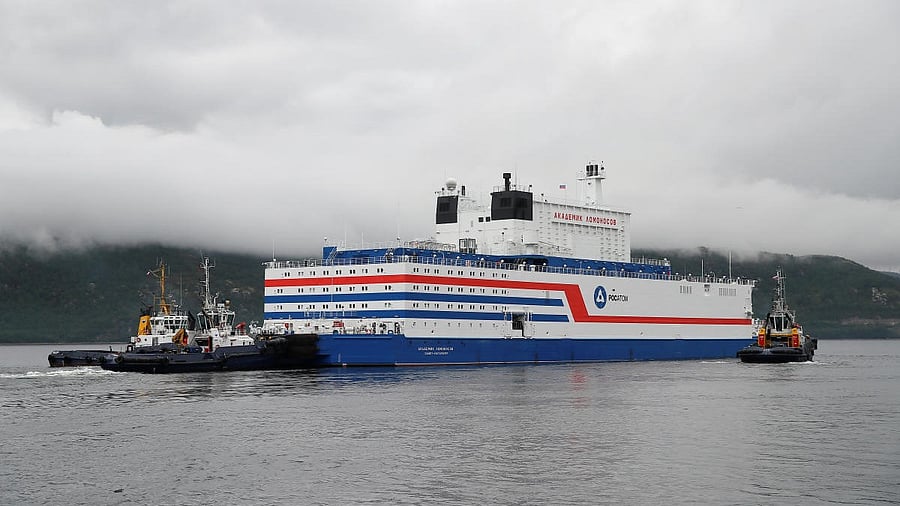
Russia's floating nuclear power plant Akademik Lomonosov.
Credit: Reuters
New Delhi: Russia offered to build a floating nuclear power plant in the territorial waters of India, in addition to sharing the Small Modular Reactor (SMR) technologies, as Prime Minister Narendra Modi and President Vladimir Putin on Friday discussed taking the bilateral atomic energy cooperation beyond the facility in Kudankulam in Tamil Nadu.
Moscow also renewed its call to New Delhi to allot a second site in India to build a new nuclear power plant with technologies from Russia.
“We believe that building small modular reactors and floating NPPs (nuclear power plants) (in India) could also be relevant, just as using nuclear technology for non-energy purposes, including in healthcare, agriculture and other sectors,” Putin told journalists after his meeting with Modi at Hyderabad House in New Delhi.
Russia’s Akademik Lomonosov, a barge-mounted facility with two KLT-40S reactors, is the world’s first floating nuclear power plant. It was launched in 2018, brought to its permanent location in the Arctic Chukotka region of Russia in September 2019 and made operational in December 2019.
Several environmental organisations expressed concerns over the safety of the Akademik Lomonosov, with Greenpeace calling it “Chernobyl on Ice”, referring to the 1986 disaster at the Chernobyl Nuclear Power Plant in Ukraine, which had been a part of the Soviet Union then.
The two sides confirmed “their intention to broaden cooperation in nuclear energy, including fuel cycle, life cycle support for operating Kudankulam Nuclear Power Plant (KKNPP) and non-power applications, as well as to elaborate the new agenda of interaction in the field of peaceful use of atomic energy and related high technologies”, according to a joint statement issued after Modi and Putin held the 23rd India-Russia annual summit in New Delhi on Friday.
The KKNPP is the flagship project of India-Russia bilateral cooperation in the field of nuclear energy. The plant is proposed to have six VVER-1000 reactors with an installed capacity of 1,000 MWe each.
The first and second units of the KKNPP, with two Russian VVER 1000 pressurised water reactors, started commercial operation in 2014 and 2017, respectively. The third unit is currently undergoing pre-startup operations and preparing for safety tests, while delivery of equipment for the fourth unit is expected to be completed soon. The construction of the fifth and sixth units of the KKNPP would be taken up later.
“Once the KKNPP reaches its full capacity, it will make a meaningful contribution to India’s energy mix, helping Indian companies and households access affordable and clean energy,” Putin told journalists after his meeting with Modi. The two sides agreed to accelerate technical and commercial discussions on the VVER of the Russian design, research and joint development of NPPs, localisation and joint manufacturing of nuclear equipment and fuel assemblies for the Russian-designed large capacity nuclear power plant, subject to terms and conditions as mutually agreeable.
With the Modi Government in New Delhi announcing a Nuclear Energy Mission in the Union Budget 2025-26, Russia and India have been discussing cooperation in building Small Modular Reactors or SMRs. The Maharashtra State Power Generation Company Limited (MAHAGENCO) and Rosatom already inked an MoU earlier this year for developing an SMR to run on thorium. Moscow has conveyed to New Delhi its interest in expanding cooperation in the sector.