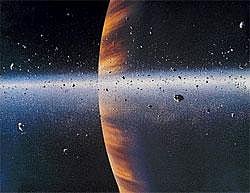
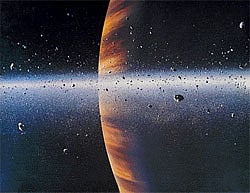
The scientists found that the moon, Prometheus, which passes through the innermost edge of the ring in about every 68 days, lifts out ring particles which then begin to clump and take on a life of their own over time.
According to the scientists, the larger and closer satellite of Saturn cruises a bit faster than the particles in the ring and is slightly inclined relative to the ring’s plane.
It collides with the diffuse, inner edge of the F-ring (the outermost ring of the planet) where the moon’s gravity is strong enough to pull streamers of particles from the ring, creating channels.
Over time, the disrupted particles — mostly dense, sticky ice — can take on a life of their own, clumping together under their own growing gravitational force, said the scientists who discovered the phenomenon by analysing images by NASA’s Saturn-orbiting Cassini spacecraft.
“We’ve never actually seen this before. You can see a real cause and effect. These objects didn’t exist before Prometheus passed,” lead researcher Carl Murray of University of London said.
Future visits by Prometheus could stoke a snowball’s growth - or it could destroy it, they said.
“Once Prometheus passes by, it gives these objects a kick. They have about 68 days to sort of get things together before Prometheus comes around again,” Murray said.
“Whether at the end of the day you end up with a fully formed satellite we don’t know. That’s something we want to look at. Maybe these objects are precursors of fully formed satellites,” he said.
The complicated physics in Saturn’s ring — particularly the F-ring where the planet’s tidal forces wane and objects can begin to form under their own gravitational sway — serve as a living laboratory for understanding how planets form, said Cassini project scientist Linda Spilker.
“You can think of Saturn’s rings as miniature versions of the disks where planets form. The same physical processes are occurring,” Spiker said.