
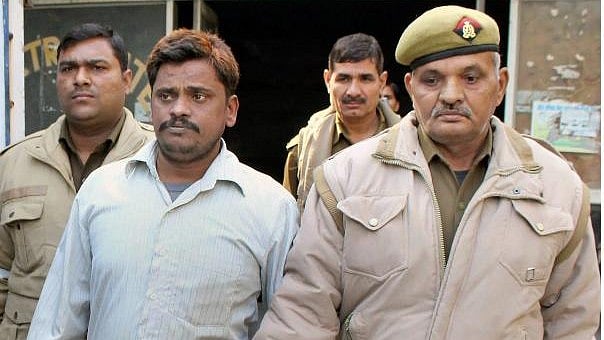
Surendra Koli being taken to jail after he was convicted
Credit: PTI Photo
New Delhi: The Supreme Court on Tuesday set free Surendra Koli, a domestic help in the last case of the sensational 2006 Nithari killings of Noida, by allowing his curative petition.
A bench of Chief Justice of India B R Gavai and Justices Surya Kant and Vikram Nath exercised the curative jurisdiction, which existed to prevent abuse of process and to cure a gross miscarriage of justice, as held in Rupa Ashok Hurra Vs Ashok Hurra (2002).
"The offences in Nithari were heinous, and the suffering of the families is beyond measure. It is a matter of deep regret that despite prolonged investigation, the identity of the actual perpetrator has not been established in a manner that meets the legal standards," the bench said.
The court opined it was genuinely unfortunate that in the present matter negligence and delay corroded the fact-finding process and foreclosed avenues that might have identified the true offender.
The bench noted in 12 companion prosecutions founded on the same confession and recoveries, the High Court acquitted the petitioner on October 16, 2023, and on July 30, 2025, this court dismissed the State appeals and affirmed those acquittals.
The petition by Koli highlighted that irreconcilable outcomes have arisen on an identical evidentiary framework and that a manifest miscarriage of justice remained despite the dismissal of review in the rape and murder case of 15-year-old.
His conviction was upheld by the Supreme Court in February 2011, and his review plea was dismissed in 2014.
Agreeing to his submission, the bench said, "Arbitrary disparity in outcomes on an identical record is inimical to equality before the law. The curative jurisdiction exists to prevent precisely such anomalies from hardening into precedent."
Though the petitioner’s death sentence in this case was commuted to imprisonment for life on January 28, 2015, the conviction continued to carry the gravest consequences, the court said.
"To allow a conviction to stand on evidentiary basis that this court has since rejected as involuntary or inadmissible in the very same fact matrix offends Article 21 of the Constitution. It also violates Article 14 of the Constitution, since like cases must be treated alike," the bench said.
The bench also noted that confession that anchored the conviction is legally tainted on grounds already accepted by this court in the companion matters.
The supposed discoveries do not satisfy the statutory preconditions for admissibility. The forensic and investigative record does not supply the missing links, it pointed out.
The bench thus held the petitioner has established a fundamental defect that impeaches the integrity of the adjudicatory process and that relief is warranted ex debito justitiae within the parameters of Rupa Ashok Hurra.