
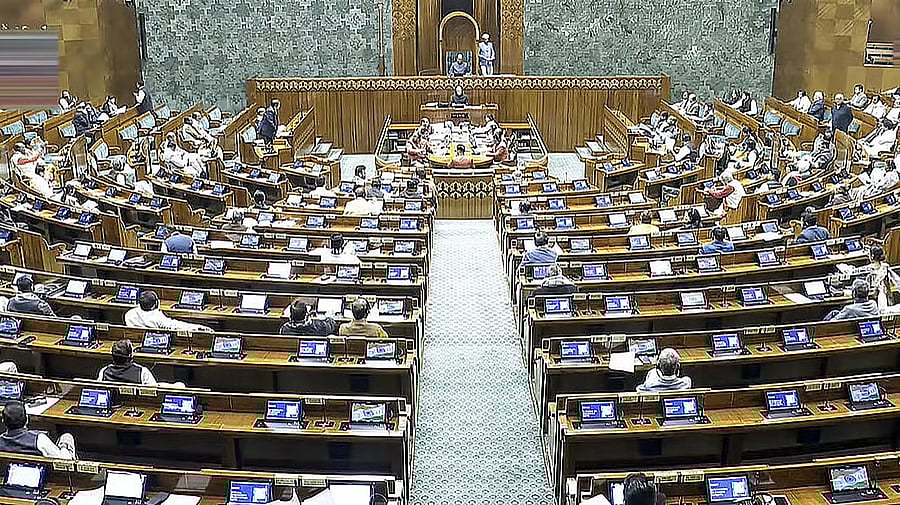
A representative image of Lok Sabha.
Credit: PTI
The Sustainable Harnessing And Advancement of Nuclear Energy for Transforming India Bill 2025 has been passed by Parliament. Senior Congress MP, Manish Tewari, explains to DH’s Shemin Joy the loopholes in the new atomic energy law.
Excerpts -
What are your concerns about the SHANTI Bill?
This Bill has three primary objectives. One is to open up the nuclear sector, which is a strategic sector, to private investment.
Second is to remove the supplier liability clause, which was arrived at after a consensus across the political spectrum in 2010. It is inexplicable as to why, at a point in time when the sector is being opened up to private participation, the supplier's liability clause has been excluded, giving the suppliers a free pass.
The third is the exemption granted from insurance cover to government-owned or public sector nuclear reactors, which is troublesome. If the argument of the government is that, as the sovereign, it assumes the responsibility of indemnifying the government or public sector-owned nuclear reactors, then it should have been explicitly stated in the Bill. Then the liability limits are extremely low.
This 300 million SDR, which is about USD 417 million, is less than what was granted by the Supreme Court as compensation for the Bhopal gas disaster. With regard to the storage and the safety of spent fuel, especially plutonium and uranium, which stays highly toxic for thousands of years, it has been left to rules, regulations or protocols. In fact, the explicit protocol should have been a Schedule to the Bill.
There are various other devils in the detail. That was why we wanted the Bill to be referred to a Joint Parliamentary Committee. The entire objective was to improve the Bill so that it becomes future-proof, especially when you are allowing both private participation and foreign direct investment to come in.
You referred to the 2010 consensus which was arrived at after extensive consultations. Could pre-consultation have helped?
In fact, at that point in time since I had led the debate from the Treasury benches, I very distinctly and clearly recall, it was late Sushma Swaraj, Leader of Opposition in Lok Sabha, late Arun Jaitley, Leader of Opposition in the Rajya Sabha, LK Advani and late Jaswant Singh, who had in fact insisted very vehemently along with the leadership of the Left parties that supplier liability clause should form a part of the Civil Nuclear Liability Bill. Unfortunately, that rigour has been missing this time around.
During the debate, some MPs have accused the government of bulldozing the Bill. What is the motive behind rushing through the Bill?
That is what completely defies imagination. One more troublesome aspect is the autonomy and independence of the Atomic Energy Regulatory Board (AERB), especially at a point in time when you're opening it up to private sector players. The supplier liability and the robust independence of the AERB as something completely distinct from the Department of Atomic Energy should have been a sine qua non.
Therefore, this extreme hurry in rushing this Bill could have only two reasons. One, of course, the government wants to open up the sector for private participation. And number two, the supplier liability clause, which actually was supposed to be a very essential safeguard for the Indian citizens or residents of India and especially those areas where these nuclear power plants are going to be located or have been located over the past 15 years, was something which many Western companies were not very comfortable with.
So, therefore, are we trying to, or was this an attempt to adjust the civilian nuclear architecture to the diktat of foreign companies who fabricate and supply nuclear reactors? This is a question which was specifically asked and not answered by the government in Parliament.
The government argues that the 2010 law was a hindrance, and for the past 15 years, nothing happened. Do you think that is a sound argument?
The safeguards have to be very vigorous, and just because somebody is uncomfortable with a regime which provides safety and security to millions, that cannot be a ground for relaxing the rigors of something which is so fundamental when you are talking about the entire paradigm of nuclear energy.
For the simple reason that historical evidence so that whenever a nuclear incident has taken place – Three Mile Island or Chernobyl or Fukushima, or the concerns around the Ukrainian reactor, which is now under control – even a slight miscalculation or a slight mishap can have very potent consequences.
The government says that the operator can have his own arrangement with the supplier on liability but the law will not mandate it. How do you see that kind of an argument?
Whatever contractual obligations an operator would get into with a supplier, that clause was specifically inserted for the simple reason that, given the fact that design, fabrication, and installation of nuclear reactors is actually something which is going to be preponderantly foreign dependent. When you are liberalising the nuclear sector, that particular clause actually would have helped indemnify even those Indian companies, which may be planning to enter the civilian nuclear space.
How do you see the merging of two Acts into a new Bill?
Since the minister repeatedly kept saying that we have retained most of the provisions of the 1962 law and also retained provisions of the Civil Nuclear Liability Act, you could have easily updated both those acts. About the independence and the autonomy of the AERB, there have been concerns now going back to the 123 agreement and the signing of the Indo-US Civil Nuclear Deal. Therefore a standalone law which would have been dedicated specifically to empowering and insulating the regulator would have been a much better option.