
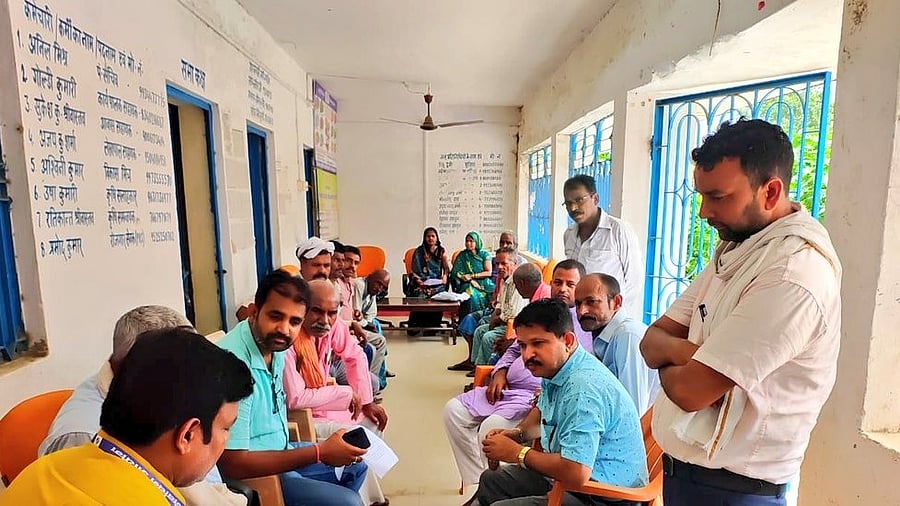
BLO's during a review meeting as part of SIR in Bihar.
Credit: X/@ECISVEEP
New Delhi: The Election Commission on Tuesday contended before the Supreme Court that its order on special intensive revision of electoral rolls in various states, was legislative in character, as it laid down complete set of principles and documents prescribed.
A bench of Chief Justice of India Surya Kant and Justice Joymalya Bagchi was informed by senior advocate Rakesh Dwivedi for the poll panel that the legal schemes which governed the preparation and revision of electoral rolls and regulate the conduct of elections.
Citing Section 62 of the Representation of Peoples Act, he submitted that voter registration is subject to specific statutory conditions, and Articles 324 to 326 of the Constitution, read with Section 19 of the Act, impose a constitutional obligation on the poll panel to ensure that only citizens are enrolled as voters.
He contended that SIR does not proceed on the assumption that every elector must submit documentary proof.
"It is not a case where no presumption has been attached at all," he said.
Dwivedi said that the nature of the SIR inquiry is fundamentally different from ordinary verification exercises.
He submitted that if a voter could establish lineage to those earlier entries, no documents were required, and documents were sought only in cases where linkage could not be established.
"Only where such linkage is unavailable have this court's directions required the production of 11 specified documents, including Aadhaar," the counsel said.
He said that voters whose names appeared on earlier electoral rolls, those up to June 2025, were given presumptive validity if they could establish a linkage with their parents’ names in previous lists.
The court was told that enumeration forms were issued to all voters up to June 2025, consequently conferring probative value even to the 2002 electoral rolls.
The counsel said the booth-level officers (BLOs) were empowered to submit up to 50 forms per day. He said that the exercise involved a house-to-house survey with pre-filled forms, requiring only signatures from voters.
"It would be highly improper to lift facts from one case, such as in West Bengal, and apply them mechanically to a different scenario where the SIR has been conducted in an entirely distinct manner,” Dwivedi said.
The court would continue to hear the matter on Wednesday on pleas challenging the EC's SIR of electoral rolls undertaken in several states, including Bihar.