
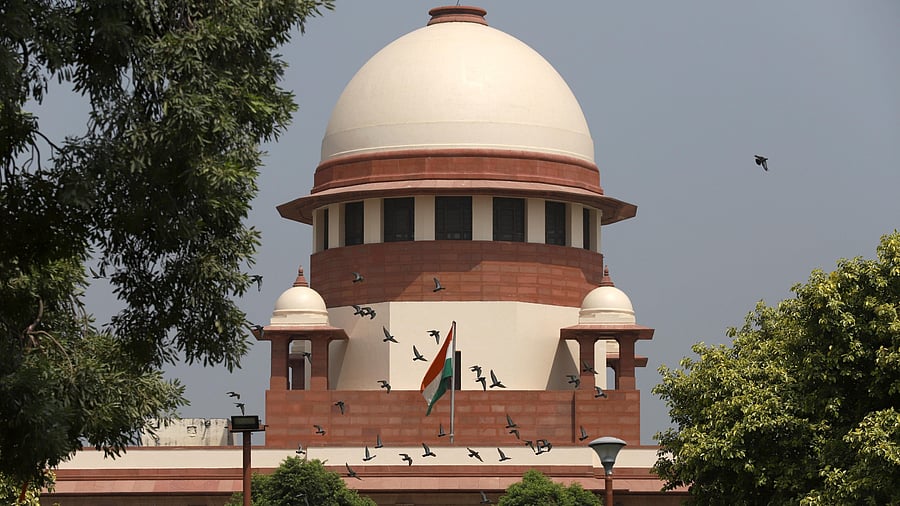
The Supreme Court of India.
Credit: iStock Photo
New Delhi: The Supreme Court has held that the state police can investigate the offences of bribery under the Prevention of Corruption Act against the central government employees without an approval or consent from the Central Bureau of Investigation.
A bench of Justices J B Pardiwala and Satish Chandra Sharma pointed out that Section 17 of the PC Act does not exclude or prevents the state police or a special agency of the state from registering a crime or investigating cases relating to bribery, corruption and misconduct against central government employees.
Dismissing a petition filed by Nawal Kishore Meena, the court on January 19, 2026 upheld the Rajasthan High Court's judgment of October 3, 2025, which said that the ACB (anti corruption bureau) of Rajasthan has jurisdiction to register the criminal case under the provisions of the PC Act despite the fact that the accused is an employee of the central government.
The court said, although the law and order including investigation of different criminal cases is a State subject and generally such matters are being investigated by the State, yet the relation between the CBI and the State Police is supplementary to each other and as per the CBI constitution and inter se arrangement between CBI and State police, there are several areas where the CBI and the Police require inter se cooperation and support.
As per the arrangement the cases of corruption by the central government are being investigated by CBI and the cases of bribery and corruption by the State Government employees are being investigated by the State Police, it noted.
The CBI also has the power under its constitution to investigate any case of the nature which includes offences against the central government employees, or concerning affairs of the central government and employees of central public-sector undertakings and public sector banks, cases involving the financial interests of the central government etc, the bench said.
The bench emphasised, it is for convenience and to avoid duplication of work that the CBI - a specialised investigating agency under the Special Police Establishment - is entrusted with the task of investigation of the cases of corruption and bribery against the employees of central government and its Undertakings and the Anti - Corruption Bureau - a specialised investigating agency of the State - is entrusted with the task of investigation of the cases of corruption and bribery against the employees of state government and its undertakings.
The bench also pointed out, the Criminal Procedure Code (now BNSS) is the parent statute which provides for investigation, inquiry into and trial of cases and unless there is specific provision in another statute to indicate a different procedure to be followed, its provisions cannot be displaced.
"In other words, the existence of a special law by itself cannot be taken to exclude the operation of CrPC. Unless the special law expressly or impliedly provides a separate provision for investigation, the general provision under Section 156 of CrPC shall prevail," the bench said.
The court also underscored, Section 156 of CrPC authorises any police officer in charge of a police station to investigate a cognizable offence without the order of the Magistrate.
The word ‘Police Station’ has been defined in Clause (s) of Section 2 of the Code to mean “any post or place declared generally or specially by the state government, to be a police Station, and includes any local area specified by the State Government in this behalf”, it pointed out.
"The Vigilance and Anti-Corruption Bureau (VACB) is also a wing of State Police. The offences under the PC Act are also cognizable and can, therefore, be investigated by the state police or VACB," the court said.
The only rider is that the investigation can be done only by a police officer of the rank specified in Section 17 of the PC Act, it added.
In the present case, the bench said, "The High Court has taken the correct view while saying that it is incorrect to say that it is only the CBI who could have instituted the prosecution."