
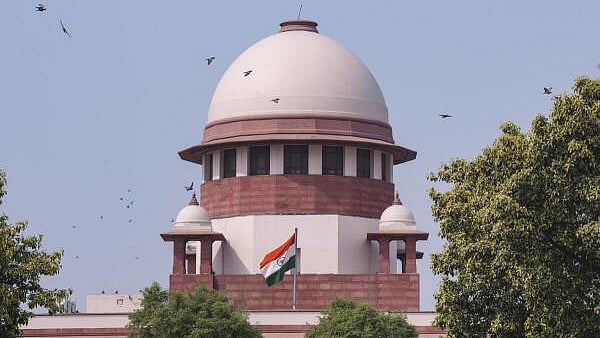
The Supreme Court of India.
Credit: PTI Photo
New Delhi: The Supreme Court has upheld the power of the Chief Justice of a High Court to appoint additional places of sitting for the more convenient transaction of judicial business, subject to the approval of the Governor.
A bench of Justices Aravind Kumar and N V Anjaria approved the August 1, 2025 notification appointing Kolhapur as a place at which the judges and division courts of the Bombay High Court may sit.
Dismissing a writ petition by Ranjeet Baburao Nimbalkar, questioning validity of the decision, the bench said, the allocation of judicial work is an exclusive prerogative of the Chief Justice, being the master of the roster.
"That principle extends, in substance, to decisions concerning the sittings of the court, which are intimately connected with the distribution and management of judicial work,'' the bench said.
The court noted, after administrative consideration on feasibility and availability of infrastructure, a proposal was formulated by the High Court for appointing Kolhapur as an additional place of sitting.
The proposal contemplated that cases arising from the districts of Kolhapur, Sangli, Satara, Ratnagiri and Sindhudurg would be assigned to the Kolhapur sitting in accordance with administrative directions of the Chief Justice.
The petitioner's counsel contended, selection of Kolhapur, to the exclusion of other regions such as Pune or Solapur amounts to discriminatory treatment without a rational basis. It was also argued access to justice is not advanced merely by proximity to a High Court, and that strengthening trial courts would better serve the constitutional mandate.
The bench, however, pointed out, Section 51(3) of the States Reorganisation Act, 1956 confers an independent and continuing power on the Chief Justice, the petitioner’s argument of indirect permanence loses much of its force.
"Courts cannot import into the statute a limitation which the legislature has consciously chosen not to enact. To do so would be to substitute judicial apprehension for legislative judgment, a course impermissible in constitutional adjudication," the bench said.
The court found, the establishment of the Kolhapur Bench is consonance with the constitutional vision of bringing justice closer to the people, and it does not infringe Article 21 in any manner.
The bench also said, even if the consultative process did not conform to the petitioner’s expectations, that circumstance by itself would not vitiate the exercise of power under Section 51(3).
"Ultimately, the statute entrusts the decision to the Chief Justice, subject to the approval of the Governor, and once those requirements are satisfied, the court would be slow to interfere in the absence of mala fides or manifest illegality,'' the bench said.