
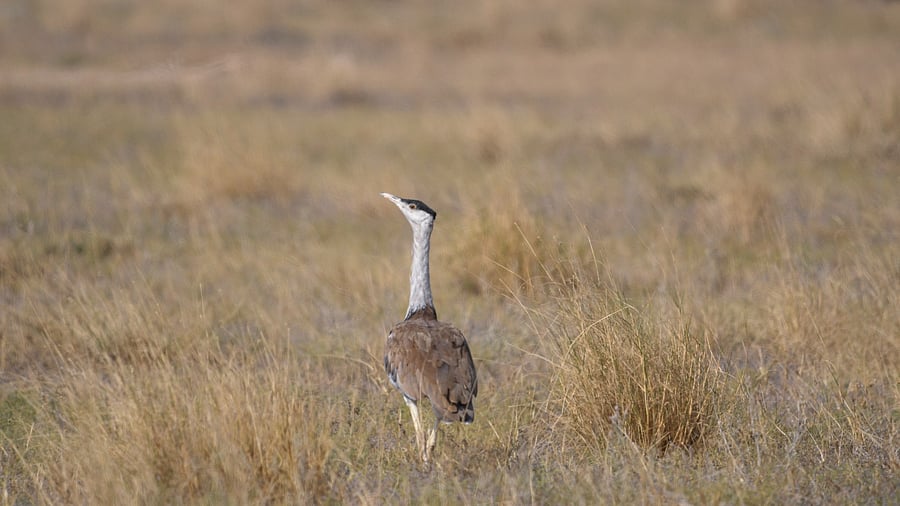
The Great Indian Bustard.
Credit: iStock Photo
New Delhi: The Supreme Court on Friday issued a slew of directions to protect the Great Indian Bustard. It observed that despite its immense historical, cultural, and ecological significance, the GIB today is one of the rarest birds to spot due to a steep decline in its population in the last few decades.
A bench of Justices P S Narasimha and Atul S Chandurkar said, the GIB is, therefore, soon approaching the fate of recently extinct animals like Golden Toad, Western Black Rhinoceros, Pinta Giant Tortoise, Poʻouli, Bridle WhiteEye, etc, which the universe has lost forever.
"The threats of climate change and unplanned development are real, and it is widely acknowledged that our planet is experiencing the sixth mass extinction in its history. In addition to traditional conservation measures, steps must be taken to protect currently endangered animals, and moreover, to regenerate populations,'' the court said.
The Great Indian Bustard (GIB), one of the heaviest flying birds in the world and a flagship species of the arid and semi-arid grasslands of the Indian subcontinent, is a majestic, long-legged bird that symbolizes the health of the fragile grassland ecosystem, as its presence indicates a balanced environment.
In its judgment on a 2019 writ petition filed by M K Ranjitsinh and others, the court noted, the issues in the instant case aptly demonstrated the contestation between the goals of preserving historically and ecologically significant species and green energy generation to address climate change.
The instant plea arose out of two orders by this court passed on April 19, 2021, and March 21, 2024, directing certain measures.
"The present adjudication aims to move further towards greater certainty in our approach to conserving two species, the Great Indian Bustard and the Lesser Florican and, importantly, to rethink environmental conservation going forward in our pursuit of sustainability and mutual coexistence with other living beings on our mother Earth,'' the bench said.
The court earlier restricted overhead transmission lines across nearly 99,000 sq km in Rajasthan and Gujarat. Upon the Union government's concern over implications for India's renewable energy transition, the court had constituted a high-level expert committee to recommend scientifically grounded and balanced measures.
Among its directions, the bench said, the revised priority area for Rajasthan, as recommended by the committee, would be 14,013 sq kms, and the revised priority area for Gujarat, would be 740 sq. kms.
The court also said, the measures recommended by the committee for in-situ and ex-situ conservation of GIB within the priority areas of Rajasthan and Gujarat would be implemented forthwith.
"Recommendations of the committee with respect to the monitoring of GIB in the revised priority areas shall be given effect immediately. Recommendation of the committee for the conduct of long-term studies on the effects of climate change on GIB must be conducted,'' it ordered.