
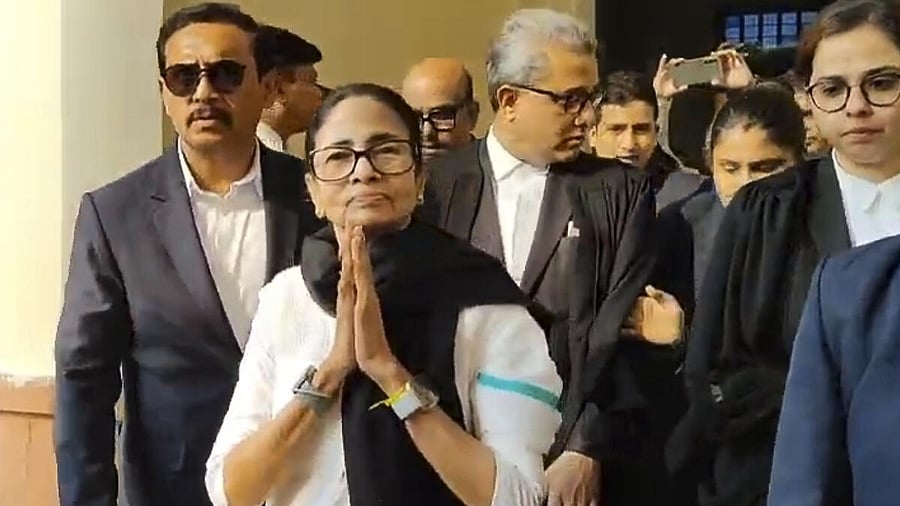
West Bengal CM Mamata Banerjee on the Supreme Court premises in New Delhi on Wednesday.
Credit: Screengrab/PTI
The Supreme Court on Wednesday issued notice in the plea filed by West Bengal Chief Minister Mamata Banerjee challenging the Special Intensive Revision (SIR) of electoral rolls in the State.
The Bench of Chief Justice of India (CJI) Surya Kant and Justices Joymalya Bagchi and V M Pancholi told the Election Commission of India (ECI) to take care while sending notices to voters on the basis of name mismatches.
The court will hear the matter next on Monday, February 9.
'Furnish list of officers'
Earlier, the CJI observed that a practical solution could be worked out and directed that, by Monday, the State should furnish a list of Group B officers who can be spared and made available.
'EROs have been stripped of their powers'
West Bengal Chief Minister Mamata Banerjee alleged that Electoral Registration Officers (EROs) have effectively been stripped of their powers, which, according to her, have been superseded by the deployment of 8,300 micro observers drawn from BJP-ruled States.
She claimed that these micro observers are deleting names while sitting in offices, without proper verification. She further alleged that filing of Form 6 has not been permitted, resulting in the deletion of lakhs of names. According to her, several living persons have been wrongly declared dead. She described the actions as anti-women in nature.
Giving concrete examples: Mamata
West Bengal Chief Minister Mamata Banerjee submitted in the Supreme Court that she was giving concrete examples and could even show photographs published by leading newspapers.
She said the SIR process was being used only for the deletion of names. By way of illustration, Banerjee said that when a daughter moves to her in-laws’ house after marriage, questions are raised about why she is using her husband’s surname. According to her, several such women have been unilaterally deleted from the rolls.
She added that poor people who purchase a flat or shift residence are also being deleted. Banerjee alleged that despite these circumstances, the authorities term such cases as “incorrect mapping,” in violation of the Court’s earlier directions.
People in Bengal were relieved after this court directed that Aadhaar be accepted as one of the documents. She pointed out that in other States, documents such as domicile and caste certificates are accepted, whereas Bengal alone was being singled out on the eve of elections.
'Fighting for a larger cause'
Banerjee addressed the Supreme Court in person on Wednesday, stating that she belongs to the State and was grateful for the Bench’s kindness. She said that when justice is “crying behind closed doors,” it creates the feeling that justice is not being received anywhere.
She informed the court that six letters had been written to the Election Commission. Describing herself as a “bonded labourer”, she emphasised that she was not fighting for her political party, but for a larger cause.
Mamata in front row with senior advocates
Earlier, Justice Joymalya Bagchi remarked that in Bengal, Mr. Dwivedi would be pronounced as “Dibedi,” noting that the Bengali language does not have the sound for “va.” The Chief Justice responded that his own name would at least be pronounced correctly, to which Chief Minister Mamata Banerjee interjected, saying that it would not be.
Earlier, Senior Advocate Shyam Divan submitted that issues relating to name discrepancies are consuming a substantial part of the limited time available and are causing serious inconvenience to voters.
Senior Advocate Rakesh Dwivedi, for the Election Commission of India, submits that some discrepancies arise from variations in local dialects and pronunciation, and that such issues occur across the country.
Senior Advocate Dwivedi, appearing for the Election Commission of India, submitted that all notices contain reasons and that the persons concerned were also permitted to engage authorised agents. Senior Advocate Shyam Divan responded by seeking a direction to the Election Commission to withdraw all notices that pertain solely to name mismatches.
West Bengal CM reaches SC ahead of hearing on pleas against SIR of electoral rolls in state
West Bengal Chief Minister Mamata Banerjee on Wednesday reached the Supreme Court ahead of a crucial hearing on the petitions challenging the Election Commission's ongoing Special Intensive Revision (SIR) of electoral rolls in the State.
The Chief Minister has also moved an interlocutory application seeking permission to appear and argue in person.
Banerjee is personally present in court room one along with her lawyers. A gate pass was issued in the chief minister's name on Tuesday.
As per the apex court website, a bench comprising Chief Justice Surya Kant and Justices Joymalya Bagchi and Vipul M Pancholi is scheduled to hear the petitions of Banerjee and three others filed by Mostari Banu and TMC MPs Derek O'Brien and Dola Sen.
Supreme Court to hear Mamata Banerjee's plea against SIR today
According to the apex court website, a bench comprising Chief Justice Surya Kant and Justices Joymalya Bagchi and Vipul M Pancholi is scheduled to hear the petitions, including those filed by Banerjee, Mostari Banu and All India Trinamool Congress MPs Derek O'Brien and Dola Sen.
On January 19, the top court passed a slew of directions, observing that the SIR process in West Bengal should be transparent and not cause inconvenience.
It directed the Election Commission (EC) to display the names of those on the "logical discrepancies" list at gram panchayat bhavans and block offices, where documents and objections will also be submitted.
Logical discrepancies in progeny linking with the 2002 voter list include instances of a mismatch in the parent's name and the age difference between a voter and their parent being less than 15 years or more than 50 years.
Noting that 1.25 crore voters in the State figure on the "logical discrepancies" list, the CJI-led bench had directed that offices for submitting documents and objections be set up within the panchayat bhavans or block offices and asked the West Bengal government to provide adequate manpower to the election authorities.
Banerjee filed her petition on January 28. She has made the EC and the West Bengal Chief Electoral Officer parties in the case.
The Chief Minister had earlier written to the Chief Election Commissioner (CEC), urging him to halt the "arbitrary and flawed" SIR in the poll-bound State.
Sharpening her attack on the EC, Banerjee had warned that continuation of the SIR in the present form could trigger "mass disenfranchisement" and "strike at the foundations of democracy".
In a strongly worded letter, dated January 3, to CEC Gyanesh Kumar, she accused the poll panel of presiding over an "unplanned, ill-prepared and ad hoc" process marked by "serious irregularities, procedural violations and administrative lapses".
Earlier, O'Brien had filed an application alleging arbitrariness and procedural irregularities in the SIR of electoral rolls in the State.
The application claimed that since the inception of the SIR process in the State, the EC had issued instructions to officers at the ground level through "informal and extra-statutory channels", such as WhatsApp messages and oral directions conveyed during video conferences, instead of issuing formal written instructions.
O'Brien has filed the application in his pending petition, which has challenged the order and guidelines issued by the poll panel directing SIR in various States, including West Bengal.
The application said it was reported that in the course of SIR in West Bengal, the EC has created and deployed a new category described as "logical discrepancies" without any written order or guideline to "issue/decide to issue notices to 1.36 crore electors without any statutory basis".
It has also sought a direction to the poll panel to publish the final electoral rolls only after the disposal of all claims, objections and hearings.
(With PTI inputs)