
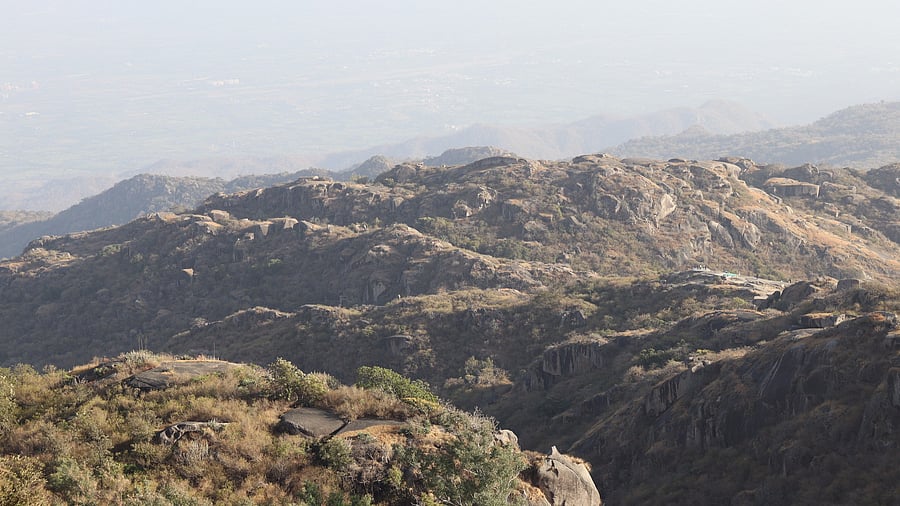
The Aravalli Hills.
Credit: iStock Photo
New Delhi: The Supreme Court on Monday proposed to constitute a high-powered committee of domain experts to undertake a comprehensive assessment of the report submitted by a committee on October 3, 2025, which formed the basis of November 20 judgment on definition for demarcating the territorial extent of the Aravalli hills and range.
A bench of Chief Justice of India Surya Kant and Justices J K Maheshwari and Augustine George Masih noted the previous committee stated any landform located in the Aravalli districts, having an elevation of 100 metres or more from the local relief, shall be termed as Aravalli Hills.
The committee also stated two or more Aravalli Hills, located within the proximity of 500 meters from each other, measured from the outermost point on the boundary of the lowest contour line on either side forms Aravalli Range.
The court noted that a significant outcry had been expressed among environmentalists, who raised profound concern about the potential for misinterpretation and improper implementation of the newly adopted definition and this court’s directions.
"This public dissent and criticism appear to stem from the perceived ambiguity and lack of clarity in certain terms and directives issued by this court. Consequently, there is a dire need to further probe and clarify to prevent any regulatory gaps that might undermine the ecological integrity of the Aravalli region,'' the bench said.
The court proposed a committee to examine issues whether the definition of the ‘Aravalli Hills and Ranges’, restricted exclusively to the 500-meter area between two or more Aravalli Hills, created a structural paradox wherein the geographical scope of protected territory is significantly narrowed.
It also asked the panel to consider whether this restrictive demarcation has inversely broadened the scope of ‘non-Aravalli’ areas, thereby facilitating the continuation of unregulated mining and other disruptive activities in terrains that are ecologically contiguous but technically excluded by this definition.
The court also asked the committee to look into whether the Aravalli Hills, characterised by an elevation of 100 meters and above, constituted a contiguous ecological formation even when the intervening distance exceeds the stipulated 500-meter threshold.
"Furthermore, in such instances, it must be clarified whether regulated mining would be permissible in these gaps. If so, what precise spatial parameters or lateral width would be utilized to define the extent of the ‘Aravalli Range’ to ensure that ecological continuity is not compromised,'' it said.
The bench also sought to know whether the widely publicised criticism asserting that only 1,048 hills out of 12,081 in Rajasthan meet the 100-meter elevation threshold, thereby stripping the remaining lower ranges of environmental protection, is factually and scientifically accurate.
"In the event this assessment correctly identifies a significant regulatory lacuna, it must be determined whether an exhaustive scientific and geological investigation is necessitated. Such an inquiry would involve the precise measurement of all hill and hillock elevations to facilitate a more nuanced and ‘measured’ assessment of the criteria required to maintain the structural and ecological integrity of the entire range,'' the court said.
The bench further wanted to know whether there existed any supplementary issues or systemic vulnerabilities that may emerge during the course of these proceedings that necessitate this court's intervention.
The court also asked the experts panel to undertake a comprehensive assessment of the teport submitted by the committee.
It stated, this study would constitute an exhaustive and holistic examination of the questions formulated and amongst others the following parameters:
(i) A definitive enumeration of the specific regions that fall within the scope of the recommended definition;
(ii) A detailed identification of the territories that would be excluded from protection under the proposed criteria;
(iii) An analysis of whether ‘sustainable mining’ or ‘regulated mining’ within the newly demarcated Aravalli areas, notwithstanding regulatory oversight, would result in any adverse ecological consequences;
(iv) An assessment of the areas no longer covered by the definition, specifically whether such exclusion risks their eventual erasure or degradation, thereby compromising the overall ecological integrity of the Aravalli range; and
(v) A multi-temporal evaluation of the short-term and long-term environmental impacts resulting from the implementation of the recommended definition and its associated directions.
The court fixed the matter for consideration on January 21, 2026.