
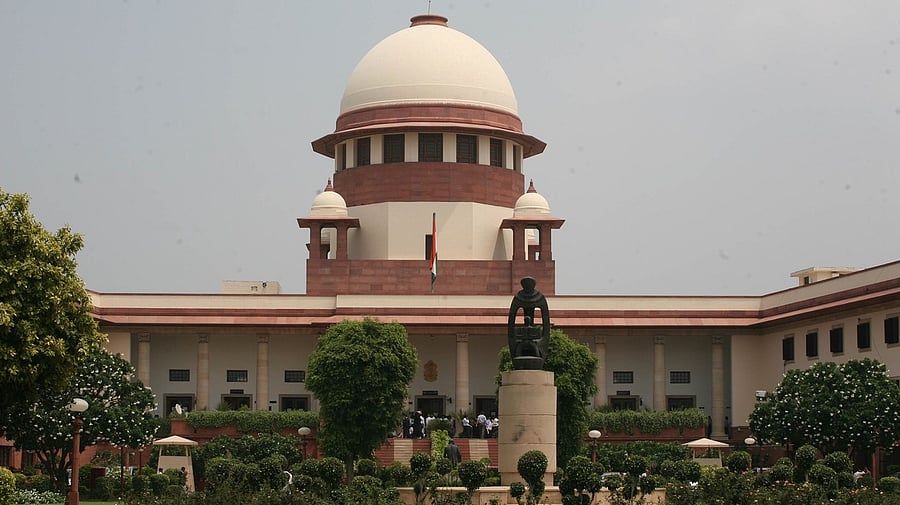
The Supreme Court of India.
Credit: iStock Photo
New Delhi: The Supreme Court on Thursday refused to entertain a PIL seeking a comprehensive legal framework and enforcement of minimum wages for domestic workers, saying trade union leaders are largely responsible for stopping industrial growth in the country, and closure of all traditional industries in the country.
A bench of Chief Justice of India Surya Kant and Justice Joymalya Bagchi said, the court cannot issue a writ asking the Centre and states to consider amending existing laws, and when a minimum wage is enforced, these unions will ensure that every household is dragged into litigation.
"Sometimes in our anxiety about reforms and to bring a non-discriminatory perspective through legislative means, it leads unwittingly to further exploitation. You fix a minimum wage. Look at the need for employment in this country, demand is far less as compared to the supply, you fix minimum wages, people will refuse to hire and this will further generate hardship,” the bench said.
Senior advocate Raju Ramachandran for petitioner organisation cited the Supreme Court judgment of January 29, 2025, where the court had highlighted the plight of domestic workers and noted repeated but unsuccessful legislative attempts to enact a comprehensive law.
Raju said that while some states have notified minimum wages for domestic workers, others have failed to do so, despite the nature of domestic employment remaining uniform across the country.
He said in Singapore, one cannot hire a domestic maid unless one registers that person and provides weekly offs, wages, etc.
As the counsel contended that there were workers’ unions and domestic workers’ unions registered under the Trade Union Act, the bench asked, “How many industries in this country have been closed, thanks to these trade unions? Let us know the reality also”.
“They do not want to work. They are largely responsible for stopping the industrialization growth in this country,” the bench orally observed.
Acknowledging the exploitation of domestic workers, the court felt the means should have been different to stop that exploitation.
“People should have been made aware of their individual rights. People should have been made skilled instead of using them as manual labour,” the bench said.
Raju contended that collective bargaining is a valuable right.
The court, however, pointed out that domestic workers were already covered under existing welfare frameworks.
“It is not as if there is no safety net. The Unorganised Workers’ Social Security Act does take care of several aspects,” the bench said.
While acknowledging the “plight” of millions of domestic help across the country, the court emphasised that the judiciary cannot encroach upon the legislative domain to mandate the enactment of laws.
It said, “No enforceable decree or order can be passed unless the legislature is asked to enact a suitable law. Such a direction we are afraid ought not to be issued by this court.”
The bench asked petitioners, including Penn Thozhilalargal Sangam, a domestic workers’ union, to highlight the plight of domestic help to states and the Union government to take a suitable decision in the matter.