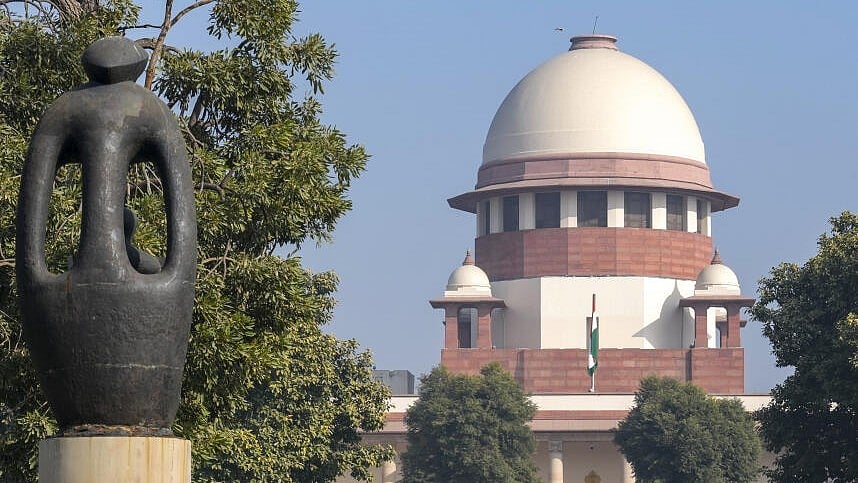
Supreme Court of India.
Credit: PTI
New Delhi: The Supreme Court has set aside a Rajasthan High Court order that directed the wife of a software engineer, accused of raping a woman on a false pretext of marriage, to be present in the country if he wishes to travel abroad for a job.
A bench of Justices Sanjay Kumar and Alok Aradhe took on record an undertaking given by the man that he would attend every hearing via video-conferencing.
Advocate Ashwani Dubey, appearing in the court on behalf of the engineer, submitted that his client's wife is neither an accused nor a party to the case.
Dubey informed that as on the date of the passing of this order, the appellant's wife was not even in India as she was employed in the United States.
"In the light of the undertaking given by the appellant, stating that he would attend every hearing in Sessions Case No. 12 of 2024 on the file of the learned Additional Sessions Judge (Women Atrocities Court), Ajmer, Rajasthan, through video-conferencing and also giving an assurance that he would be physically present before the trial court whenever so directed, we find no ground to alter the order dated August 8, 2025, passed by this court, which has been duly complied with. The said order is made absolute, subject to the undertaking given by the appellant," the bench said.
The top court had, on August 8, stayed the high court order and directed the man to deposit Rs 2 lakh as surety for foreign travel.
The plea says the high court, in a clear violation of "procedural impropriety" and without hearing or impleading the engineer's wife, who is employed in the US, and ignoring the fact that she was not a part of the criminal case, directed her to remain in India.
It was further argued that the high court's direction was "erroneous" and violative of the fundamental rights guaranteed under Article 21 of the Constitution.
The direction was stated to suffer from procedural irregularity and legal perversity, having been passed without affording a hearing to the person affected.
"The petitioner is an Indian passport holder and an Indian citizen and not the citizen of any other country and he will be under the control of the Consulate General in the US and there are no chances of his absconding as he is willing to go abroad to earn his livelihood on a work visa and therefore, there is no question of his absconding," the plea has said.
The bench was informed that the appellant would travel for a specific period and is ready to state on oath that he would be available for trial as and when directed.
"There is no question of a delay in the trial and also, there is no question of his absconding," the plea says.
The case of rape against the man was lodged at Ajmer's Christianganj police station after it was alleged that he came across a woman on a matrimonial website and maintained a close acquaintance with her for four years following a promise of marriage.
Section 69 of the Bharatiya Nyaya Sanhita (BNS) deals with the offence of "sexual intercourse by employing deceitful means, etc." and defines deceitful means to include a "false promise of employment or promotion, inducement or marrying after suppressing identity".
Apprehending arrest, the accused moved an anticipatory bail application, which was allowed.
He then moved an application before the trial court to allow him to go abroad for a job.
The trial court dismissed his plea, following which he challenged it before the high court.
The high court allowed him to go abroad but imposed a condition that his wife must remain in India.