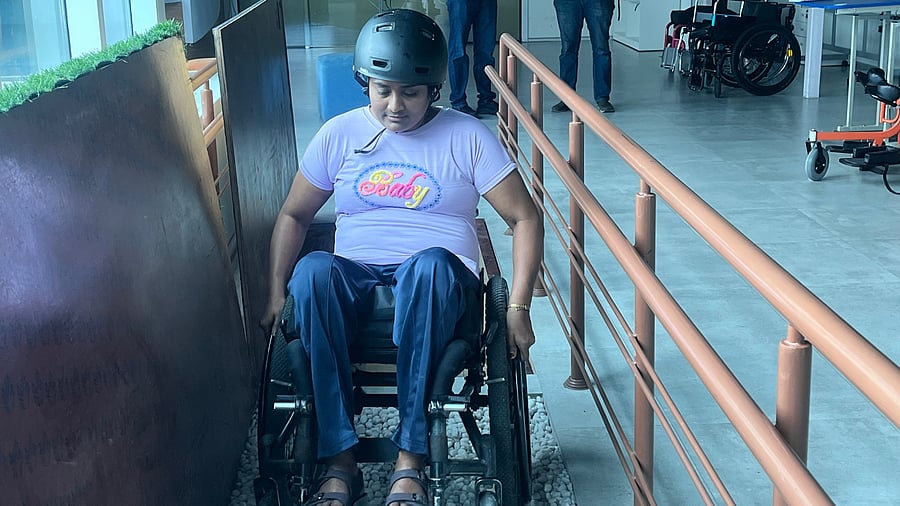
Jennifer is an expert wheelchair peer trainer who trains people with disabilities to navigate different terrains.
Credit: DH Photo
Chennai: M Jennifer, formerly a physical training teacher, was immobilised for about six years after a spinal cord injury from an accident in 2014.
A decade later, she now rides a 4-km distance from her house to the workplace at the IIT-M Research Park without anyone’s help on her NeoBolt, an electric vehicle specially designed for wheelchair users.
“I don’t depend on anyone to travel or go about my daily life. This vehicle has given me the freedom of mobility, from being bedridden to a wheelchair user to now riding a vehicle on my own,” Jennifer said.
Jennifer is now an expert wheelchair peer trainer and trains people with disabilities in wheelchairs to navigate different terrains like villages and hilly areas, equipping them with the right skills through intensive programmes to live life to the fullest.
Dr Manish Anand, assistant professor, Department of Mechanical Engineering, IIT-M, told DH that one of the fundamental evolutions in developing assistive devices is making prescription the standard criterion to ensure that devices are customised for individual users rather than mass-distributed generics.
“There were multiple challenges in getting these products to the needy in India, including wheelchairs being sold without any prescription. Also, the user is not the buyer. We are changing this through CSR dissemination, and we train and track the users long-term, to ensure the end users benefit and continue to use the devices,” he added.
Ashish Jebin, Lead (R&D), R2D2, told DH that their approach is to make designs user-centric by catering to what the user needs while identifying the problem statements.
He added that even if someone is paralysed below the hip, the transfer-cum-mobility device, currently under development, provides an effective mobility solution. Primary users include the geriatric population, elderly citizens, and hospitals/clinics aiming to prevent falls and secondary injuries.
“Our approach ensures that whatever solution we create addresses the problem reliably. We don't just create something for the sake of it. We make it modular. Even if a person has already purchased a mechanical or push wheelchair, we convert it into an electric one through a clip-on device,” he said.