
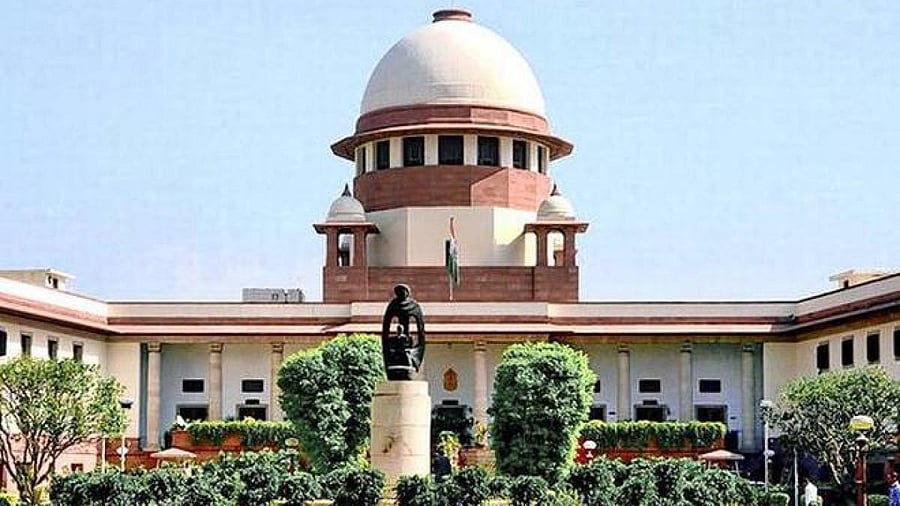
The Supreme Court of India
PTI
New Delhi: The Supreme Court on Thursday questioned Tamil Nadu Governor R N Ravi over sitting over the bills passed by the state legislature, observing he "seems to have adopted his own procedure" in dealing with the matter and thereby frustrating Article 200 of the Constitution.
A bench of Justices J B Pardiwala and R Mahadevan wondered how long the Governor could withhold his assent to the bills, as it was hearing petitions filed by the Tamil Nadu government concerning the prolonged confrontation between the state assembly and the Governor over his refusal to assent to bills passed by the legislature.
The court said it does not make any sense that the Governor withholds his assent and doesn't ask the legislative assembly to reconsider the bills.
Upon hearing senior advocates Rakesh Dwivedi, Dr A M Singhvi, Mukul Rohatgi and P Wilson, for the state government, the bench framed issues for consideration, including as to what is the concept of a Pocket Veto, if it does find a place within the constitutional framework and if the discretion of the Governor to present a bill to the President limited to specific matters or it extends to beyond certain prescribed subjects.
Among others, the court sought to examine as to what are the consideration which weighed the Governor by which the bill was presented to the President and how is Article 200 to be construed.
Attorney General R Venkataramani, representing the Governor, said in one of the cases, the Chancellor is the appointing authority and as per UGC regulations, which are binding according to the Governor, the composition of search-cum-selection committee for the appointment of VCs in state universities is in the hands of the Governor.
The court asked him to show the contemporaneous record available with the office of the Governor as to what was discussed and what was looked into.
"What are the lacunas, loopholes, which the Governor found," the bench asked the AG, insisting that it wanted to see what was the basis of the Governor's decision.
The bench pointed out that the Governor's declaration that he was withholding assent to the bills came soon after the apex court ruled in the Punjab governor's case that Governors cannot veto the assembly by sitting over bills. To this, AG said it just happened, a coincidence, that the judgment came.
The AG contended the controversy is not essentially about the Governor not having acted in breach of the mandate of Article 200, but indirectly the state government wanted the apex court to give a stamp of approval on the legitimacy and the legality of the bills passed by the legislative assembly.
"For how long the Governor will withhold his assent to the bills and what is he expected to do after," the bench asked.
The court said it wanted to understand what was expected of the Governor to do after he decided that he must withhold the assent.
The bench observed the Governor had the option to refer all the 12 bills to the President but he first referred two bills and refrained from assenting to the remaining bills. "What is next? Can he say I will not grant assent? I will not refer it to the President nor I will ask the assembly to reconsider. Keep quiet," the bench asked.
On this, the AG said he does not think that the Governor can do that.
The bench also asked why the Governor took so long to send the bills to the President in the name of repugnance. "What is something so gross in the bills for which the governor took three years to find," the court asked.