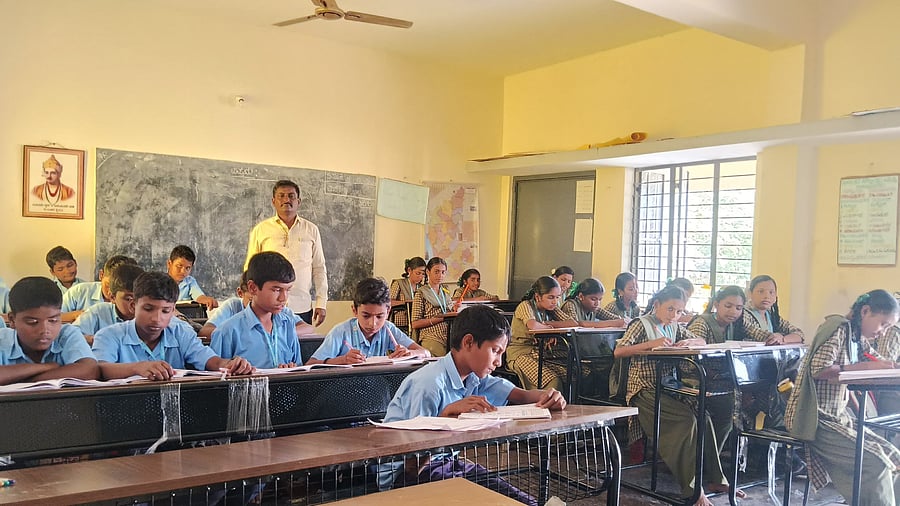
Students in a school. Image for representational purpose.
Credit: DH Photo
New Delhi: Tamil Nadu will now no longer be able to refuse to have Jawahar Navodaya Vidyalayas across the state after a Supreme Court ruling. The union ministry of education has consequently written to officials in the state asking for a meeting to facilitate them.
As the only state without any of these government-run schools, Tamil Nadu had till now said that as these schools insist on a three-language curriculum, it interferes with the state’s two-language policy. The Supreme Court, in a ruling on December 16, had held that the state cannot continue to do so and asked for a concrete timeline within a fortnight. The apex court directed the state to calculate the amount of land required for establishing such schools in each district.
“We have recently written to them, asking for a meeting to finalise the modalities,” a senior ministry official said.
The National Education Policy 2020 stipulates that teaching be done in three Indian languages between the classes of 6 to 10, with two languages being Indian, while the curriculum in classes 11 and 12 must be taught in two languages, with one Indian. The Central Board of Secondary Education (CBSE) had carried out a language-mapping exercise across its schools to find out the languages spoken the most. It is yet to announce the findings.
Textbooks in different languages have been produced by the ministry only for class 6 and 7, and textbooks for class 8 are being rolled out now. The official quoted above said that textbooks for classes 9 and 10 are expected soon.
The Centre has now written to six states – Tamil Nadu, Kerala, Puducherry, Andhra Pradesh, Telangana and Chhattisgarh – to comply with the Centre’s policy as per the NEP 2020 that the minimum age of students in class 1 should be six years. This is the second time the union ministry of education is writing to states; it had earlier written to them on February 9, 2023.
“We have written to these states; some of them have written back positively giving us a clear time frame. Chhattisgarh will adopt the change soon,” a ministry official said.
As per the policy, a child must have atleast three years of pre-primary education prior to starting formal school education.