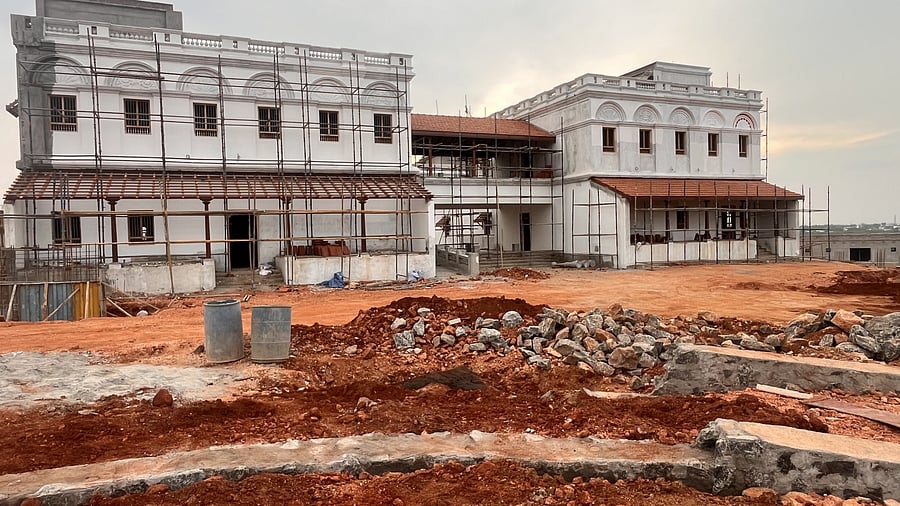
Built at a cost of Rs 33 crore, this is the second major museum to open under the DMK government, following the one at Keeladi, a Sangam Era site near Madurai, in 2023.
Credit: DH photo
Chennai: Iron implements from Sivakalai that pushed back the introduction of smelted iron in India by over a millennium, along with urns, skulls, and offering potteries unearthed from nearby Adichanallur, are among thousands of artefacts that will adorn the Porunai (Thamirabarani River Civilisation) Museum in Tirunelveli.
Chief Minister M K Stalin will inaugurate the imposing white-and-red structure on December 21. It has come up on 13 acres along the highway connecting Chennai and Kanyakumari.
Built at a cost of Rs 33 crore, this is the second major museum to open under the DMK government, following the one at Keeladi, a Sangam Era site near Madurai, in 2023. Spanning 54,296 square feet across six blocks, including an administrative building with a conference hall and an audio-visual (AV) hall, the museum will enthral visitors.
Showcasing the lives of ancient Tamils, it features two blocks each for artefacts from Sivakalai and Adichanallur, plus Korkai, the celebrated port of the famed Pandya Kingdom.
Sivakalai put itself on the world map in January when the Tamil Nadu State Department of Archaeology (TNSDA) announced that carbon dating of artefacts from the site showed iron usage dates back 5,300 years. This is the oldest known date for the Iron Age worldwide.
Sivakalai first created a buzz in 2021 after rice husks found in a burial urn were carbon-dated to 3,200 years old by Beta Analytic Lab in the US. This prompted Stalin to assert that the state government would continue scientific efforts to prove India's history should be rewritten from the Tamil landscape.
The museum will have details about the glorious Iron Age across India and display artefacts from several Iron Age sites in Tamil Nadu, including Mayiladumparai, and Kilnamandi, prehistoric, Neolithic, and Early Historic periods.
Tools from different ages – lower Palaeolithic, middle Palaeolithic, upper Palaeolithic, Microlithic, and Neolithic will also be displayed along with rock shelter paintings. A female figurine model from Adichanallur, iron objects with Sangam Literature in background, urns, skulls, and offering pottery will also be displayed.
“This museum is grander than the one in Keeladi with rich 3D maps and other technical aspects. The roof will have Mangalore Tiles in most of the buildings, while efforts are being taken to ensure that the buildings reflect the local culture and architecture,” a TNSDA official told DH.
The buildings will also have thinnai (a shaded veranda), and thalvaram (corridor) much like they are found in old houses built in the state.
The Sivakalai block will display 160 burial urns unearthed from Sivakalai, 70 iron objects, 163 graffiti-inscribed potsherds, five Damili-inscribed potsherds and 582 antiquities, while the Adichanallur block will display burial burns, and majority of the 1,585 antiquities.
The TNSDA will also exhibit over 812 antiquities including glass beads, glass bangles, shell bangles, terracotta beads, rare stone beads, terracotta figurines, iron objects, copper objects, terracotta pipes, Sangam Era coins unearthed from Korkai.
Korkai, now a small village in Thoothukudi district, was a celebrated port of pearly fishery of the famed Pandya Kingdom of the present-day Tamil Nadu. The rich Sangam Literature mentions Korkai as the harbour of the Pandyas during the 5th Century CE.