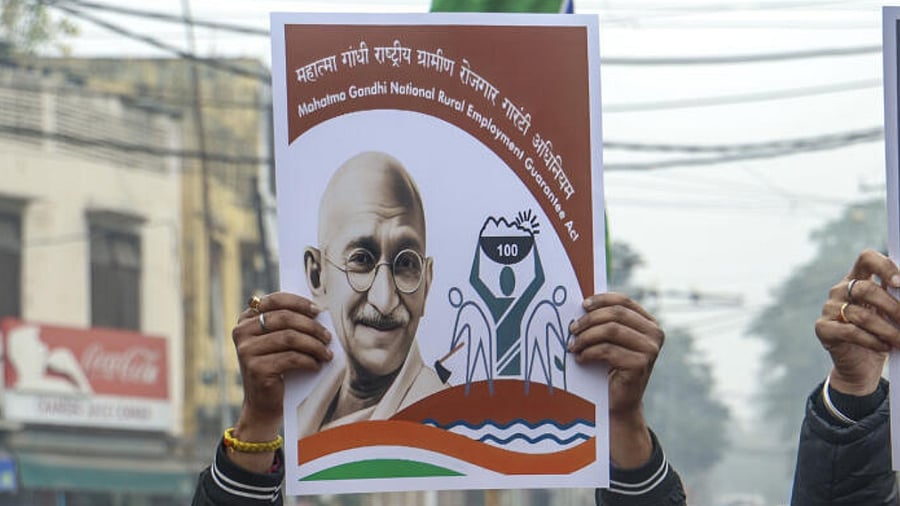
MGNREGA.
Credit: PTI
Hyderabad: The newly introduced VB–G RAM G Act, which replaces the Mahatma Gandhi National Rural Employment Guarantee Act (MGNREGA), is expected to impose a substantial financial burden on both Telugu states due to a new provision requiring states to bear 40 per cent of the programme’s expenditure.
In 2024–25, Andhra Pradesh spent around Rs 7,800 crore under MGNREGA, of which the state’s contribution was about Rs 780 crore. Once the revised funding pattern under the new Act takes effect, the state’s share is projected to jump fourfold to nearly Rs 3,120 crore, placing significant additional strain on its finances.
Telangana, with an overall MGNREGA expenditure of Rs 4,340 crore, currently contributes about Rs 434 crore. Under the new funding formula, this is expected to rise to approximately Rs 1,736 crore, similarly heightening fiscal pressure.
Andhra Pradesh has issued 65.36 lakh job cards, covering 1.14 crore registered workers during 2024–25. Telangana, meanwhile, has issued 51.96 lakh job cards covering 1.06 crore registered workers reflecting a wide potential base of rural households eligible for employment under the scheme.
According to researcher Chakradhar Budha, representing LibTech India, a Delhi-based organisation working in the MGNREGA space, the programme in Andhra Pradesh has shown strong representation from marginalised groups and women. Scheduled Castes accounted for 21.6 per cent of total persondays generated, Scheduled Tribes for 12.5 per cent, and women contributed a striking 60.14 per cent.
Each household in Andhra Pradesh received, on average, 51.62 days of employment a little over half of the 100 days legally guaranteed. The average rural wage under the programme stood at Rs 255.52 per day, among the higher rates nationally. Notably, 5.09 lakh households completed the full 100 days of wage employment during the year. The scheme also provided work to 76,584 differently abled persons, demonstrating a measure of inclusive outreach.
In Telangana, of the 51.96 lakh job cards, 26.69 lakh households and 42.44 lakh individuals actually worked under MGNREGA during 2024–25 indicating lower utilisation compared to Andhra Pradesh. Scheduled Castes accounted for 21.13 per cent and Scheduled Tribes for 21.15 per cent of total persondays, reflecting a higher share of tribal participation. Women’s participation was particularly strong, making up 62.51 per cent of total persondays. However, the intensity of employment per household was lower in Telangana, averaging 45.82 days a year, below both the statutory 100-day limit and Andhra Pradesh’s average. The state’s average wage rate was Rs 213.31 per day.
“Across both Andhra Pradesh and Telangana, MGNREGA has functioned as a vital safety net for rural households, engaging crores of workers annually and providing steady wage support to women. The looming shift in the Centre–state cost-sharing formula is expected to sharply raise the financial burden on the states, with Andhra Pradesh’s share likely to increase from Rs 780 crore to Rs 3,120 crore and Telangana’s from Rs 434 crore to Rs 1,736 crore. This could significantly affect the future implementation of the programme,” Chakradhar Budha told DH.