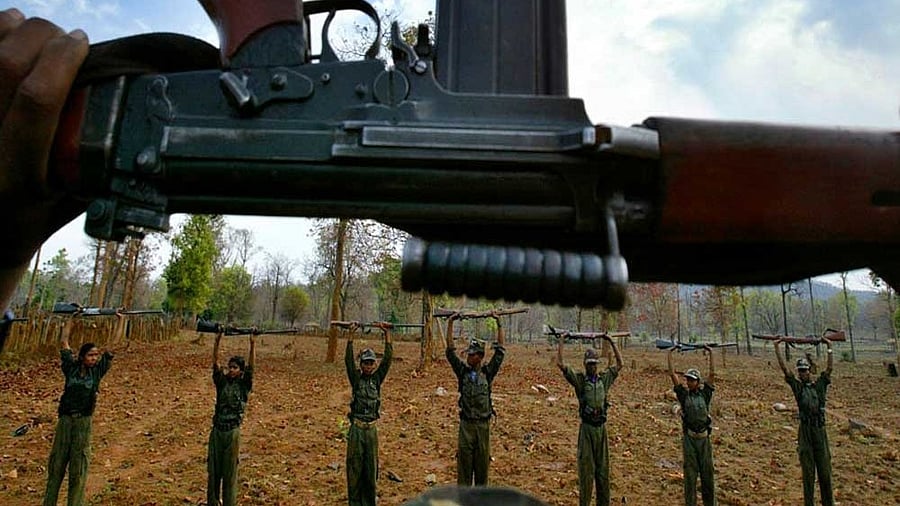
Representative image showing Maoists.
Credit: PTI File Photo
The Maoist rebellion has, since its peak in 2010, gradually been pushed into a small and progressively shrinking corner of the country, where the remnants of the movement are engaged in an existential struggle. This is a far cry from the rampaging movement that had swelled after the unification of the People’s War Group and the Maoist Communist Centre under the banner of the Communist Party of India – Maoist, in September 2004. By 2009, the Maoists were active in 223 districts across 20 States. Indeed, by 2006, then Prime Minister Manmohan Singh had already declared that “Naxalism is the single biggest internal security challenge ever faced by our country”, an assessment he repeated several times in the years following.
As the movement spread, the Centre’s desperation showed in the strategically ill-conceived “massive and coordinated operations” backed by the Central Armed Police Forces, which spread a relatively small force, at maximum, of 95 battalions – under 40,000 personnel in actual deployment – across an affected area covering 1.86 million square kilometers and a total population of 446 million in just the six worst-affected states, to back under-manned and ill-equipped state police forces that were largely unprepared and unwilling to join the counterinsurgency effort. The result was a succession of debacles resulting in massive losses of life among security force personnel and civilians. In 2009, for instance, of the 1,013 persons killed in Maoist-linked violence, 319 were security personnel and 368 civilians. The next year, of 1,180 total fatalities, 630 were civilians and 267 security personnel [all data from the South Asia Terrorism Portal].
Gradually, however, the reality sank in, and the delusional ‘area domination’ strategies, to ‘clear, hold and develop’ the Maoist-dominated regions yielded to a more realistic approach that could be reconciled with the state’s resources and capacities, even as these was gradually augmented. Instead of trying to ‘seize’ the vast areas of Maoist dominance, intelligence-led operations, particularly targeting the Maoist leadership, were increasingly adopted from 2012 onwards, resulting in dramatic Maoist reverses, and a steep drop in total fatalities – down to 606 in 2011 itself. By 2014, fatalities had dropped to 350, and further to 256 in the following year.
Maoist overreach also contributed to this outcome. Intoxicated with their ‘unification’, the Maoists sought to extend their movement ‘across the country’, including urban areas. The accelerated expansion and recruitment created opportunities for the intelligence apparatus – particularly the Andhra Pradesh Police’s Special Intelligence Bureau – to penetrate the movement’s networks across the country, resulting in a flurry of high-profile arrests and killings of top leaders.
This is the process that has continued since, under succeeding governments at the Centre and in the affected States, with fatalities fluctuating below the mid-400s, and bottoming out at 135 in 2022. Total fatalities have spiked, again to 372 in 2024 (till November 25), but, significantly, 278 of these are in the Maoist category, as the Centre sets into motion a policy of “completely eliminating Naxalism by March 2026”. The residual movement has been pushed into just 38 districts, with just two of these recording over 50 fatalities in the current year – Narayanpur and Bijapur in Chhattisgarh. Other significantly affected districts include Sukma, Kanker, and Dantewada in Chhattisgarh, Gadchiroli in Maharashtra, and West Singhbhum in Jharkhand. These ‘military’ measures have been supported by a generous ‘surrender policy’, some welfare measures – including the very popular subsidized rice scheme – and an extension of infrastructure and civil administration to the areas ‘recovered’ from the Maoists. Most of the grievances that the Maoists harnessed to their movement have, however, not been addressed.
It is not clear whether the ‘deadline’ of March 2026 can be met, or indeed, what precisely “completely eliminating Naxalism” could mean. It is evident, however, that the Maoists have been substantially marginalized and are on the edge of a comprehensive defeat. Indeed, a generous state, at this stage, would have opened up channels of a negotiated settlement to bring the surviving Maoist leadership into the ‘mainstream’, and stem further bloodletting.
AJAI SAHNI
(The writer is the Executive Director of the Institute of Conflict Management. The article reflects his personal views)