
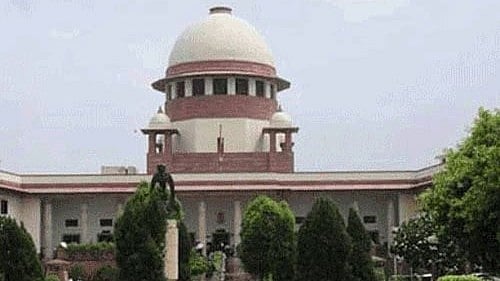
The Supreme Court of India.
Credit: PTI Photo
New Delhi: The Supreme Court has said that directing time-bound investigations should be the exception rather than the norm, as courts must respect the practical realities of investigation and intervene only when delay itself threatens fairness, liberty, or the integrity of the criminal justice system.
A bench of Justices Sanjay Karol and N Kotiswar Singh emphasised, an investigation is a product of many factors and happenings, apart from the crime itself, which lend to it a sense of uncertainty.
The law therefore accords investigating agencies a reasonable degree of latitude. At the same time, the Constitution does not permit investigations to remain open-ended, the court pointed out.
“Where there is evident stagnation, unexplained inaction, or a pattern of delay that cannot be justified by the nature or complexity of the case, judicial directions fixing timelines have been considered warranted," the bench said.
The court also highlighted, speedy trial, which necessarily includes timely and diligent investigation, has been recognised as an integral part of Article 21 of the Constitution and is essential to the fairness and credibility of the criminal justice system.
"Courts have also been mindful of the impact of prolonged investigation on personal liberty, particularly where coercive measures or extended custody are involved. In such cases, fixing timelines is viewed not as an intrusion into the investigative domain, but as a safeguard against inertia and arbitrariness," the bench said.
The court pointed out, at the same time, the Supreme Court has cautioned against routine or mechanical directions for time-bound investigation.
It noted in Union of India Vs Prakash P Hinduja (2003), this court reiterated that the manner and pace of investigation ordinarily lie within the investigator’s domain.
In a judgment on December 19, 2025, the bench said that timelines are not drawn by the court to be followed by the investigators/the executive right from the beginning, for that would clearly amount to stepping on the toes of the latter. “Timelines are therefore imposed at a point where not doing so would have adverse consequences i.e., there is material on record demonstrating undue delays, stagnation, or the like. In sum, timelines are imposed reactively and not prophylactically,” the bench said.
The court said that the investigation of an offence is a long, winding road, and it is full of ups and downs and is not, possibly, even for a moment, predictable in the true sense. “There can be delays in the investigation, witnesses who at one point in time appeared confident may begin to hesitate or completely resile from their statements, documentary evidence on which much hope was pinned may turn out to be unusable, or so many other such possibilities may occur,” the bench said.
The court also said that the investigative process is at times straight, at other times one of lots of twists, turns and recalibrations and in yet others, frustratingly round-about like, before it can come to a somewhat definitive conclusion to present the case for trial before the concerned.
The court allowed the Uttar Pradesh government's appeals against three identically-worded judgments of the Allahabad High Court on petitions challenging an FIR related to alleged forgery and misuse of arms licenses.
The HC had directed completion of the investigation within 90 days and ordered that the accused should not be arrested till the trial court takes cognisance of the offences against them.
The court opined, the timelines imposed by the High Court need to be interfered with and set aside. It also ordered the interim protection in favour of the respondents would continue to operate for the next two weeks only.