
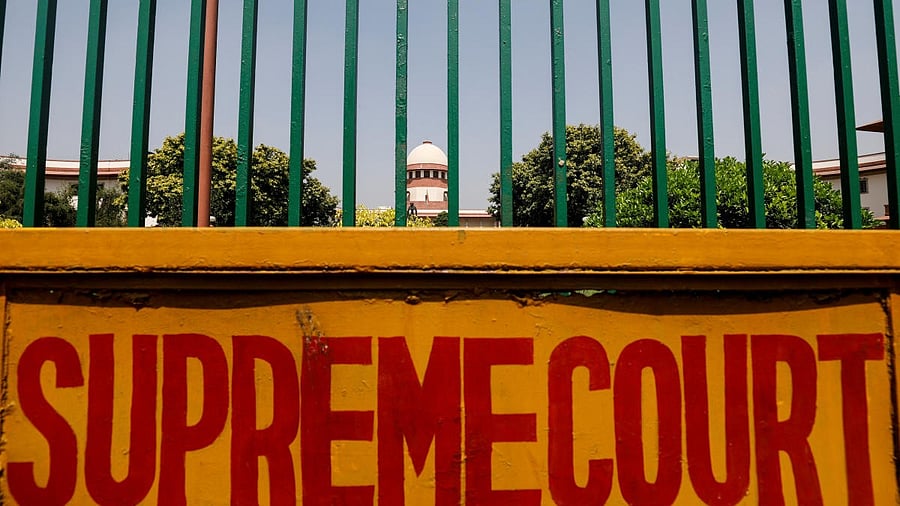
A signboard is seen outside the premises of Supreme Court in New Delhi
Credit: Reuters File Photo
New Delhi: The Supreme Court said that a trial court cannot impose the sentence of imprisonment till the end of one's natural life without any remission.
A bench of Justices Ahsanuddin Amanullah and K Vinod Chandran emphasised that the power to impose punishment of imprisonment for life without remission was conferred only on the constitutional courts and not on the sessions courts.
The court here partly allowed an appeal filed by Kiran, who was held guilty of murder for setting ablaze a widow for rejecting his sexual advances.
The victim had died 10 days after the incident on April 1, 2014.
The appellant was sentenced to imprisonment till the end of his natural life. The trial court also directed that he would not be granted the benefit of remission under Section 428 of the Code of Criminal Procedure.
The bench, which upheld his conviction, modified the sentence as imprisonment for life.
The court also directed for deletion of a direction of the sessions court not to grant set-off under Section 428, CrPC.
In the judgement of December 18, 2025, the bench held, "The sentence of life imprisonment cannot be directed to be till the end of natural life, by the sessions court as it would be in conflict with the provisions of the CrPC. The power of remission or commutation conferred on the State cannot be taken away.''
The court emphasised that the sentence of life imprisonment, no doubt means the entire life, subject only to the remission and commutation provided under CrPC and also to Articles 72 and 161 of the Constitution of India, which cannot be curtailed by a sessions court.
"Nor can the sessions court, a creation of the CrPC curtail the provision under Section 428, CrPC, available in the Code which created it,'' the bench said.
The bench pointed out that an alternative measure was brought in to break the standardisation in sentencing in such cases wherein the crime is heinous, dastardly and brutal.
The court underscored that though life sentence literally denotes imprisonment till the last breath, it operates only as an imprisonment for 14 years with the power of remission and commutation conferred on the government.
Balancing, the need to provide proportionate punishment at least in crimes which shocks human society, with the need to avoid death; an irreversible penalty, a middle ground was found, the court said.
"A measure by which, in crimes possible of categorisation as ‘rarest of the rare’, the courts even then find a need to avoid death, on mitigating circumstances, could award life imprisonment without remission," the bench said.
Also, when the case falls short of the ‘rarest of the rare’ category, thus excluding imposition of death sentence, but by the nature of crime the normal sentence of life imprisonment subject to remission or commutation, working out to a term of 14 years would not suffice and would be grossly disproportionate and inadequate, again this measure could be employed, the bench said.
"It was in such circumstances that this court considered the possibility of expanding the options so as to cover the ‘vast hiatus between 14 years imprisonment of life and death’. The court thus, substituted the death sentence awarded by the trial court and confirmed by the high court, with imprisonment for life and directed that the accused shall not be released till the rest of his life,'' the bench said.
The bench emphasised that in Union of India Vs V Sriharan alias Murugan and Others (2016), a Constitution bench by majority reaffirmed the alternative option as laid down in Swamy Shraddananda case (2008) restricting the principle to be applied only by the Supreme Court and the high courts.