
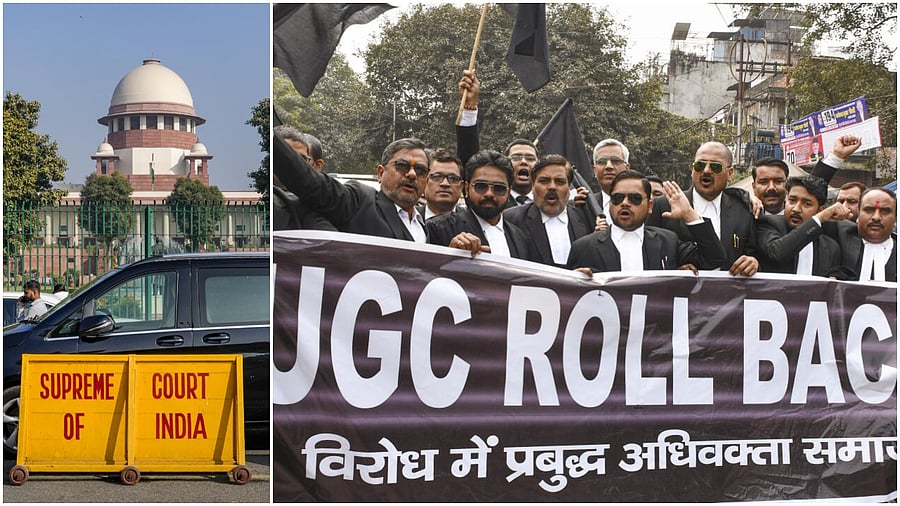
Supreme Court(L), Advocates hold a protest against the UGC Bill 2026.
Credit: PTI Photos
New Delhi: The Supreme Court on Thursday said that some of the provisions of the University Grants Commission (Promotion of Equity in Higher Education Institutions), 2026 prima facie suffered from certain ambiguities, and the possibility of their misuse cannot be ruled out.
A bench of Chief Justice of India Surya Kant and Justice Joymalya Bagchi directed for keeping in abeyance the 2026 regulations and used its power under Article 142 of the Constitution to do complete justice to order that the 2012 regulations will continue to operate and remain in force till further orders.
Petitioners contended that incorporation of Clause 3(c) in the 2026 UGC Regulations defining “caste-based discrimination” was restrictive and exclusionary in its formulation, as the individuals belonging to non-reserved or general classes were rendered completely remediless under the statutory framework, even if they were subjected to caste-based discrimination or institutional bias within higher education institutions.
They also claimed the regulations proceeded on an unfounded presumption that caste-based discrimination was necessarily unidirectional and can never operate against persons belonging to non-reserved or general categories.
"Upon a prima facie consideration, it appears to us that some of the provisions of the Impugned Regulations suffer from certain ambiguities, and the possibility of their misuse cannot be ruled out,'' the bench said.
The court framed the following substantial questions of law for considerations:
(i) Whether the incorporation of Clause 3(c) defining “caste-based discrimination” bears a reasonable and rational nexus to subserve the object and purpose of the 2026 UGC Regulations, particularly in light of the fact that no distinct or special procedural mechanism has been prescribed to address caste-based discrimination, as opposed to the exhaustive and inclusive definition of “discrimination” provided under Clause 3(e)?
(ii) Whether the introduction and operationalisation of “caste-based discrimination” would have any bearing on the existing constitutional and statutory sub-classification of the Most Backward Castes within the Scheduled Castes, Scheduled Tribes, and Other Backward Classes, and whether the regulations provide adequate and effective protection and safeguards to such Extremely Backward Castes against discrimination and structural disadvantage?
(iii) Whether the inclusion of the expression “segregation” in Clause 7(d), in the context of allocation of hostels, classrooms, mentorship groups, or similar academic or residential arrangements, albeit on transparent and non-discriminatory criteria, would amount to a “separate yet equal” classification, thereby infringing the constitutional guarantees of equality and fraternity under Articles 14, 15 as well as the Preamble to the Constitution?
(iv) Whether the omission of the term “ragging” as a specific form of discrimination in the framework, despite its existence in the University Grants Commission (Promotion of Equity in Higher Education Institutions) Regulations, 2012, constitutes a regressive and exclusionary legislative omission? If so, whether such omission is violative of unequal treatment of victims of discrimination by creating an asymmetry in access to justice and thus falls foul of Articles 14 and 21 of the Constitution of India?
(v) Any other ancillary question that may arise or be proposed by the parties during the course of these proceedings and warrant the intervention of this court.