
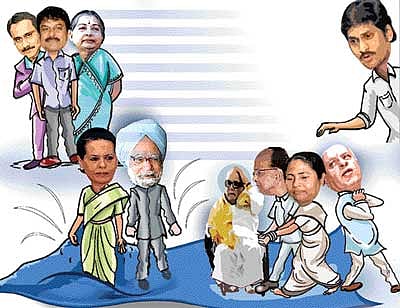
As the ruling Congress marked the completion of one year of the second UPA government just a fortnight ago, a distinct lack of deference on its part towards its coalition allies and partners was evident. It hasn’t come as any surprise. Even at times of its critical dependence on allies and partners during the last six years of the UPA experiment at the Centre, the Congress has been wary of conceding anymore space to them than the bare minimum required to keep the coalition ship afloat.
But, now with rivals parties like Mulayam Singh Yadav’s Samajwadi Party, Lalu Prasad’s Rashtriya Janata Dal, Mayawati’s Bahujan Samaj Party, Shibu Soren-led Jharkhand Mukti Morcha and even Jayalalitha’s AIADMK and CPI-M, the Congress leadership doesn’t seem to require committed partners to sustain the UPA-II government. What, as a result, the country witnesses in UPA-II’s coalition practices is a phenomenon very different from the one that was in evidence during the first UPA and predecessor NDA’s coalition terms.
No strings attached
No longer are Prime Minister Manmohan Singh, UPA chairperson Sonia Gandhi and the Congress’ coalition managers tied down by allies as they were during the first UPA’s tenure in office. Unlike the arrangement worked out at the beginning of UPA-I in 2004, the second UPA has no common minimum programme. Nor is there a coordination panel for consultations among allies and partners. The first year of UPA-II might not have been as distinguished as the first one year of UPA-I. For that the Congress leadership would have to blame itself or the circumstances, and its allies or partners.
From the very beginning of its tenure, UPA II decided the “troublesome” Left was no longer required, a weakened Lalu and Ram Vilas Paswan were shown their place – they had no place in the Ministry – and Mulayam Singh and Mayawati were forced by their respective political compulsions to lend support from outside voluntarily than because the Congress required it.
The DMK, the second most important coalition constituent in UPA-II, could do little to force Congress hands on critical issues, fully aware that its requirement of the Congress was much more than the other way round. If this is not enough, rival AIADMK is anxiously waiting in the wings, to fill any vacuum that might arise if DMK were to act too pricy for the Congress’ liking.
Different strokes
The Left, which suffered its worst parliamentary election debacle in 2009 after it pulled out of the UPA-I in July 2008 over the Indo-US nuclear deal, is of late signalling its readiness to forget the past acrimony and revive ties with the Congress.
Just a few days after Sonia and Singh made a joint public appearance in the national capital to mark the first anniversary of the UPA-II, CPM Politbureau member Sitaram Yechury is reported to have called on senior Congress leader Pranab Mukherjee with the offer of post-poll political accommodation in West Bengal’s urban local bodies.
The April 28 voting in the Lok Sabha on the Opposition-sponsored cut motion against the Finance bill illustrates the luxury the Congress enjoys because of desperate rivals. A day before the cut motion, Mayawati had announced her support for it. Mulayam Singh and Lalu too were to throw their weight behind the move that was sponsored by the BJP and the Left parties. This should have triggered panic in the Congress ranks as the government’s survival was in question.
Desperate flip-flop
What happened the next day is a different story. Mayawati invoked her commitment to secularism and political stability at the Centre as her party members staged a U-turn in the Lok Sabha. Mulayam Singh and Lalu did not go to that extent. But they bailed out the government by staging a walkout just before the voting on the ground that they could not vote for a motion sponsored by the “communal BJP.”
The extreme case of the desperate flip-flop came from the then Jharkhand chief minister Shibu Soren, who too voted against the cut motion. It was a shocking vote as Soren was heading the state government in Ranchi in alliance with the BJP.
No choice
The Congress couldn’t have asked for anything better. Much as the party might be running a minority coalition, it is a coalition in which the allies have no choice but to stick with the Congress. To make up for the majority numbers, there are a number of parties who are its rivals but are under political compulsions to effectively support the government when the occasion arose.
The Congress, in the process, may be deliberately targeting parties to be its supporting partner from outside on a selective basis.
UPA-II has thus become a coalition of not necessarily willing allies and partners; it is a flexible coalition in which the Congress has the freedom to pick and choose its partners from the rival ranks, who are only too willing and waiting to be partnered.
Lalu Prasad
April 28, 2010: (On his party’s walkout in the Lok Sabha over the cut motion that allowed the government to prevail over the Opposition)
We cannot vote with the communal BJP.”
Mar 8, 2010: (On Congress persistence with the Women’s quota bill in the Rajya Sabha)
This is a political dacoity. We will not tolerate it. We are withdrawing support to the government”
Shibu Soren
June 3, 2010 (contradicting his party’s earlier position on his vote in favour of the UPA in the cut motion on April 28, 2010)
“It was not a mistake. I did what suited me at that time,’