
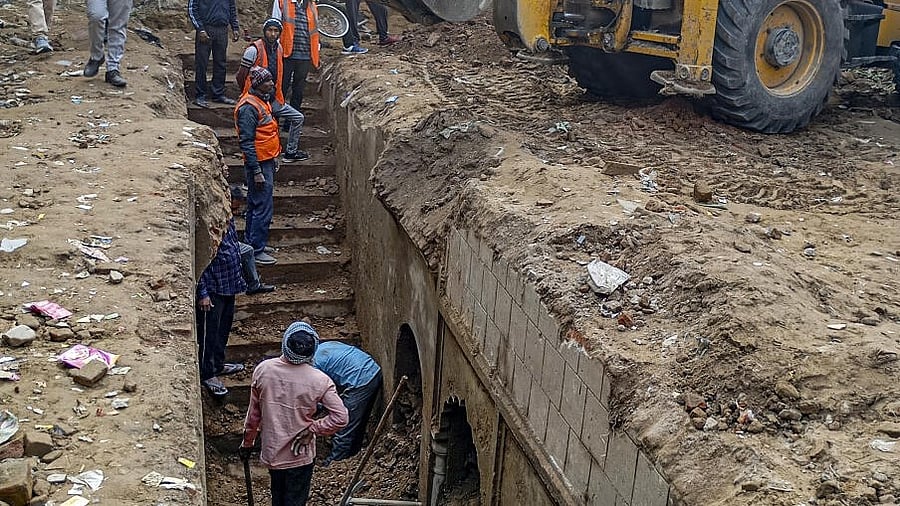
Excavation work continues after a stepwell and tunnel-like passage were discovered at Sambhal.
Credit: PTI Photo
New Delhi: The Uttar Pradesh government has told the Supreme Court that the Shahi Jama Masjid, Sambhal committee has objected to revival of a well, locally known as 'Dharani Varah koop', even though it was situated outside the "disputed structure" which is itself established on public land.
It said the district administration has been involved in an ongoing plan to revive the culturally significant sites in Sambhal District for the conservation and restoration of 19 historically significant wells.
"The subject well forms one of the 19 wells. A proposal has been submitted for the conservation/restoration of 14 of such wells, estimating an expenditure of Rs 123.65 lakhs. In fact, the process of restoration has begun," it said.
The Supreme Court on January 10 asked the Sambhal municipal authorities not to give effect to its public notice issued through posters describing a well around Shahi Jama Masjid as 'Sri Hari Mandir' available for puja and bathing by Hindus.
In a status report, the state claimed the petitioner’s attempt to thwart the said revival process of wells is not only illegal but also detrimental to the ecological preservation and development of the region.
"The petitioner herein has annexed misleading photographs attempting to show that the subject well is located inside its premises," it said.
The state government claimed the petitioner by its misconceived application attempted to create private rights in respect of public property.
"It was also found during the inspection that this well was in use since time immemorial by persons of all communities. However, now it has no water and it was further found that after the communal riots of 1978, a Police chowki was built on top of one part of the well. The other part continued to be in use even post 1978. It was further found that sometime in 2012, the subject well was covered," it said.
The state government said the Allahabad High Court had on January 8, 2025 stayed all entire proceedings related to the suit of 'Shri Hari Mandir'. However, without disclosing the High Court's order, the application was filed before this court for an order to ensure that status quo is maintained with respect to the private well situated "near the stairs/entrance of the Mosque and not to take any steps/actions".
The state government claimed, "The said subject well is situated near and not inside the disputed religious site, and as such, has no relation/connection with the mosque/ disputed religious site. Even the disputed religious site is itself situated on public land."
It asserted that the well is a public well and is not situated anywhere inside the mosque or the dispute religious site. In fact, there is no access to the subject well from inside the mosque, it claimed.
After the apex court's order of January 10, 2025, it said, the District administration had formed a three-member committee comprising the SDM Sambhal, Area Officer, Sambhal and the Executive Officer, Municipal Council, Sambhal, to examine the status of well in question.
"Upon examining the records, it was discovered that the petitioner has failed to disclose that there is in fact a well within the boundary walls of the mosque /disputed religious site locally known as “Yagna koop”. It is submitted that there has been no interference with the said “Yagna koop”," it said.
The state government referred to a report of February 20, 2025 by the Municipal Council, Sambhal, which noted that the 19 wells sought to be restored in Sambhal city are associated inter alia, with rainwater harvesting, water recharge and socio-cultural-religious beliefs.
"The initial phase of the revival plan, the municipality has gotten all the wells in the city area, which were closed or filled with mud and garbage, cleaned completely, with netting installed for safety. Signage boards with the historical names and historical significance of the wells, are being installed," it said.
The next steps would include the creation of a Parikrama path, drinking water facilities, installation of Boards depicting the historical and cultural significance of the wells, it said.
Referring to the UN Covenant on Economic Social and Cultural rights, the state government said, "At present Sambhal district is in the dark zone in terms of ground water levels, and therefore, the renovation of wells for ground water recharge is urgently needed. The Sambhal well revival plan is one step to ensuring such goal."