
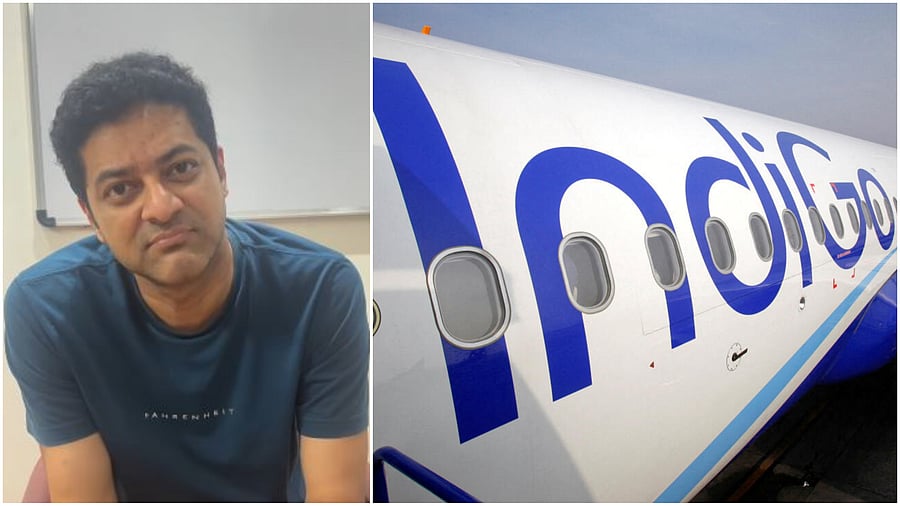
Former AirAsia CFO Vijay Gopalan, an imaege of an IndiGo aircraft.
Credit: Instagram/@vijay.gopalan, Reuters Photo
As IndiGo grapples with their ongoing cancellation of flights, Vijay Gopalan, former CFO of AirAsia India, shared his thoughts on how the situation is heavily influenced by the Flight Duty Time Limit (FDTL) rule changes.
Gopalan took to social media to address some general queries on the crisis faced by IndiGo Airlines. He stressed on the revised FTDL rules that require a pilot to get 48 hours of rest, the previous rest period being 36, being a main reason on why the confusion ensued.
"If they say the previous regulation was that they needed 36 hours of rest, now they say you need 48 hours of rest. Which means the number of hours available for a pilot to fly gets reduced. Unless you increase the number of pilots, the number of pilots available to operate all your aircraft, therefore, gets reduced logically," he said.
He also clarified how recruiting pilots is not as easy as many think. It involves fulfilling mandatory notice periods. "For a pilot to move between two airlines in India, if you're a senior pilot, there's a mandatory notice period of 12 months. And if you're a co-pilot, the notice period is a mandatory 6 months. So, you just can't go poaching people."
Further in the video, he said how hiring pilots involves type-rating, extensive training periods, and many more considerations. "As I told you, one is a notice period. The second is, if you want to bring in fresh pilots, they need to get type-rated. They need to go through the trainings. They need to finish the minimum number of flying hours. I don't think Indian infrastructure supports any of those things. It's a long process. It's not going to be easy. I just can't build bench strength so easily," he said.
Gopalan also simplified the logic behind the number of cancellations the public has been seeing these past two to three days, "They moved it from 36 to 48 hours of mandatory rest, which means that is about 20 to 25 per cent reduction in the available flying hours. If you don’t staff yourself adequately, then 25 per cent of the flights will have to be cancelled. IndiGo does about 2,200 flights a day. So 25 per cent of it is roughly about 500 to 550."
As he termed IndiGo being a "low-cost carrier," and it has always been a "very lean and mean machine" from the start, their pilot management is what one may blame here.
"IndiGo has been a very lean and mean machine always, and this is not something new. Right from the start everything has been extremely lean. They are a low-cost carrier. The only other meaningful airline is Air India. Air India, probably, given that many of their aircraft are anyway grounded, they must have had a surplus of pilots from those aircraft to be able to cater to this," he elaborated.
He mentioned how there was nothing sudden about these cancellations. Knowing the new rules would have caused immense pressure on airlines, he blamed IndiGo for not preparing well enough for this, "This wasn't all of a sudden. The government issued this notification well in sometime in 2024 itself, telling that this is what is coming."
"Truth be told, I think it was an extremely...the only thing that you can attribute this to is a very very lackadaisical, nonchalant attitude from the airline," he criticised IndiGo for the fiasco that could have been avoided.