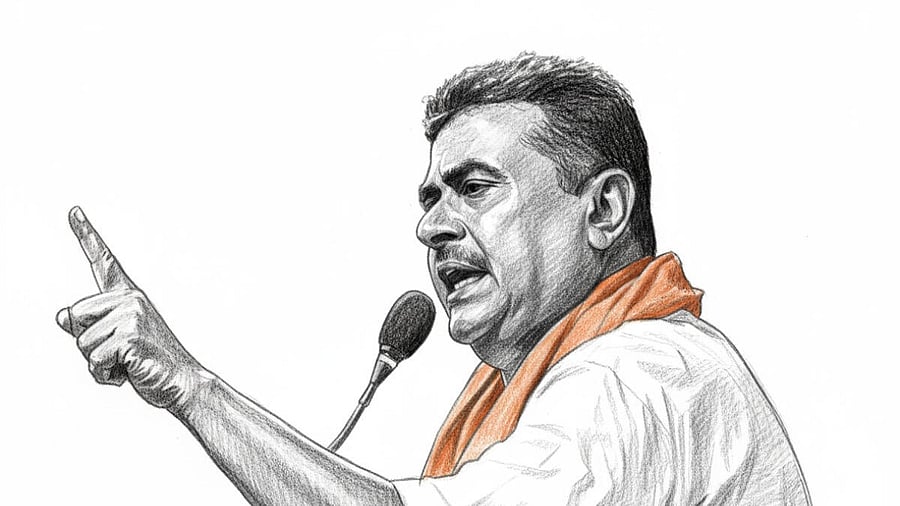
Credit: DH Illustration
Stakes in deepening the divide between religious communities are rising in West Bengal, with the laying of foundation stones for mosques and temples emerging as the latest tactic to polarise voters along communal lines in the state’s fiercely competitive politics.
In the 78 years since India’s independence, West Bengal has not witnessed such unabashedly communal and divisive politics as a strategy for vote mobilisation.
On December 6, maverick, now suspended Trinamool Congress leader, Humayun Kabir laid the foundation stone for a replica of the destroyed Babri Masjid in Ayodhya, at Beldanga in Muslim-majority Murshidabad district. Kabir was suspended from the party before he announced his resignation. The event was a massive mobilisation, which Kabir described as a “prestige battle for Muslims”.
His goal is to launch a new party representing Muslims; in the 2026 Assembly election, he expects to win 90 of West Bengal’s 294 seats, thereby positioning himself as a kingmaker.
Since the 2016 Assembly elections, the BJP has talked up several storms, accusing the ruling Trinamool Congress of Muslim appeasement through subventions to clerics and madrasas.
On the issue of reconstructing a replica of the Babri Masjid, it curiously avoided targeting Kabir, choosing instead to direct its vitriol at the Trinamool regime for enabling the MLA to do what he did.
BJP state president Samik Bhattacharya declared, “The current government in West Bengal is a pro-Babar government. This is a government opposed to Hindus and even Muslims of the state.”
Polarisation on the basis of religious identities is now kosher politics. To counter the December 6 rally for the foundation stone of a replica Babri Masjid, former BJP president in Murshidabad, Sakharab Sarkar, organised a far more modestly attended foundation stone, or bhumi puja, ceremony in Baharampur for a replica Ram Temple.
This was the second replica of the temple, for which bhumi puja was done in Murshidabad. Earlier, in January this year, at Alankar village under the Sagardighi constituency, the Bangiya Ram Seva Parishad Charitable Trust installed an eight-inch replica of Ram Lalla at the site.
Add to this the organised chanting of the Gita by an announced five lakh voices — Panch Lokkho Konthe Gita Path — and a marathon two-hour reading of the Quran, all within the span of roughly 40 hours from December 6 to December 7.
These calls to the faithful of Islam and Hinduism were an unapologetic exercise in mass mobilisation, with the expectation that, come the 2026 elections, votes would be more firmly consolidated along religious lines. The instrumentalisation of religion for electoral gains is the BJP’s reworked strategy to strengthen its appeal among wavering Hindu voters, dismayed and alarmed by the Special Intensive Revision (SIR) of electoral rolls now underway, which also aims to identify “ghuspaithiyas” — illegal migrants. Contrary to expectations that Muslims in West Bengal would be seriously rattled by the SIR, it is, in fact, many Hindus — those who fled Bangladesh in large numbers before and after the 1971 war of liberation — who are apprehensive about their status as Indian citizens and voters.
The BJP’s expectations are simple: temple replicas and Gita Path tactics are for a single purpose. As Union Minister Sukanta Majumdar asserted, “Hindus will have to unite if they want to protect their religion and culture.” He elaborated further, “Hindus in Bengal are gradually becoming outsiders. Bengal decided to stay with India because Hindus needed a separate land for themselves.”
The unprecedented investment in places of religious worship was explained by a BJP leader, “Humayun Kabir has been egged on by some people in the BJP. They believe Kabir will split Muslim votes to the disadvantage of the Trinamool Congress, creating a tiny chink through which the BJP can mobilise and consolidate Hindu votes along with Muslim dissidents.”