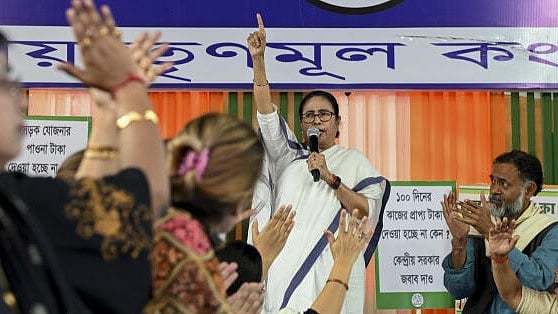
West Bengal CM Mamata Banerjee.
Credit: PTI
Kolkata: With assembly elections looming, West Bengal's interim budget on Thursday leaned heavily on Chief Minister Mamata Banerjee's well-worn political grammar of welfare-first governance, deploying cash transfers, job assurances and symbolic pay hikes to lock in women, youth and frontline workers -- the TMC's reliable electoral currency.
The Rs 4.06 lakh crore vote-on-account for 2026-27, tabled by Finance Minister Chandrima Bhattacharya, read less like a conventional fiscal statement and more like a campaign document, sequencing cash transfers, allowances and symbolic concessions to stitch together the ruling party's most dependable social coalitions ahead of the high-stakes polls.
At the heart of the budget lay a renewed and sharpened pitch to women voters, nearly half of West Bengal's electorate, who have underpinned the TMC's electoral dominance since 2011.
The Rs 500 monthly hike in the flagship financial assistance scheme 'Lakshmir Bhandar', raising the allowance to Rs 1,500 for general category women and Rs 1,700 for SC/ST women, was announced with immediate effect, ensuring the enhanced amount reaches beneficiaries' bank accounts well before the polls.
Within the ruling party, the scheme is often spoken of not merely as welfare but as political infrastructure.
A senior TMC leader described Lakshmir Bhandar as "the one scheme voters will measure us by", particularly in rural and semi-urban households where the transfer has acquired the texture of what many beneficiaries call "Mamata's guarantee".
The timing of the hike underlined the party's intent to convert policy into memory.
Youth, a more volatile and vocal constituency, were offered a parallel narrative. The announcement of the Banglar Yuva Sathi scheme promises Rs 1,500 a month to unemployed youths aged 21 to 40 years for up to five years or until they secure employment, whichever is earlier.
The scheme, with an allocation of Rs 5,000 crore for the financial year, is to be rolled out from August 15, 2026, provided the TMC returns to power.
The conditionality was seized upon by the opposition as evidence of "vote-linked welfare".
Yet within the TMC, the scheme is viewed as a direct rejoinder to sustained BJP attacks on unemployment, particularly in districts where the ruling party ceded ground in the 2024 Lok Sabha polls.
"This buys time and trust," a party MLA remarked. "Jobs are the question. Allowance is the answer for now."
For the BJP, the interim budget offered fresh lines of attack. State leaders dismissed it as a "pre-election shopping list", accusing the TMC of mortgaging Bengal's fiscal future for immediate political returns.
Privately, however, party functionaries concede that countering the emotional appeal of direct cash transfers remains their steepest challenge in the state.
Leader of the Opposition Suvendu Adhikari said that if the BJP is voted to power, it would hike the monthly allowance under the Lakshmir Bhandar scheme to Rs 3,000, effectively conceding the centrality of cash-transfer politics in Bengal's electoral contest.
The promise, made without a financial roadmap, signalled the BJP's attempt to blunt the TMC's advantage among women voters by outbidding the ruling party on its own flagship welfare plank.
Frontline workers, the often invisible scaffolding of Bengal's welfare delivery system, were also brought firmly into the budget's electoral calculus.
Monthly allowances for Anganwadi workers and helpers, ASHA workers, civic volunteers, village police and Green Police personnel were increased by Rs 1,000, accompanied by a Rs 5 lakh death compensation assurance.
These groups, deeply embedded at the last mile of governance, double as informal opinion-makers in villages and urban neighbourhoods -- a reality the TMC has leveraged in previous campaigns.
Their inclusion reflects a recognition that organisational reach and welfare delivery frequently converge at the booth level.
Government employees, another restive bloc, were offered a four per cent hike in dearness allowance, alongside a reiteration of the state's intent to work towards implementing the 7th Pay Commission. While unions have long demanded parity with central DA rates, the move appeared calibrated to temper discontent without straining the exchequer ahead of elections.
Beyond welfare, the budget attempted to signal balance.
Five new MSME industrial parks were announced, alongside plans to develop "business, environment and employment-friendly cities", seeking to counter criticism that Bengal's growth model is excessively consumption-driven.
An allocation of Rs 2,000 crore for the Mahatma Shree scheme, the state's rural 100-day job programme, reinforced the government's emphasis on employment-linked spending.
In a politically sensitive intervention, the budget also unveiled a master plan to prevent Ganga erosion in Muslim-majority Murshidabad and Malda, districts where displacement, migration and communal polarisation have sharpened electoral faultlines.
The move, though framed as developmental, carries clear political resonance in constituencies where demographic churn has become a campaign issue.
As the countdown to the Assembly polls begins, the interim budget leaves little doubt about the terrain Mamata Banerjee has chosen. Once again, she is betting that welfare-front-loaded, personalised and visibly delivered-will trump ideological contestation, turning the election into a referendum not just on governance, but on gratitude.