
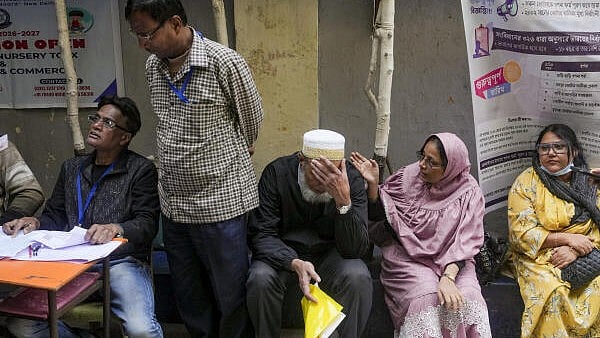
People with their documents wait for their turn at a centre in central Kolkata during hearings under the Special Intensive Revision (SIR) of the electoral rolls.
Credit: PTI PHoto
Kolkata: Film and TV actor Manali Dey will have to take a day off from shooting soon, as her right to vote has come under scrutiny, just because — believe it or not — a vowel somehow replaced another in her father’s name in the Election Commission (EC) database.
She has received an EC notice asking her to appear before the officials deployed for the Special Intensive Revision (SIR) of electoral rolls in West Bengal and furnish documents proving that her father Nitai De and the Netai De cited as her father in the 2002 electoral rolls are in fact the same person.
Manali’s is one of the countless cases of “logical discrepancy”, a rather innocuous and hitherto little-known jargon, that has entered everyday parlance in West Bengal since the EC published the draft electoral rolls on December 16 at the end of the SIR's enumeration phase.
Errors that could have been dismissed as clerical — a mismatched age, a misspelt name, a missing letter — are now forcing people into long queues at block offices, scrambling for old documents, losing daily livelihood, and living with the anxiety that a minor data glitch could jeopardise their right to vote.
“Why are they asking me for so many documents? I don’t know yet whether I will remain on the electoral rolls to be published on February 14,” said West Bengal Women and Child Development Minister Shashi Panja after receiving a notice for an SIR hearing.
Kolkata-resident Spandan Bhattacharjee received a notice because his father’s name was spelt "Ashok Bhattacharyya" in the 2002 voter list — the baseline for the ongoing SIR. Other documents had Ashok's surname spelt differently. Spandan will now have to explain the mismatch.
Bayron Biswas, a legislator of the ruling Trinamool Congress, and his brothers Milton and Nippon received notices for SIR hearings as their father, Babar Ali Biswas, had five other namesakes on the 2002 electoral rolls, and the EC software flagged all of them as one. The number of children of all six Babar Ali Biswases exceeded what the EC considered logical.
College professor Bidit Mukherjee also received a notice: The EC found that the surname of his father, Ashani Mukhopadhyay, was different from his. So did Arunita Banerjee, as her father’s surname was mentioned as Bandopadhyay in the 2002 electoral rolls.
What the EC software missed was that many Bengali surnames acquired their shortened forms during the colonial period, when British administrators simplified longer Sanskrit names to suit English pronunciation and record-keeping. Mukhopadhyay became Mukherjee, Bandyopadhyay Banerjee, and Chattopadhyay Chatterjee. Over generations, these anglicised versions entered everyday use and official documents, even though both forms continued to refer to the same family line.