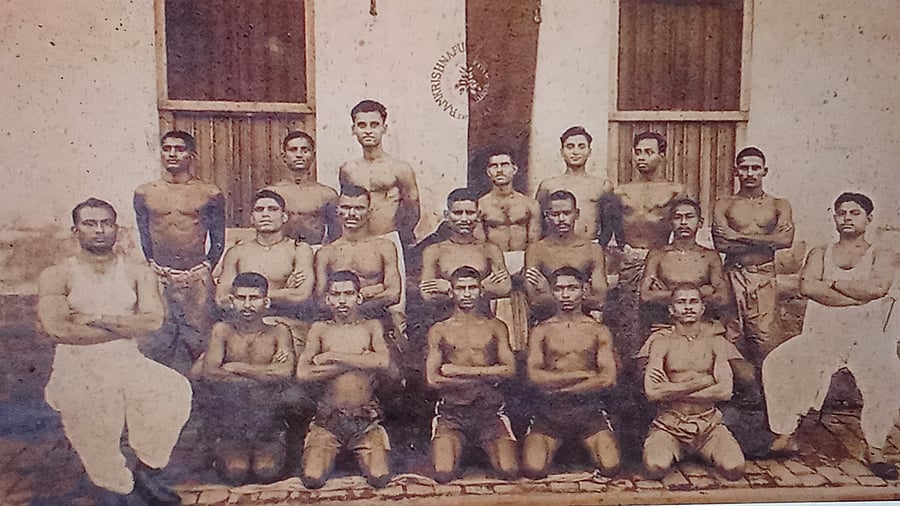
Inspired by Maharashtra’s Sarvajanik Ganeshotsav as started by the great leader, Bal Gangadhar Tilak, in Bengal too, in the late 1920s Durgotsav became Sarvajanik (public collective celebrations).
Credit: Special Arrangement
Mumbai: India’s one-of-the-oldest traditional gymnasium, the Ramkrishnapur Bayam Samiti, at Howrah in West Bengal, which also runs several social and cultural programmes, is celebrating its centenary.
Born in 1927, in the backdrop of India’s freedom movement, Ramkrishnapur Bayam Samiti was founded with the mission of creating a generation of hope and courage while secretly working for the independence of India.
Founder late Sailen Sinha was under police surveillance for many years and had to attend the IB Office every week.
“However, nothing deterred them from staying true to their motto – gyan – bhakti – karma,” says the President of the Ramkrishnapur Bayam Samiti, Gautam Sinha.
“The Ramkrishnapur Bayam Samiti is one of the pioneers in weightlifting competitions in India. It was the cradle of weightlifters and bodybuilders and sports administrators,” Ambarnath Sinha, Co-Chairman of the Publicity Department of the Samiti, told DH, during his visit to Mumbai.
Carnivals, roadshows, social work and cultural programmes marked the beginning of the centenary celebrations of India’s one of the oldest surviving clubs /associations that has a history worth sharing and a year-long eventful year awaits them, which include various competitions in yoga, weightlifting, five miles running competition, painting, dance, singing, recitation, etc., scheduled to commemorate the imposing landmark.
Sailen Sinha, the founder of the Samiti, himself was a renowned sports promoter and has the distinction of participating in the first Asian Games as a judge.
The government of West Bengal awarded him the Best Sports Promoter Award in 1992.
Credit: Special Arrangement
Credit: Special Arrangement
Credit: Special Arrangement
Credit: Special Arrangement
Credit: Special Arrangement
The Samiti for 50 years organised India’s most prominent weightlifting competition - ‘The Eastern India Weightlifting Competition’ and even received special gift of a set of barbells from the then USSR, now Russia, premier Nikita Bulganin and Nicolai Khrushchev when they came to India in 1955.
However, the Samiti’s most prized moment was when they won the letter of appreciation in 1938 from none other than Netaji Subhash Chandra Bose for their military band performance.
The Samiti has a Maharashtra link as well.
Inspired by Maharashtra’s Sarvajanik Ganeshotsav as started by the great leader, Bal Gangadhar Tilak, in Bengal too, in the late 1920s Durgotsav became Sarvajanik (public collective celebrations).
“The Samiti is a pioneer in Sarvajanik Durga Puja in Bengal way back in 1934 - a step towards creating a bonding between the people of a nation that was still under subjugation of a foreign rule,” says Ambarnath Sinha.
Centenary Celebrations Chairman, Kalyan De Sarkar adds up, about the Samiti’s regular social works including their contributions the 1943 and the 1978 calamities and their fierce resistance to keep harmony during 1946 riots, when even one of their members, Atindra Mukherjee laid down his life for the sake of peace.
In 1943 during the famine and flood, Asama Sundari Sinha, Sailen’s mother, then during those days gave away her jewellery worth 500 rupees, which is worth over 12 lakh rupees in today’s market rate, to begin Samiti’s fund for natural calamities.
“All these and more, the entire history of the Samiti is even preserved through paintings by the former President late Ranendranath Sinha, which is indeed unique. The paintings were done through 50 years,” he added.