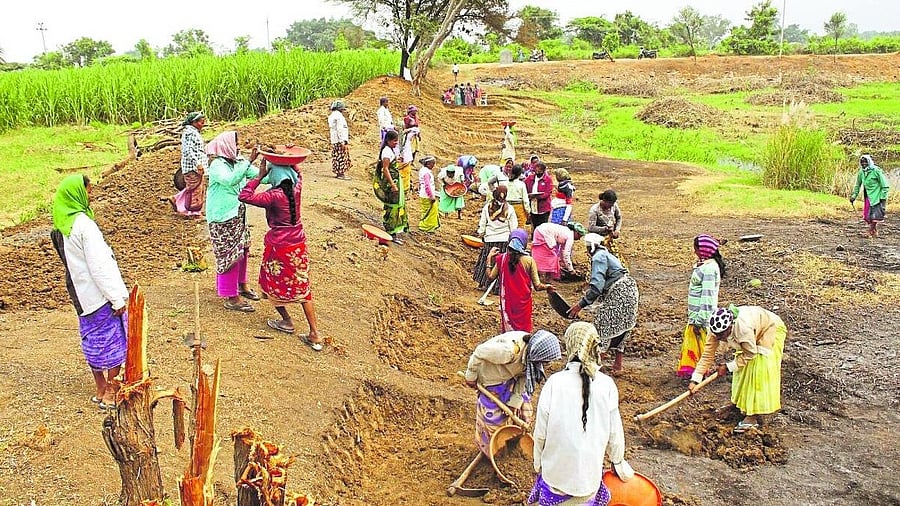
Normative allocation in VB–G RAM G Bill could threaten workers' access to guaranteed employment. In pic, villagers in Mysuru district participate in lake restoration work under the MGNREGA scheme.
Credit: DH Photo
At the heart of the debate over the Viksit Bharat- Guarantee for Rozgar and Ajeevika Mission (Gramin) Bill, or VB–G RAM G, versus the Mahatma Gandhi National Rural Employment Guarantee Act (MGNREGA) are two key constitutional principles at stake: federalism and the right to livelihood as included in the right to life under Article 14. The core issues do not lie in the renaming of the now-repealed MGNREGA, as emphasised by Opposition leaders since the new Bill was tabled, but in something far more significant: the redesign of an economic development framework centred on the country’s rural workforce.
The central vision of MGNREGA was to provide a measure of economic security to poor, landless and socially marginalised rural wage labour households, while simultaneously creating productive village-level assets through decentralised planning and participation. Without adequate safeguards and enabling provisions, VB–G RAM G risks turning India’s already marginalised workforce into a reserve pool of disempowered labour, with the Centre controlling how, when and where they are deployed to fulfil its vision of Viksit Bharat. This could exacerbate, rather than reduce, regional disparities and inter-state friction.
Had it adhered to its stated objective of empowering the rural workforce through enhanced livelihood guarantee, the two key provisions of the new Bill would have looked very different. The first deals with wages (Section 10) and the second lays down the funding pattern (Section 22).
Statutory minimum wages
Section 10 of VB- G RAM G mirrors Section 6(1) of MGNREGA, giving the Centre, rather than the states, the power to set wage rates. Constitutionally, this is the most violative section in both laws, disregarding workers’ fundamental rights. The non-obstante clause, which overrides the Minimum Wages Act, 1948, was introduced by the UPA government on the eve of tabling the MGNREG Bill. In 2010, rejecting the National Advisory Council’s recommendations, then-Prime Minister Manmohan Singh wrote back saying that “statutorily the wage rate under NREGA is delinked and independent of the provisions of the Minimum Wages Act.” Consequently, Clause 6(2), which notified the state agricultural minimum wages as the NREGA wages ceased to operate and 6(1) took effect — decoupling MGNREGA wages from minimum wages. Protests, letters from former Chief Justices of India and contempt of court proceedings were ignored.
MGNREGA wages have since created a new, unconstitutional ‘floor’ for millions of workers, a sub-subsistence wage below agricultural minimum wages. A 2025 report finds this to be the case in 13 major states. VB–G RAM G makes no attempt to correct this gross injustice.
For workers under MGNREGA, this effectively amounts to continued state-sanctioned exploitation. It violates multiple Supreme Court rulings that uphold that non-payment of minimum wages amounts to forced labour, prohibited under Article 23 of the Constitution. Even today, senior Congress leaders speak of “raising the NREGA wage” or “changing the methodology to protect it from inflation,” yet we do not hear them advocate for bringing the MGNREGA (or now VB–G RAM G) wage back under the Minimum Wages Act (or the Code on Wages, 2019).
The importance of statutory minimum wages for workers under MGNREGA, or any scheme that replaces it, is still widely misunderstood. International Labour Organization conventions and Supreme Court judgements make it clear that the “minimum” in statutory minimum wages is an inviolable floor, below which wages cannot legally fall. In contrast, the wages notified by the Centre under MGNREGA act as a ‘maximum’ rate, payable only if workers meet the required daily output. As a result, the actual wages received by workers are often even lower than these already abysmally low and unconstitutionally set rates.
Table showing additional burden on states due to VB-G RAM G.
Greater burden on states
The second major shift is the drastic change in the funding pattern under VB–G RAM G. Previously, total expenditure was shared 90:10 (Centre: States), with the Centre covering 100% of labour and administrative costs and 75% of material costs, and the remaining borne by the states. Under the new Bill, this is recalibrated to 60:40 for 18 states and one UT with legislature (excluding North-East and Himalayan states, and UTs without legislature). Now these 19 states/UT will presumably have to bear 40% under each of these heads.
Based on 2024-25 MGNREGA expenditure data, a rough estimate of the annual additional burden on these 19 states/UT works out to be Rs 31,513 crore. However, the actual figure could differ for two reasons: first, the expenditures provided only 50.24 days of work on average in 2024-25, half the guaranteed number of days; second, the final amount will depend on the Centre’s normative allocations for each state and the scheme’s coverage.
The financial memorandum to the Bill indicates that states and the UT would have to bear Rs 55,000 crore of the programme’s estimated annual cost of Rs 1.51 lakh crore, with the Centre covering Rs 95,600 crore. Any expenditure beyond the normative allocations will also fall on the states.
Another major change is the shift from demand-based labour budgeting by states under MGNREGA to normative allocations. The Centre will now decide, “based on objective parameters” set by bureaucrats, state-specific quotas from the predetermined Rs 1.51 lakh crore. It will also determine when, in which state, and in which region within a state, the scheme is notified. This effectively strips the programme of its universal guarantee, leaving rural households at the mercy of bureaucratic discretion. Unlike before, not every rural labourer seeking work is assured employment — they must be in the right state, region and time.
It is important to note that not all states will be affected equally. A quiet overhaul of MGNREGA has been in the works for some time. The Amarjeet Sinha Committee, tasked with reviewing MGNREGA and studying states’ expenditure trends and inter-state variations, submitted its report to the Centre in 2023 — but it has never been made public.
A media report suggests that the committee saw merit in “one form of MGNREGS for the whole country and another focused intervention for higher person days only for blocks/districts with a very high number of deprived households.” It recommended “increasing its use among low to moderate MGNREGS-use states such as Madhya Pradesh, Odisha, West Bengal, Assam, Bihar, Jharkhand” and “special policy interventions…to examine alternatives for MGNREGS in states with high to middle wealth index but currently having high use of MGNREGS such as Tamil Nadu, Andhra Pradesh, Telangana, Kerala, Himachal, Jammu and Kashmir and Uttarakhand.” These recommendations could have informed the making of VB–G RAM G.
Viewed alongside the new funding pattern, higher allocations to poorer states, while desirable, would also mean a greater fiscal burden, as they must contribute their 40% share. This self-defeating aspect of VB–G RAM G, which undermines the goal of reducing regional disparities, could have stemmed from misplaced fiscal conservatism. Additionally, the shift from a demand-driven to a data-driven process could leave many needy households behind, even in so-called high-to-mid wealth states.
More broadly, the funding debate touches the core of cooperative federalism. Both MGNREGA and now VB–G RAM G are centrally sponsored schemes (CSSs), which have long been a contested area in Centre-State fiscal relations. The XV Finance Commission has cautioned that such discretionary, cost-sharing schemes can impose burdensome requirements, especially on states with lower fiscal and institutional capacity and in that sense, “probably regressive.” It recommends that CSSs “should be flexible enough to allow States to adapt and innovate. Top-down mandates and strictures on programme implementation are the antithesis of an open-source model.”
VB–G RAM G clearly ignores this advice. Ironically, if the Bill aims to address inter-state disparities, it has done so without consulting the states.
(Sowmya Sivakumar is an independent writer)