
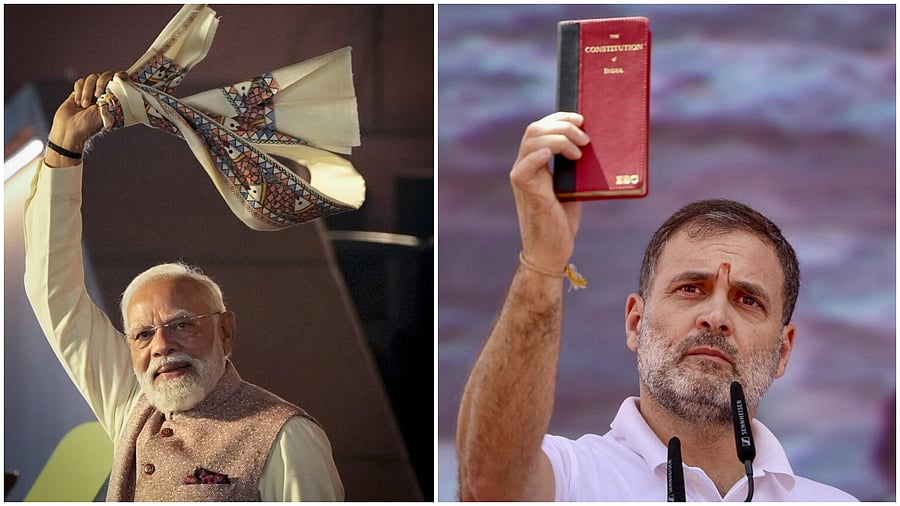
Prime Minister Narendra Modi (left) and LoP Rahul Gandhi.
Credit: PTI Photos
“Elections belong to the people. It's their decision,” former US President late Abraham Lincoln once said, and this quote nearly sums up the Indian political scene this year.
2025, despite having had only two Assembly elections, was a year dominated by electoral politics. As the year draws to a close, it is safe to say that the Bharatiya Janata Party (BJP) not only regained the ground it appeared to have lost after the 2024 Lok Sabha elections, but also reasserted its command over the electoral narrative.
Running parallel to this electoral dominance, however, was a persistent unease over democratic processes, with allegations of “vote manipulation” raised by the Opposition Congress and concerns around electoral roll revisions.
Before the dawn of another year, let's have a look at the biggest headline-grabbing episodes of Indian politics in 2025.
Saffron wave from Delhi to Bihar
The BJP returned to power in the national capital in February after 27 years. Arvind Kejriwal-led Aam Aadmi Party (AAP) was confined to 22 seats while the BJP won 48 seats in the 70-member Assembly. Later, Shalimar Bagh MLA Rekha Gupta took oath as the Chief Minister of Delhi.
Another electoral victory greeted the BJP-led NDA alliance in Bihar where Nitish Kumar managed to overcome both anti-incumbency and several ‘suspicions’ regarding his deteriorating health and was sworn in as the Chief Minister of the State for the tenth time.
The election results came as a big wake-up call for the Opposition Mahagathbandhan alliance which was restricted to just 35 seats in the 243-member Assembly, with the Congress proving to be the weakest link in the alliance.
The BJP emerged as the single-largest party with 89 seats followed by the JD(U) that won 85 seats.
As of now, the NDA is in power in 18 States and two Union Territories, excluding Manipur which is under the President's rule.
Rahul pushes back with 'vote chori' charge
The allegations surrounding the integrity of the election process in India is not new. The Congress and its alliance partners have raised concerns on use of electronic voting machines (EVMs) and have demanded a return to ballot paper on several occasions. This year, however, Leader of the Opposition (LoP) in the Lok Sabha Rahul Gandhi took the allegations further and accused the Election Commission of India (ECI) of colluding with the ruling BJP and allegedly favouring it.
Rahul held high-profile press conferences presenting “proof of voter manipulation” in several Lok Sabha seats and the Haryana Assembly polls. His claims sent shock waves from Haryana to Brazil, quite literally, as Rahul claimed a Brazilian model’s photograph was used 22 times in 10 booths in the Rai Assembly constituency during the 2024 Haryana elections.
At the same time, the ECI conducted Special Intensive Revision (SIR) of electoral rolls in several poll-bound States. The process began from Bihar, leading to Opposition parties accusing the poll body and the BJP of conducting ‘NRC in disguise’.
Karnataka and ‘breakfast table conversations’
After a lot of noise over change of guard in Karnataka, two breakfast meetings saved the Congress government from a public fallout, at least for now.
Following a bunch of round-trips to Delhi, as per Chief Minister Siddaramaiah and his deputy D K Shivakumar, there are no differences between them and the party high command has chalked out an agreement to be followed by both the leaders.
The Chief Minister has expressed confidence that the party leadership supported him to complete his full five-year term.
The Opposition BJP raked up the issue in the State Assembly and said political uncertainty over the top post was affecting the State’s development.
The speculation was fuelled by a rumoured "power-sharing" pact between Siddaramaiah and Shivakumar when the government was formed in 2023.
India retalites to terror
The year also saw two ghastly terror attacks in India — the Pahalgam attack in April and the Delhi Red Fort blast that happened in November.
The Pahalgam attack which claimed the lives of 26 civilians led to India retaliating with Operation Sindoor, a precise, retaliatory military operation in May 2025 against terrorist infrastructure in Pakistan and Pakistan-occupied Kashmir (PoK). In the following days, border tensions escalated between the neighbouring country until a ceasefire was called on May 10.
The ‘ceasefire’ worked as fodder for the Opposition as US President Donald Trump claimed that he brokered the India-Pakistan ceasefire by threatening the countries of snapping trade ties with them.
Legislature in limelight
Several Bills were passed by both the Houses of Parliament during different sessions with far reaching consequences for the laymen. Of these, the Waqf (Amendment) Act passed by Parliament in April and the VB-G RAM G Bill during the Winter session made the most noise.
The ruling BJP-led NDA has hailed the law as a step towards transparency and empowerment for backward Muslims and women in the community, while the Opposition has criticised it, alleging that it infringes upon the rights of Muslims.
The VB-G RAM G Act, which will replace the 20-year-old Mahatma Gandhi National Rural Employment Guarantee Act (MGNREGA), guarantees 125 days of rural wage employment every year. The Opposition strongly protested the removal of Mahatma Gandhi's name from the MGNREGA, and said that the government was putting the financial burden on States.
Parliament also witnessed the sudden resignation of Vice-President Jagdeep Dhankhar in July. Dhankhar’s unceremonious departure was largely attributed to him pre-empting the government’s moves on the removal of High Court judge Justice Yashwant Varma.
C P Radhakrishnan was sworn-in as the new Vice President in September.
Governor vs govt in Tamil Nadu
M K Stalin-led Tamil Nadu government and Governor R N Ravi remained at loggerheads with each other throughout the year.
After the Supreme Court's verdict on April 8, 2025 in the matter involving Bills vis-a-vis the Governor, the Tamil Nadu government notified 10 Bills (on April 12, 2025 in the government gazette).
The court had held that the Bills sent to the President by Governor Ravi following re-adoption by the Tamil Nadu Assembly were deemed to have been accorded assent. Later, the Supreme Court, however, in its advisory opinion in the matter of Presidential reference said that there cannot be deemed assent to Bills.
Tariffs, Taliban and thaw with China
As India-Pakistan hostilities reached an all-time high in recent years, India warmed up its stance on Taliban and assured of restoring the status of its mission in the capital of Afghanistan to that of an embassy along with restarting supporting development projects in the conflict-ravaged country.
External Affairs Minister S Jaishankar hosted the Foreign Minister of the Taliban regime in Kabul, Amir Khan Muttaqi, in October this year. Afghanistan, too, promised India that no group or individual would be allowed to use its territory against India.
India-US ties, on the other hand, mostly remained tense as Washington imposed 50 per cent tariffs on Indian goods, citing unfair trade practices and Russia oil imports. US is India’s largest export destination and the steep tariffs have strained the Modi-Trump bonhomie. Both the countries are yet to reach a trade deal.
China and India relations, meanwhile, witnessed a period of thaw as Prime Minister Narendra Modi visited China after a gap of seven years and met with Chinese President Xi Jinping on the sidelines of the 25th Shanghai Co-operation Organisation meeting in September.
The two sides took a series of measures to repair the ties, including the resumption of the Kailash Mansarovar Yatra and the resumption of direct India-China flights.
As India enters 2026, four States and a Union Territory — West Bengal, Kerala, Tamil Nadu, Assam and Puducherry — await Assembly polls amid the chaos of SIR. It will be interesting to note whether the Opposition will manage to overcome the defeats of this year to leave a mark on the electoral landscape or the ruling party will further tighten its grip. But, above the electoral battles, the unresolved unease over democratic institutions and federal balance needs serious consideration.