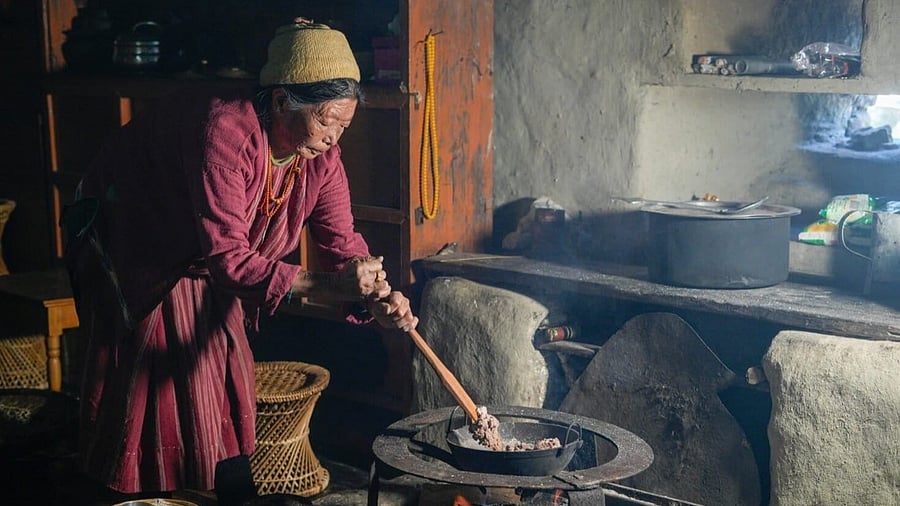
When 41-year-old Rinchin Jomba’s recipe for momo, a type of steamed dumpling, won the Millet Recipe Contest organised by the agriculture centre Krishi Vigyan Kendra in 2023, her joy transcended the thrill of winning an award. She had spotlighted the culinary heritage of her community, the Monpas. The contest was part of the International Year of Millets 2023 celebrations, in Arunachal Pradesh’s Chug Valley, nestled in the West Kameng district.
Jomba created her momo recipe using kongpu (finger millet) for the wrap and stuffing it with boiled locally-sourced potatoes and onion greens. Her goal was to reintroduce the indigenous kongpu, once very popular, to appeal to the changed palate of the younger generation.
In just a year, her millet momo has become a hit, among the local residents and tourists.
The Monpas have lived in the Tawang and West Kameng districts of Arunachal Pradesh for a long time. In Tibetan/Bhoti literature, ‘Mon’ generally refers to regions at a lower altitude compared to the Tibetan plateau and ‘pa’ refers to people. Monpa refers to the community living in the south of Tibet on the Himalayan slope.
For a tourist visiting the popular West Kameng and Tawang circuit, the momo (dumplings) and thukpa (a type of noodle soup) have become synonymous with Monpa food. Ironically, these dishes, now made with refined flour, are modern adaptations. Dumplings were part of the festive delicacies, where the wraps were crafted from bong (barley), and filled with vegetables, herbs, pork, and yak meat. Thukpa is more than noodles. A regular household variant, it is a roasted maize soup, with dried radish, local kidney beans, dried yak meat with a subtle touch of jabrang (Sichuan peppercorns), and seasoned lightly with salt.
Monpa food traditions
The Monpa community traditionally cultivated millet, barley, buckwheat and maize crops. The Brokpa, a sub-group of the community, specialises in rearing yaks, crucial to their cuisine and livelihood. Monpas have a rich knowledge repository of alcoholic beverages, dried and fermented foods, foraged herbs, berries, mushrooms, and meat from domesticated and wild animals.
While the tribe traditionally consumes meat, some sections consume only the meat of dead bovines like yak. Yak milk products, such as chhurpi, churkam, ghee and curd, have a significant presence in their daily diet.
The older generation reminisce that rice was unknown to most people three to four decades ago, with only certain varieties being cultivated in the valleys of West Kameng.
When wheat took over
In the mid-1960s, the Indian Army began establishing permanent military bases in Arunachal Pradesh. “The Army provided food, medicines, and other essentials,” Jomba says, adding, “Our father used to bring home atta (wheat flour) from the barracks — it was darker in colour, and it was from the Army that we first learned to make roti.”
Tsering Drema, a horticulturist from Dirang town in West Kameng, says that until then, they had never seen vegetables such as cauliflower, cabbage, or even tomatoes. “For example, the Japanese persimmon was introduced by the horticulture department in the late 1980s. Before its arrival, a wild variety with much smaller fruit was native to the region. Today, the new variety is propagated through grafting onto the native species, and persimmon harvests have boomed.”
In the 1980s, fair-price shops supplied rice, wheat, sugar, and kerosene extensively. The abundance of food led villagers to abandon the cultivation of labour-intensive crops and vegetables, impacting traditional food practices.
Pema Wange, a native of Thembang Heritage Village and Senior Project Officer at World Wide Fund for Nature (WWF) India, says the lack of proper education and medical facilities drove villagers to “migrate to urban settlements, leaving behind their traditional agrarian lifestyle.”
Rediscovering lost flavours
Jomba and seven other women operate a diner called Damu’s Heritage Dine in Chug Valley. Damu means ‘daughter’ in the local Duhumbi language. With support from WWF-India, the eatery has revived forgotten native ingredients and recipes. A seven to eight-course meal is prepared using homegrown and hand-picked forest produce in a traditional kitchen.
It begins with phursing gombu, a corn tart with the oleoresins of the Chinese lacquer tree, gently roasted in yak ghee over charcoal. The corn tart is followed by takto khazi puttang — buckwheat noodles with local herbs and fermented soybean and chilli sauce. The noodles are handmade in an indigenous wooden noodle maker called puttang shing.
Other dishes include the gunchung (buckwheat) thukpa, millet tacos (a contemporary recipe with native fillings), khurba (buckwheat pancake) with litho (wild pear) marmalade, fin brumsha chura kamtang (pumpkin and glass noodle stew), shya marku (chicken ginger and ghee stew), korsha (kidney bean stew) and dressi (local red rice fried in yak ghee with crushed walnuts and jaggery).
The dishes are served with a variety of chamin (chutney). “Monpa cuisine has a lot of chutneys made from seasonal berries and herbs,” adds Jomba.
Nishant Sinha, coordinator for community-based tourism with WWF-India, who led this initiative, explains that they aim to provide the local community with an alternative source of livelihood as an incentive to conserve their forests and natural resources.
Retrieving the lost recipes was a struggle. “The elders taught us a few, and since then, we’ve been rediscovering them one-by-one,” says Jomba. The next challenge was sourcing buckwheat, finger millet, and other native grains. The eatery is now encouraging the local community to resume growing them in the valley.
TWF.