
Frozen foods, and ready-to-eat heat-and-eat packaged foods are taking the drudgery out of cooking, writes Michael Patrao.The longer it takes to cook food, the tastier is the result. However, life in fast lane is in favour of fast food.
Instant mixes for making rice idli, rava idli, rava dosa, gulab jamun, khara bhath, upma and vermicelli payasam have been in use in the kitchen for quite some time now. Ready-to-eat snacks and heat-and-eat khara bath, bisibele bath, pongal and navaratna kurma have also followed.
Speed is the buzz word in the cooking of food. At the commercial level mechanisation has made life easier for the food entrepreneur.
In many highway dhabas in North India, where there is a great demand for lassi, especially during summer, lassi is churned in washing machines, exclusively used for the purpose. The roti making machine in the Amritsar Gurudwara makes 2,000 rotis per hour.
Vacuum-frying is exactly what it sounds like: putting food into a machine that pressurizes and cooks it with the use of hot oil, but at much lower temperatures than traditional frying methods.
At these temperatures the oil does not decompose so readily, so carcinogens are less present. During a low-heat/high-pressure fry, simple fruits and vegetables become superbly crisp and intense distillations of themselves.
Some studies even indicate that vacuum-frying retains more nutrients than traditional frying. Potatoes, sweet potatoes, and groundnuts are vacuum fried these days!
Food innovations have been driven by defence research across the world. American military scientists have developed the indestructible sandwich beginning with pepperoni and barbecued chicken varieties for soldiers on the move. It can survive air drops and rough handling and stay fresh for over three years, even in tropical conditions. Soldiers who tasted said they are “acceptable.”
Bangalore has the credit for supplying ready-to-eat items like bisibele bath, pongal, upma and khara bath to the army during the Kargil war. The retort packaging material provided by Defence Food Research Laboratory, has revolutionised food processing with ready-to-eat and heat-and-eat.
A retort pouch is a type of food packaging created by aseptic processing, made from multiple layers of flexible laminate, allowing for the sterile packaging of a wide variety of food and drink. It is used as an alternative to traditional industrial canning methods.
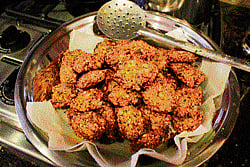
“Traditional snacks such as samosa, Mangalore bajji, vada (black lentil doughnut), masala vada and ambode can now be frozen and when refried can regain the freshness of freshly made snacks,” says P Sadananda Maiya, Centre for Food Science and Research. These snacks can be stored at -18 degree C or below. Defrost the required number of snacks for 2 minutes in microwave oven to bring it to room temperature naturally before frying.
Heat oil in a frying pan on a medium flame (aboout 180 degrees C). Transfer the snacks into pre-heated oil and deep fry till the crust turns golden brown. These products, which use frozen technology, have no added preservatives, artificial colours, transfat or MSG.
Attempts have been made to mechanise the dosa making.
A few years ago, a Chennai-based company, Dosa King, invented a dosa-vending machine and parked them in various places in the city. Dosa King wheezed and whooshed while you looked into its glass exterior to see its various arms and joints move to pour out the dough, squirt on the potato mix and fold the object into a small, but perfect, masala dosa. Dosa King failed to sustain. Perfect the fact that it was machine-made was only a novelty which faded over a short time. Or may be the idea far ahead of its time.
One of the lesser known facts concerning automatic dosa-making equipment happens to be a nugget of history. The first machine of its kind in India was contrived by three enthusiastic students of the Guindy Engineering College, Madras, way back in 1938. N V Shenoi, Hassan Marikkar an B James took on the challenge of getting the gizmo ready for the annual exhibition, always a big draw.
Working night and day at the College workshop, the machine was assembled within three months, and when unveiled it made hot news. Vistors piled up to watch it working, and what’s more, they heartily devoured the dosas turned out at the rate of one every two and a half minutes. No less a person than the Nobel Prize winner C V Raman, who watched the operation in fascination congratulated the trio who devised it.
The machine was later demonstrated at the prestigious annual Congress exhibition at Teynampet. It proved an instant attraction but the glory was short-lived. The exhibition was consumed by fire and the dosa maker and much else went up in flames.
The youthful ardour of the inventors died with the fire of 1938 and were in no mood to recreate their invention. The Second World war broke out not much later, and the dosa machine, the first in India, was soon all but forgotten.
South Indians go ga ga over their idli made of rice and black gram dal which tastes best when made at home. There are of course people who swear by joints where the delicacy is turned out “as if mom made it”. Idlis are always served fresh. No one ever thought fully cooked (as opposed to idli mix) idlis could be frozen and could be defrosted and eaten at one’s will. However, some years ago, Dave Annapoorna of Coimbatore attempted frozen idlis for export which were “reheatable”, something sacrilegeous for the traditional consumer of idlis. However, this experiment was short-lived. Now though, frozen idlis are in vogue!
Whether or not such fast and frozen foods are truly healthy is debatable, but they are certainly the life savers of the busy urban residents today.