
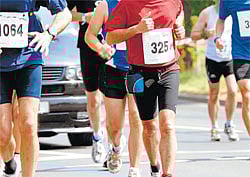
A marathon is a long-distance running event with an official distance of 42.195 kilometres, that is usually run as a road race. The event was instituted in commemoration of the fabled run of a Greek soldier, a messenger from the battle of Marathon, who ran to Athens to announce their victory of a battle. More than 500 marathons are held throughout the world, each year.
Bangalore hosts the International Midnight Marathon in the month of December every year . This year, the fifth one in a row, is going to be held today, at midnight, in Whitefield.
Walking and running boost a healthy life. The human body is designed for ‘movement’. Our ancestors would walk and run more than 20 kilometres every day. After the advent of transportation, this activity began to fade away and we have completely given up all kinds of physical activity.
Some also believe that walking and running will damage joints, cartilage, ligaments, tendons, muscle. On the contrary, walking and running will only strengthen the muscles and joints. More calcium will be deposited in the bones, and the bones become stronger.
This is good news for women who will have calcium depleted from their bones during pregnancy and child birth and menopause.
Physical inactivity will weaken the bones further. The only solution to this is pursuing vigorous physical activity regularly. Taking calcium supplements is not the only answer, although it may help to a certain extent.
Running 42.2 kms at a stretch, nonstop, requires tremendous stamina, endurance, strength and cardio-respiratory fitness. All this can be achieved through proper training. Running a marathon starts with the feet but ends with the mind. Apart from a strong body, a strong mind is very essential. Running will build a strong and toned body.
People of all ages can walk and run. The oldest marathoner is 100-year-old Fauja Singh, who finished the Toronto Waterfront Marathon in 8 hours, 11 minutes, 59 seconds, on October 16, 2011. It is not true that you should start running at a young age to be good at running. Any age is a good age to begin walking and running. Anyone can build their fitness at any age.
Avoid pain after a run
It is important to stretch after every running session. Stretching the lower limb major muscles is very important to keep the muscles in fresh and active state. This prevents muscle soreness and prepares the body for the next physical activity. One should not allow any contractions to stay in the body for a long time. After a run, relax the muscles and bring it back to a neutral state.
Cardio-respiratory fitness: For six months prior to the marathon, practise running on a treadmill and on a hard surface (road, park). Run 50 to 75 kilometres in a week. You can go up to a 100. A minimum is 30 kilometres a week, with an average of 60 kilometres should be the benchmark. Stop running one week prior to the marathon and continue to do other fitness activities.
Flexibility training: Suryanamaskaras and other yoga postures work the best to make one flexible. A flexible body helps in avoiding injuries
Body composition: It is the ratio of lean body mass to fat. Correct body composition can be tested through methods like ultrasound and electrical impedance to determine the ratio of muscle, fat, organs and water content of the body. This is very important for long distance runners. A light body is a great advantage for long- distance running.
Proper running gear is very important to increase efficiency and prevent injury. Thick cotton socks should be worn to prevent injury to toes. Petroleum jelly, applied to the toes and feet, will prevent friction while running.
Proper hydration during running (water and isotonic fluids) is important to prevent dehydration and cramping. Your feet should be immersed in cold water for 20 minutes after the run, to prevent a burning sensation under the feet.
All major muscles of the body should be strong for long distance running, not just the lower limb muscles. Upper body can be strengthened with regular pushups, shoulder presses, chest presses, biceps and triceps exercises, abdominal crunches and back muscle strengthening. Combine aerobic activity with muscle strengthening workouts.
What to eat
A balanced diet should have carbohydrates, proteins, fats, vitamins and minerals. Fibre and water are very important too. Proteins are essential for muscle building and repair of wear and tear. Fats are the source of stored energy.
(The write is Director, Skin Diagnosis Centre)