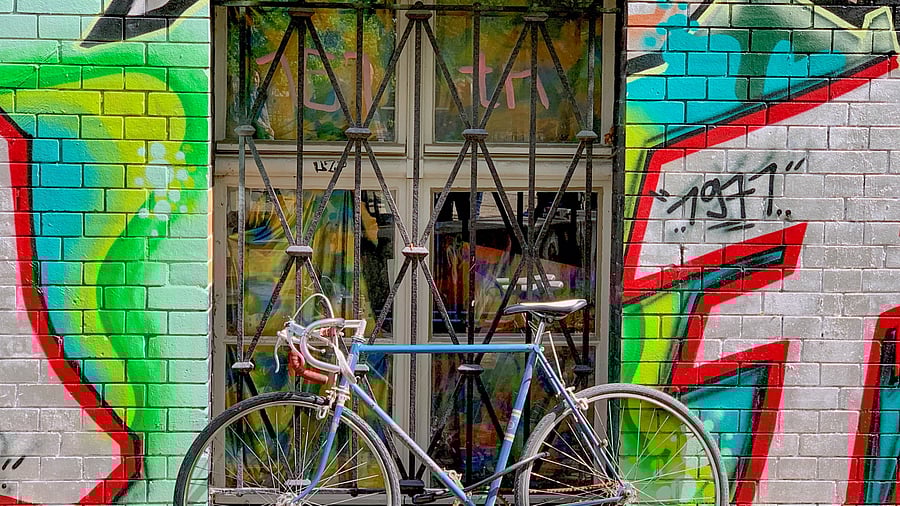
The colourful Kreuzberg.
A new kind of traveller is emerging, one motivated less by the desire to escape and more by the need to grow. Instead of chasing perfect beaches or the next must-post attraction, many are seeking experiences that shift something internally. These three journeys invite travellers to slow down, look inward, and reconnect with the world more deliberately.
For creativity: Berlin, Germany
Berlin has long served as Europe’s cultural laboratory, where ideas are tested and often boldly reimagined. At its centre lies Museum Island, a UNESCO World Heritage Site whose museums and galleries chart artistic and architectural history from antiquity to the present day. Yet even a brief detour from the popular hop-on hop-off bus route uncovers quieter pockets of experimentation. One such discovery occurs during an aimless walk that leads me to the Samurai Museum, a private, meticulously curated space dedicated to artefacts and art objects of the Japanese Samurai class.
Diversity drives the city’s ceaseless dynamism. On a guided food tour through Kreuzberg with Italy Novik, founder of Elements of Food, the extent of that vibrancy becomes clear. With a substantial proportion of residents born abroad, the neighbourhood’s culinary identity is layered. At Markthalle Neun, Italian chefs offer modern twists on heirloom recipes, while seafood stalls serve the freshest fish. The market itself is a microcosm of Berlin, experimental, and unafraid to blend traditional food ways with contemporary ideas. Between stops for traditional Kurdish fare and organic, new-wave small plates, music spills into the streets, with jazz riffs, electronic pulses, and experimental sounds. Studios and small galleries tucked into side streets pull visitors in. At one such space, I find myself wielding a paintbrush, adding a few strokes to a communal mural. In that moment, the appeal of creative cities becomes clear: participation feels natural, and curiosity is rewarded.
For the unfamiliar: Kashubia, Poland
Roughly 100 kilometres southwest of Gdańsk lies Kashubia, a region known for its lakes, quiet villages, and a distinctive cultural identity that has endured for centuries. The Kashubians continue to uphold their traditions, language, dress, mythology and crafts, despite waves of historical change. The best introduction to their world is in Wdzydze Kiszewskie at the Kashubian Ethnographic Park, a 22-hectare open-air museum showcasing the architecture and rural life of old Pomerania.
Here, farmhouses, peasant homes, churches and inns have been meticulously reconstructed, their interiors arranged to reflect life in times past. Many of the buildings double as workshops. I learn from a basket weaver who fashions crepe paper into bright flowers, and explore the art of Kashubian glass painting, its motifs, techniques, and designs. A school group practising the Kashubian language adds a gentle soundtrack to the afternoon.
Outdoors, children walk on stilts, play traditional games, and test wooden toys. A potato festival is underway, complete with the dishing out of sizzling plates of potato pancakes. With one in hand, I drift toward a nearby lake for a quiet boat ride. Life moves unhurriedly along the banks, and the unfamiliarity, far from disorienting, proves restorative.
For nature: Maria Island, Tasmania
A 90-minute drive from Hobart to the coastal town of Triabunna, followed by a short ferry crossing, brings you to Maria Island, one of Tasmania’s most immersive national parks. Car-free and largely off-grid, the island feels instantly remote: fern-draped forests, wind-sculpted beaches and dramatic coastal cliffs form a landscape shaped by millions of years. I base myself near Darlington, from where short treks lead to the island’s geological wonders. If you have the stamina (and the rewards are high), you can venture on one of the island’s longer bushwalks, with views of rugged headlands, ancient rock formations, and the Painted Cliffs. Bands of ochre, gold and russet swirl through the sandstone of these cliffs like frozen brushstrokes.
The old convict settlement at Darlington offers a peek into Australia’s most intact probation station. It preserves insights into convict life, reform experiments and the island’s use as an isolated place of punishment. The contrast of these Georgian-era buildings against the island’s wild beauty is striking. Coastal blooms, kangaroos and wombats gently nudge one onto a path of introspection.