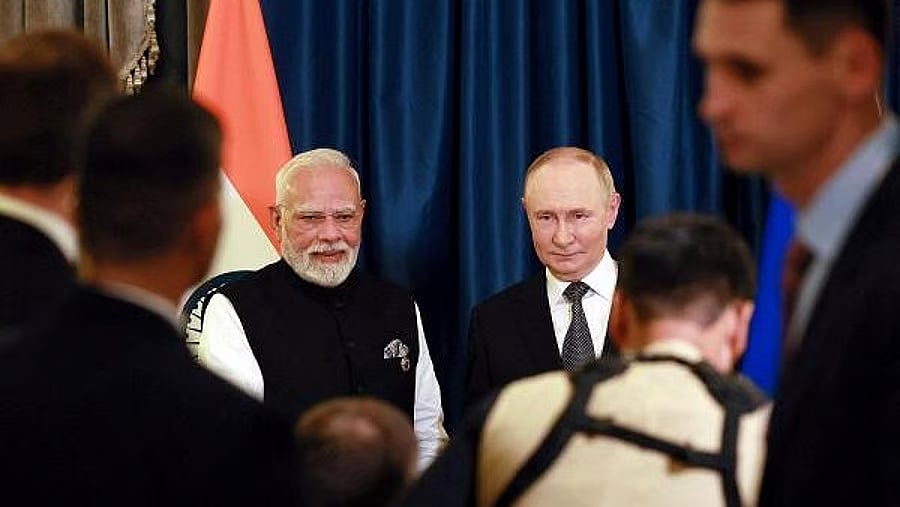
Russian President Vladimir Putin and Indian Prime Minister Narendra Modi.
Credit: Reuters Photo
The 23rd India-Russia annual summit on December 5 will put to the test not just New Delhi’s stated policy of strategic autonomy, but also its diplomatic skills, seeking as it is to balance its ties with Moscow and Washington as they face-off over the Ukraine war.
New Delhi is signalling the importance of its long-standing robust ties with Moscow by designating Russian President Vladimir Putin's trip to New Delhi, the first since Ukraine’s invasion, as a ‘State Visit’. This is noteworthy, especially at a time when its ties with Washington are particularly frayed.
Ahead of the summit, India has asserted that it wants to strengthen the ‘Special and Privileged Strategic Partnership’ with Russia. Even so, India is likely to tread carefully, at least for public consumption, lest it raise the hackles of the United States and its Western allies arrayed against Russia. Putin, on the other hand, will be looking to see some big-ticket gains from his India visit to convey to the West that he has a strong ally in India.
To be sure, India would not like to jeopardise the trade deal it’s trying to work out with the US, even though it would not like to be seen as completely capitulating to the Donald Trump administration’s bullying. Neither would it want to alienate European countries as it heads into an India-EU summit next month where the two sides are hoping to finalise an FTA.
India has been caught in the crosshairs of heightened US-Russia tensions even as its relations with the Trump administration have nose-dived sharply due to Washington imposing 50% tariffs on imports from India, including a 25% penalty for the purchase of Russian oil.
There was further arm-twisting by the Trump administration after it announced restrictive sanctions on its Russian crude purchase, forcing India to curtail its crude imports. This is a huge setback for India as it had turned to Russian crude, offered at discounted rates, to bolster its energy security.
It is amid this backdrop that the India-Russia summit assumes tremendous significance. India knows well the benefits of a close engagement with ‘time-tested partner’ Russia. The two sides acknowledge a ‘strategic convergence’ of interests, with energy and defence being among the key pillars of bilateral ties.
Over the last three years, India became a leading buyer of Russian crude, citing ‘strategic autonomy’ and ‘national interest’ to do so even as Western nations shunned Russia. Undoubtedly, discussions on how to navigate the energy trade will figure prominently during the Modi-Putin meet.
Russia would be keen that India continue with its oil purchases using alternative methods to continue with its imports. It is, however, doubtful that New Delhi would be willing to go out on a limb to continue buying Russian oil, though expanding civil nuclear co-operation will certainly be on the table.
While a curtailment of Russian crude purchases by India may be a setback for both, their energy partnership will continue apace. It’s noteworthy that India has investments in Russia’s oil and gas sector. Likewise, Russia too has investments in India’s oil, gas, and petrochemicals sector.
The already expansive defence partnership, the cornerstone in bilateral co-operation, too is expected to receive a further impetus at the summit. Here again, India has faced pressure from the US over the years to buy more defence equipment from it rather than Russia. Russia remains the largest arms supplier to India, though the latter has been increasingly turning to the US, France, and Israel for military hardware and software.
India’s plan to acquire more S-400 air defence systems, as well as replenish stocks of its surface-to-air missiles that were used during Operation Sindoor, will also be on the table during the summit. New Delhi is also keen Moscow sticks to its promise of delivering by November 2026 the remaining two of the five S-400 squadrons contracted earlier, which have been hugely delayed due to the Ukraine war.
New Delhi will also be hoping to get a sense of Moscow’s views on the 28-point peace plan proposed by Trump to end the Ukraine conflict. For New Delhi, an end to the conflict would also mean that crude supplies from Russia can continue unhampered.
India, of course, is deeply concerned about the fast-expanding strategic ties between Russia and China. Having faced the brunt of China’s territorial aggression, the summit offers India the opportunity to make certain the Moscow-Beijing clinch does not adversely impact its own security interests.
Strategic autonomy in the face of major diplomatic challenges can be an extremely difficult ballgame. India needs to play its cards well, and ensure its standing on its own rights on the world stage.
(The writer is a senior journalist)
Disclaimer: The views expressed above are the author's own. They do not necessarily reflect the views of DH.