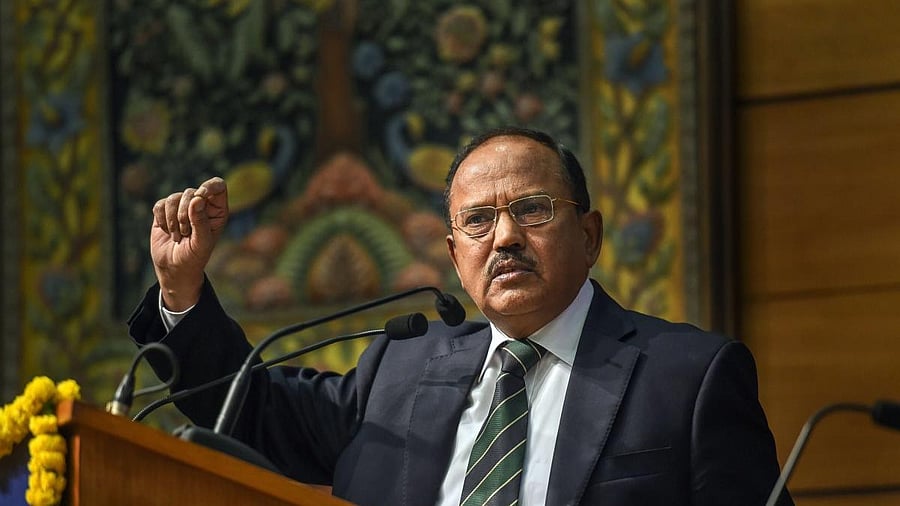
National Security Advisor (NSA) Ajit Doval.
Credit: PTI photo
When India’s National Security Adviser Ajit Doval recently declared that the nation should “take revenge” for its painful history of attacks and subjugation, the danger lay not merely in the sentiment itself, but in the authority from which it emanated.
The NSA’s responsibility is not to voice civilisational grievance, but to secure India’s strategic interests in a volatile regional and global environment. His office demands sobriety, foresight, and an unrelenting distinction between emotion and statecraft. When the custodian of national security invokes revenge as a guiding principle, policy risks being recast through wounded memory rather than measured strategy.
Nations that allow historical pain to become a permanent moral compass often confuse strength with retaliation and purpose with resentment. In a nuclearised, interdependent world, security rests not on the theatrics of retribution, but on restraint, credibility, alliances, institutional depth, and the long discipline of diplomacy. To substitute this with the language of vengeance is to lower the threshold between grievance and action, inviting a politics in which history is not understood, but weaponised.
The idea of a nation perpetually consumed by vengeance against real or imagined injuries is profoundly flawed. It is especially troubling for a civilisation that should, by now, have learned to look forward rather than remain imprisoned by its wounds, real or fictional.
When grievance becomes the organising principle of national life, memory turns into malice, and justice into a theatre of retribution. The past, which ought to instruct, is reduced to an unending reservoir of anger. Then, the future is not imagined; it is merely deferred.
Every society carries scars — wars, invasions, partitions, humiliations, and betrayals; these are part of the human story. History is not a museum of triumphs, but also an archive of pain. Mature nations metabolise this pain, acknowledging it without allowing it to become their sole compass. They understand that remembrance is not resentment: the former deepens wisdom, the latter impoverishes it.
The danger of grievance-based nationalism lies not merely in its emotional tone, but also in its political consequences. A nation trained to see itself as a victim begins to require enemies for coherence. If none exist, they must be invented. Thus, minorities, dissenters, intellectuals, migrants, artists — anyone who complicates the story of innocence and injury — becomes suspect. Complexity is seen as betrayal; nuance as weakness. The world is divided into those who ‘belong’ and those who do not.
In such an atmosphere, politics becomes the ritual of settling scores. Elections are framed as battles for historical revenge. Policies are justified not by their capacity to improve lives, but by their ability to symbolically punish imagined enemies. The State becomes less a vehicle of collective aspiration than an instrument of emotional compensation. This is unsustainable. Nations collapse not because they forget their past, but because they cannot imagine a future.
To build is to imagine; to govern is to anticipate contemporary challenges and prepare accordingly. Roads, schools, hospitals, universities, scientific institutions, cultural spaces — these are signs of a forward-looking nation. They require patience, generosity, and a belief that future generations deserve more than the current one. Vengeance, by contrast, is temporally shallow, living in a perpetual ‘yesterday’. It draws its energy from what was done — not from what could be achieved.
A politics of perpetual grievance is structurally incapable of development. It can mobilise crowds but cannot sustain institutions. It can generate passion but not policies to address inequality and vulnerability. It can win elections but cannot produce hope. It keeps society emotionally inflamed while leaving it civically undernourished.
History offers repeated warnings. Societies that define themselves primarily through humiliation — real or fictional — spiral inward. They grow suspicious of the world, allergic to criticism, and obsessed with symbolic victories. They invest more in monuments than in minds, more in spectacle than in systems. Over time, the language of public life changes. What is lost is moral courage: the courage to say that the past matters, but it does not own us; that suffering deserves recognition, but not endless reproduction; that identity is inheritance, not imprisonment.
Civilisations endure not because they remember everything, but because they know what to carry forward and what to lay down. There is a profound ethical distinction between honouring history and weaponising it — especially by collapsing the distinction between what was real and what is imagined. The former invites reflection; the latter demands allegiance. A nation that endlessly rehearses its hurts confuses pain with purpose, mistaking emotional intensity for moral depth. Without reflection, suffering becomes a resource to be mined, not a lesson to be learned.
This is why the language used by those in positions of power matters. Leaders do not merely describe reality; they shape it. Their words calibrate what is thinkable, permissible, and desirable. When senior custodians of the State speak in the idiom of revenge, they legitimise a framework in which injury becomes entitlement and rage becomes policy. Governance begins to resemble grievance and revenge.
National security is not the militarisation of memory, but the creation of conditions in which society can live without permanent fear — of external threat, internal fracture, or historical erasure. It is about resilience, not retribution; stability, not spectacle. Statesmanship consists precisely in resisting the seductions of emotional clarity. Revenge is simple: it divides the world neatly into victim and villain, absolving us of self-scrutiny while offering the intoxication of moral certainty. Strategy is difficult: it must operate in shades of grey. The leadership’s task is not to amplify grievance, but to transform it. This does not mean erasing history or silencing wounds, but situating them within a larger narrative of becoming.
A forward-looking nation does not forget; it refuses to let memory — real or imagined — become destiny. The highest tribute to past suffering is not vengeance, but the creation of a society in which such suffering need not be repeated. It builds institutions strong enough that injury need not be inherited as identity.
The future is built by those who know when to close the ledger and open a map. India, with its layered histories of conquest and coexistence, trauma and transcendence, is ill-served by a politics that reduces its civilisational inheritance to a single emotion.
This is a land of philosophies of renunciation and renewal, traditions of dissent and dialogue, languages of reconciliation and repair. Its endurance has never rested on purity or permanence, but on its extraordinary capacity to absorb, adapt, and reimagine. To shrink such a civilisation into perpetual grievance is to misunderstand its genius. Greatness lies not in being perpetually aggrieved but in remembering without being consumed, honouring without hating, and moving forward without denying where one has come from.
An appeal, then, to those entrusted with the gravest responsibilities of the State: a nation worthy of its history is one that does not remain trapped inside it. Security lies not in rehearsing ancient injuries, but in building a future expansive enough that those injuries no longer define who we are.
Manoj Kumar Jha is an RJD leader, Member of the Rajya Sabha, and the author of ‘In Praise of Coalition Politics and Other Essays on Indian Democracy’. X: @manojkjhadu.