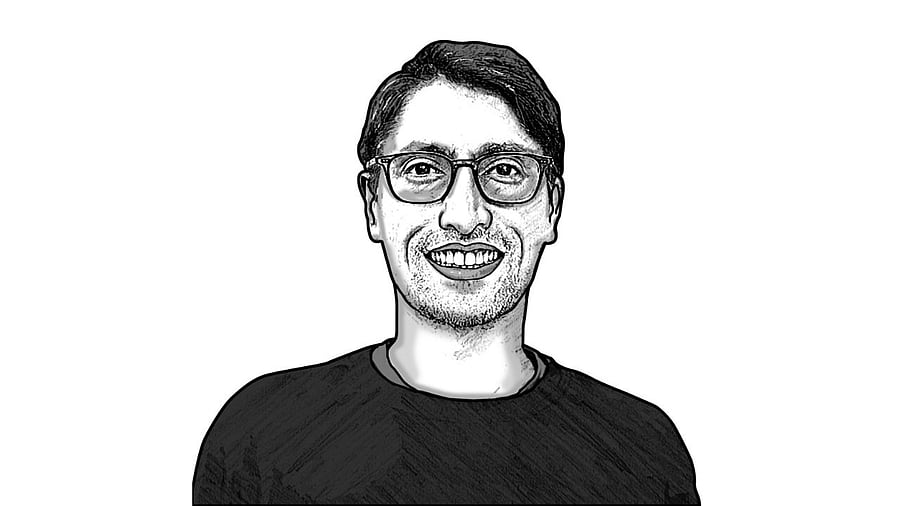
Aakash Singh Rathore as Dr Jekyll is a Professor of Philosophy, Politics and Law, author and editor of over 20 books and counting, and as Mr Hyde, one of India’s top-ranking Ironman triathletes  @ASR_metta
‘I pulled into Nazareth, was feelin’ about half past dead/ I just need some place where I can lay my head/ “Hey, mister, can you tell me where a man might find a bed?”/ He just grinned and shook my hand, “No” was all he said.’
English delights in collective nouns that turn the ordinary into the poetic: a ‘crash’ of rhinoceroses, a ‘parliament’ of owls, a ‘murder’ of crows. For albatrosses – those vast, effortless gliders of southern oceans – tradition gives us a ‘weight’ (like The Band’s surrealistic 1968 song). I have begun, in private whimsy, to call them a ‘paradise’ of albatrosses. At first, the phrase conjures pure bliss: a celestial flock soaring above endless turquoise, unbound by gravity. Yet on this first morning of February in 2026, with Republic Day just behind us, the phrase sharpens into something more contradictory. It names the quiet burden we carry in a Republic that proclaims equality and fraternity while still asking us to shoulder heavy, arbitrary weights.
Coleridge’s Ancient Mariner, forced upon many of us in school, made the albatross the enduring symbol of this duality. The bird arrives as a blessing, guiding the ship through impenetrable ice, only to be shot on impulse and hung, dead, around the mariner’s neck – a self-inflicted curse of guilt that outlasts the storm. In contemporary India, we carry similar albatrosses, often not imposed by others but chosen and renewed by ourselves. Privileged castes cling to advantages long after justice demands their surrender; voters and leaders remain loyal to dynastic politics long after democratic vitality has drained away; we mourn the betrayed constitutional ideals yet rarely confront the source of that betrayal. These are not private failings, but systemic burdens that we voluntarily refresh in the name of tradition or security, even as they pull the Republic deeper into stratified despair.
This reminds me of the insidious albatross paradox – sometimes wryly called “birds of a paradise”. It is a philosophical thought experiment that exposes the absurdity of choice in a supposed utopia. Imagine a true paradise: scarcity eradicated, conflict eliminated, perfect equity achieved. No one lacks anything; no one suffers injustice; every need is met without struggle or competition. All meaningful problems have been solved. Only one trivial task remains: you must feed one of two albatrosses standing in front of you. The birds are identical in every way – appearance, health, temperament. Feeding the left or the right changes nothing for the world or for you. It’s an ultimately inconsequential outcome.
But you must choose. The human mind, built for purpose and justification, cannot simply abstain or declare the options equal. You hesitate, invent distinctions, weigh phantom consequences, and finally decide – then you craft elaborate reasons to convince yourself that the choice mattered. A trivial act becomes a persistent demand to find meaning where none exists. This paradox distils Albert Camus’ idea of the absurd: the painful collision between our hunger for meaning and a universe that offers none.
A just Republic is meant to be humanity’s nearest approach to paradise – a system crafted to deliver equality, fairness, and shared prosperity. Instead, it confronts us with endless arbitrary forks. Which policies to prioritise when resources are finite, which groups to accommodate in moments of compromise, which vision of the nation to elevate – these decisions often resemble the choice between identical birds. The long-term effects may be indistinguishable, yet we clothe them in ideological certainty, declaring one path morally superior while vilifying those who chose the other.
Beneath the messaging of “unity in diversity”, lie exactly these forks: reservations, economic reforms, language policies – choices that in the future will boil down to left hand or right, but justified with grand narratives only serving to deepen fractures along caste, class, region, and religion, the fraternal healing of which was the true goal of the Constitution and of our Republic.
‘Take a load off Fanny/ Take a load for free/ Take a load off Fanny/ And you put the load right on me.’
Sedition laws linger, critical media voices are muted, environmental disasters displace the vulnerable, and policy repeatedly tilts towards the powerful. These burdens continue calcifying: inequality normalised as inevitable, arbitrary governance rebranded as pragmatism. Why do we keep carrying weights the Constitution explicitly promised that we could lay down?
We can challenge the absurd choices pressed upon us and demand a true reckoning with the burdens that mock our founding ideals. The albatross, after all, is built for flight despite its size; it reminds us that we, too, are capable of rising even while carrying weight.
‘Take a load off Fanny, take a load for free’.
(The writer, as Dr Jekyll is a Professor of Philosophy, Politics and Law, author and editor of over 20 books and counting, and as Mr Hyde, one of India’s top-ranking Ironman triathletes.)
Disclaimer: The views expressed above are the author's own. They do not necessarily reflect the views of DH.