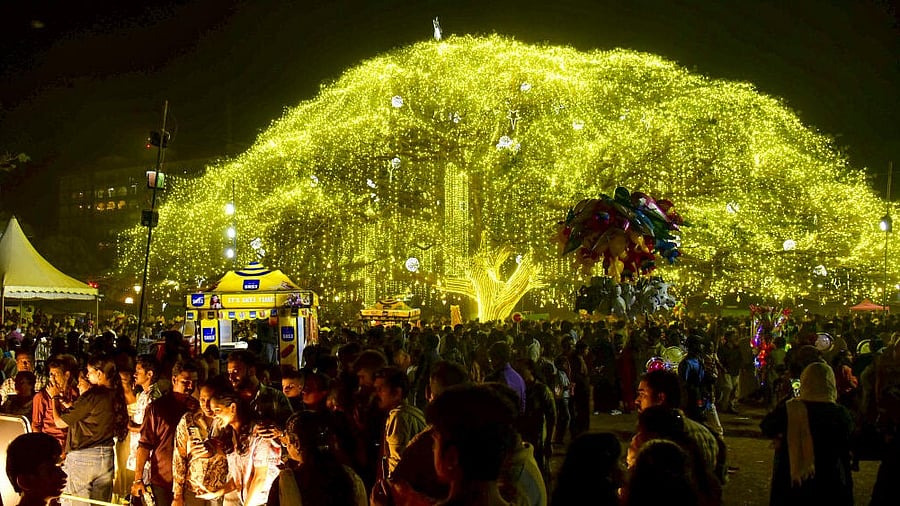
People gather as the 80-foot tall 200-year-old rain tree is illuminated with lights and decoratives during the Christmas festival celebration, at Veli Ground, in Kochi, Kerala.
Credit: PTI Photo
Christmas is a time for spiritual reflection, peace, love and shared joy. Sadly, in India, this universal feast unfolded under a shadow of fear and tension, marked by attacks, intimidation and harassment of Christians in the name of alleged religious conversion.
Disturbingly, incidents targeting Christmas celebrations were reported from across the country. These are only some of them.
In Bareilly, Uttar Pradesh, Bajrang Dal workers recited Hanuman Chalisa in front of St Alphonsus Cathedral Church. In Rajasthan’s Nagaur district, a private school principal alleged that a group claiming to be Bajrang Dal members threatened students and staff over Christmas celebrations at the institute.
In Kerala, the Lok Bhavan cancelled the Christmas holiday, and the chief postmaster general called off celebrations in post offices. In Pudussery, Palakkad, a group of carol singers, including children, was attacked.
In Nalbari, Assam, VHP-Bajrang Dal workers vandalised Christmas celebrations in a school and damaged festival items at shops. In Haridwar, Uttarakhand, a hotel run by the state tourism department cancelled celebrations on the banks of the Ganga following protests.
However, Prime Minister Narendra Modi attended the Christmas morning service at the Cathedral Church of Redemption in Delhi and later posted on X: “The service reflected the timeless message of love, peace and compassion. May the spirit of Christmas inspire harmony and goodwill in our society.” A laudable gesture indeed, but the irony could not have been starker.
As Tamil Nadu Chief Minister M K Stalin rightly observed, “When a few right-wing violent groups, acting in the name of the majority, indulge in attacks and riots, even as the prime minister participates in Christmas celebrations, it sends a disturbing message to the nation.”
While the disruption of Christmas celebrations has been widely condemned, it is imperative that the continued, blatant harassment of Christians—particularly through the controversial anti-conversion bills brought in several states across India—is brought to an end.
According to the latest figures from the civil society group the United Christian Forum (UCF), there were 706 incidents of violence targeting Christians between January and November 2025, compared to 834 incidents in 2024. Uttar Pradesh recorded the highest number of attacks (183), followed by Chhattisgarh (156). Karnataka reported 57 incidents, while Rajasthan is next with 49 reported incidents.
These incidents reveal a coordinated pattern of targeting that combines physical violence, social pressure, and legal mechanisms to suppress Christian religious expression. In many of these cases, rights activists point out, no FIR is filed—sometimes even when formal complaints are made. In other situations, victims are afraid to approach the police, fearing the case will be turned against them and false charges filed.
Christians are routinely accused of forcible conversion, a claim that has vehemently been denied. Christians constitute less than 2.4% of India’s 1.4 billion population, a figure that has remained unchanged since the 1951 Census.
If forcible conversions are indeed taking place, as alleged by the vigilante groups, they must be challenged and proven in courts of law. Courts have repeatedly pointed out the lack of evidence to support such claims and have affirmed that adult citizens are free to choose their faith. Thus far, no one has been convicted for forcible conversions. The Freedom of Religion Laws, known as anti-conversion laws, are in effect in 12 Indian states.
Historically, Christian missionaries have played a multifaceted role in India, contributing significantly towards education, healthcare, language development and social reform, including campaigns against sati, child marriage and caste discrimination. To accuse Christian organisations of forcible conversions reflects selective amnesia and the belittling of minorities to serve select ideological ends.
Church leaders are unanimous that these attacks represent a systematic and deliberate attempt to polarise society and “put minorities in their place”. Others believe the aim is to intimidate the community through hate speeches and the vandalisation of churches and educational institutions.
It is not that the Christian leadership has remained silent. Concerns have repeatedly been raised with authorities, including those at the highest level of power. In light of the continuing attacks, the UCF has written to the PM, drawing his attention to the growing targeted violence and hostility faced by Christian citizens and seeking his urgent intervention.
Unfortunately, the silence of the powers-that-be is deafening. As long as there is no unequivocal condemnation of hate crimes, this ugly trend will persist, regardless of appeals from religious leaders, social activists or interfaith organisations.
Unless the normalisation of violence against Christians—as well as Muslims—is halted, the constitutional guarantees of religious freedom and the very idea of a secular India will be rendered meaningless.
(The writer is a Bengaluru- based independent journalist)
(Disclaimer: The views expressed above are the author's own. They do not necessarily reflect the views of DH.)