
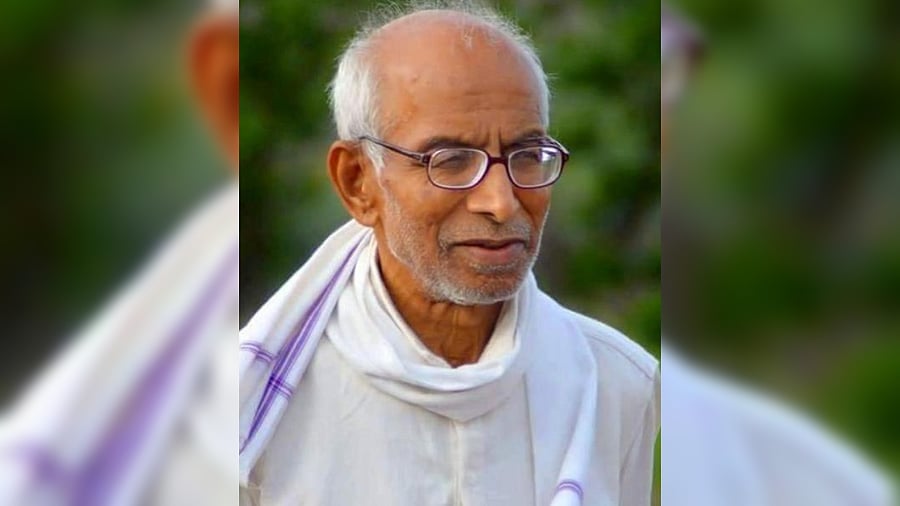
Siddheshwar Swamiji
Credit: DH Photo
We have seen innumerable confluences of law and literature. Justice Bopanna (former judge of the Supreme Court, renowned for his subtle wit) humorously quipped that for lawyers, a modified version of “where there is a will, there is a way” applies — where there is a will, there is litigation. But rarely have we seen a will metamorphosing into literature.
Siddheshwar Swamiji’s will, perhaps for the first time anywhere in the world, deserves the epithet of literature. Its unique title – ‘The Final Salutation’ – is a herald to what is to follow.
In a two-page will peppered with 24 short, poignant sentences and four neat sections, Swamiji delivers his parting message and instructions. In Section A, he explains what life, Sadhana, Dharma and the path to universal peace and happiness are. Section B expresses Swamiji’s reflections on his life and his gratitude to those who enriched his sojourn. Section C is Swamiji’s soliloquy of a man witnessing his own life fading, and in Section D he issues express instructions on how to deal with his mortal remains.
Section A of the will is Swamiji’s message – a crystallisation of years of penance:
“1. Life is a flood of experiences;
2. Life’s richness stems from constant reflection about the world and an incessant quest for truth; life’s beauty is enriched by a life free from unending desires and hatred and by boundless affection for one and all;
3. All that makes such an enriching life possible is Sadhana;
4. Sharing useful experiences of such a life with the interested is Dharma.
Such a life brings peace to one and all.”
In the autobiographical Section B, Swamiji describes his journey — a life that is placid, spontaneous, and without needless impulsiveness. He pays homage to his guru, saints, well-wishers, friends, sadhakas and one and all, and says: “I have lived a simple, contemplative life free from impulsiveness;
The one who shaped it is Gurudeva.
The ones who further chiselled it are the revered people of the land, well-wishers, sadhakas and the enlightened ordinary folk….”
The will transforms into peerless literature because every word is carefully chosen. For example, Swamiji uses Shree Samanyaru instead of Sarve Samanyaru – expressing the truth he has seen: that ordinary people are endowed with Shree, or a prosperity or enlightened simplicity that only a seer’s eyes can perceive. His ode to nature is equally breathtaking. He also expresses his gratitude to philosophers and scientists worldwide whose explorations have expanded his horizon.
Section C is Swamiji’s soliloquy of a now ebbing life. He says, “Life is dwindling like a flame burning out, a wave receding and a cloud pouring, and what remains is only vast openness, absolute silence and the truth of shoonya!” and that this final salutation is penned to pay tribute to this wonderful world and the peoples and things that helped Swamiji understand and experience the richness of life.
He then proceeds to give precise instructions on how the body is to be dealt with – that it shall be cremated instead of buried; funeral rites are unnecessary; ashes are to be dispersed in a river/sea; and finally, that no monument or memorial shall be built. When Swamiji says funeral rites are unnecessary (rather than an injunction
not to, unlike his other instructions), one is left wondering about the understated message – of a life that has attained
the ultimate realisation of shoonya needing no more earthly prodding!
Swamiji ensures that the will is attested by two judges so that no questions will be asked posthumously about his will’s validity – exemplifying how he seamlessly transformed from a seer who politely and graciously declined honours and awards to being adept at the ways of the world. The will is unconventional in more ways than one and therefore had to be legally ironclad.
In the penultimate paragraph, Swamiji quotes the 12th-century seer Allama Prabhu’s vachana – about the dissolution of truth, falsehood, identity and existence itself into an infinite openness or void – at once conveying both Swamiji’s understanding of the spiritual ideal and his tribute to the vachanakara who perhaps influenced him the most.
Swamiji’s conclusion with the salutation in Sanskrit conveys Swamiji’s love and gratitude to another language that he was a master of – yet another lesson to us in these divisive days. It is one of those rare or first-of-its-kind wills that leaves behind no property but a very rich legacy.
(The writer is an advocate practising in the Karnataka High Court)