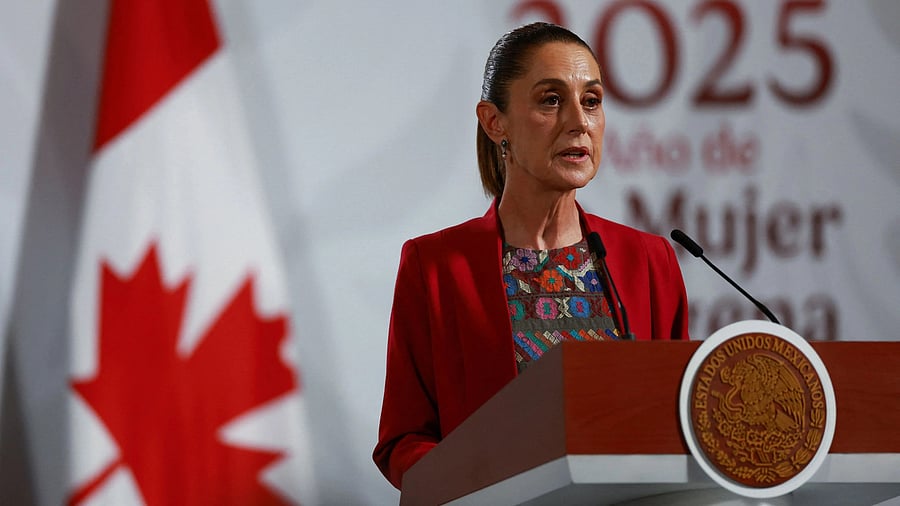
Mexican President Claudia Sheinbaum speaks during a press conference.
Credit: Reuters Photo
By Mihir Sharma
When the Mexican Senate voted last week to approve a 50% tariff rate on a broad swathe of countries – China, India, Brazil, South Korea, Vietnam, and Taiwan among them – politicians from President Claudia Sheinbaum’s ruling Morena party pretended they did it for their own reasons. Nobody in Asia believes that this is a bold declaration of economic independence, however.
It’s seen instead as opening a new and unexpected front in Donald Trump’s trade war on the world.
The vote waived the senators’ usual right to discuss amendments in committees, and it passed 76-5, with the opposition abstaining. Officials grandly delivered the usual lines that accompany measures cutting off trade: That they would protect local industry, that revenue would increase by almost $3 billion, that there would be more money to spend on supporting the unemployed.
But the real reason is that Sheinbaum is spooked by the deadline, six months away now, for reviewing the US-Mexico-Canada Agreement.
The speed with which she pushed the legislation through and its timing are no coincidence: Trump said earlier this month that he might let NAFTA’s successor expire, or “maybe work out another deal” that ensured the US wasn’t “taken advantage of.” Nobody wants that can of worms reopened.
About 80% of Mexico’s exports cross its northern border, and more than 80% of those are tariff-free under USMCA. The country depends upon US markets for 30% or so of its output. Mexican politicians are clearly scared enough that even acts of economic self-harm, like 50% tariffs, seem worth trying.
For the countries affected by the new rates out of Mexico City, this is a sobering reminder that they have more than just the US president to deal with. Trade is a complicated, disaggregated affair, which is why we have multilateral arrangements like the World Trade Organization. For much of 2025, we could pretend that wasn’t the case, with everyone scrambling to conclude their own bilateral deal with the US. But Sheinbaum shows that the trade conflicts Trump has launched are a cascading war, not some controlled confrontation.
Some will be hit particularly hard. One of the few industries in India that has carved out a successful export niche for itself is auto components. New tariffs may render them uncompetitive inputs for the giant factories along the US border serving America’s insatiable appetite for cars.
But a significant proportion of Indian exports to Mexico aren’t about the US at all. It is consistently among the top three or four destinations in the world for small, fuel-efficient cars, for example. These aren’t meant for Americans, but they’ve been hit with tariffs anyway. Sheinbaum is paying Trump protection money, but she’s taking it from the pockets of Indian producers.
And from her own citizens, of course. Opposition lawmakers pointed out that official modelers had given up on trying to estimate the effects of such a drastic change to Mexican trade policy. Citgroup’s economists think that this will keep domestic inflation above 4% next year. All the other downstream, predictable effects of tariffs will apply: loss of competitive advantage, factories that face supply crunches, retaliation in fields where you don’t expect it.
And what happens if Trump decides that he doesn’t care about such expensive professions of loyalty, and shuts down USMCA anyway? Mexico City will have to rebuild trade relations with the rest of the world from scratch, but capitals from Brasilia to Beijing may not be particularly warmly disposed at that point.
Many countries in Asia had hoped that America-first trade policy – even if disruptive – might end up forging a united front against Chinese dominance of manufacturing. Sheinbaum’s surrender shows us a different path. In this alternative world, some countries will quietly enact the US president’s policies for him. The others will, perhaps with China in the lead, find a multilateral path to isolate collaborators.
Countries across Asia and beyond now know that it isn’t just their relationship with the US that is threatened, but with multiple other nations as Trump tries to push everyone into his dream, high-tariff world. He has already asked the European Union, for example, to impose 100% tariffs on China and India. It is unlikely to agree. Some countries will raise high and unpredictable trade barriers against each other and the world, while the rest will seek security and prosperity by integrating faster and further. Sheinbaum may have picked the wrong side.
In his first term, Trump promised to have Mexico pay for his wall. In his second term, he has succeeded. So what if the wall is one of tariffs, and not bricks?