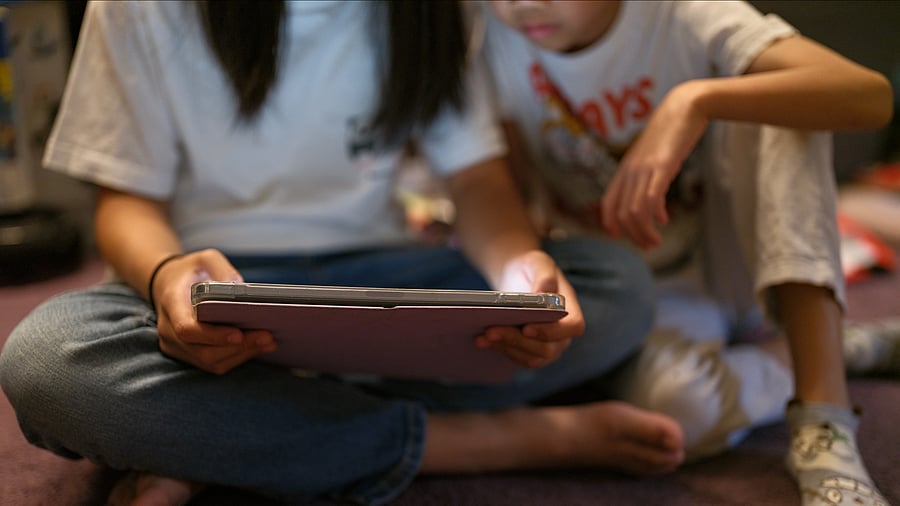
Representative image
Credit: Bloomberg Photo
By Catherine Thorbecke
It’s officially D-Day in Australia. That’s deactivation day, when Canberra will boot hundreds of thousands of children under the age of 16 off social media.
With all the newfound free time, tweens and teens will start baking, learning a new language, or could even begin training to become a professional athlete, according to Communications Minister Anika Wells. The kids seem to have other ideas.
Three-quarters of nine-to-15-year-olds said they had no plans to stop using social media once the ban kicks in. Only 6 per cent think it will actually work, according to a survey of more than 17,000 youths conducted by the Australian Broadcasting Corporation. In the lead-up to the crackdown, videos of teens swapping workarounds or encouraging each other to congregate on more obscure apps went viral. What could go wrong when swarms of underage users flock to even less-regulated corners of the internet? The timing — coinciding with the Southern Hemisphere’s summer vacation, when children will be home from school for weeks — won’t help.
Australia describes the legislation as world leading, but it has faced a lot of skeptics. I’ve written before that hardline age limits won’t save kids from online harm (and might even suppress the next Troye Sivan). They may keep some 15-year-olds from sprinting into a burning building, only to usher them in the moment they turn 16. The fire inside still rages. In a report last year, the American Psychological Association implored social media companies to do more to protect youth. But critically, the researchers also said that age limits aren’t the solution. They ignore individual differences in maturity levels, could cut teens off from the bright spots of online connection — and most importantly, don’t address the underlying problems.
Yet Australians overwhelmingly support the new law. And now that it’s here, I’m rooting for it. Perfect is the enemy of progress. The policy is messy, incomplete and porous — but at least Canberra is trying. That’s more than can be said for Washington, which hasn’t passed comprehensive online child-safety legislation in more than two decades.
What’s become overwhelmingly clear is that the status quo is untenable. We don’t need another devastated parent describing a child lost to suicide or a fentanyl-laced pill sourced online. Roughly half of American teens say social media has a “mostly negative effect” on people their age. A UK survey found 37 per cent of teen girls have received an unwanted sexual pictures or video online. More than 60 per cent of Australian children who had experienced online grooming said their most recent experience happened on social media. Whistleblowers over the years have alleged tech platforms understand the risks but tolerate them anyway.
Big Tech companies have spent years insisting that the connection between social media and mental health harm is unproven. But these firms have simultaneously pushed back against efforts from outside researchers to truly study and examine how their algorithms keep young users endlessly engaged, and how they impact developing minds. They can’t have it both ways.
One of the strongest criticisms of Australia’s new rules is that it will sever lifelines for marginalized groups who rely on these platforms for community. It’s hard to overstate, or for caregivers to really understand, how intertwined social media has become in the daily lives of a generation who grew up on it — and watched their parents become just as addicted to their smartphones as them. This is the same cohort that had swaths of their schooling disrupted by the pandemic, pushing all of us further into virtual worlds. When cutting off social media for rural, Indigenous or LGBTQ youth, authorities and guardians must make sure they are offering alternative outlets.
There are also some questionable loopholes. Kids can still watch YouTube anonymously (the most popular platform, per the local broadcaster ABC’s survey), without the guardrails that come with teen accounts. The No. 2 youth digital venue, Roblox, is exempt because it frames online socializing as gaming. And of course, many tech-savvy kids are very likely to find ways around the rules.
It's magical thinking on the part of lawmakers that this will spur a renaissance of some childhood utopia where kids play outside and abandon the smartphones they already carry everywhere. But the effort does put Silicon Valley on notice. Its real power will come if other governments follow, forcing platforms to overhaul their practices and finally decide whether to protect young users or lose them.
Doing more to shield children online is in companies’ interests, not just from a moral standpoint but a business one. Each case of harm linked to a social network becomes a rallying cry, amplified by the grief of parents. In the court of public opinion, these impassioned testimonies are no match for even the most polished statement from a tech executive.
And stricter age limits for social media and stronger safety guardrails don’t have to be mutually exclusive. Australia’s move has started a global debate on how to best protect children without cutting them off entirely from digital life. It’s a start at figuring out, collectively, how to solve a complex problem.
If it takes a village to raise a child, it takes a village to allow digital harms to flourish. Parents and caregivers can’t carry this alone. Australia has taken a first step. Other jurisdictions will need to follow with their own solutions, or leave the broligarchy free to shape childhood on their own terms.
Disclaimer: The views expressed above are the author's own. They do not necessarily reflect the views of DH.