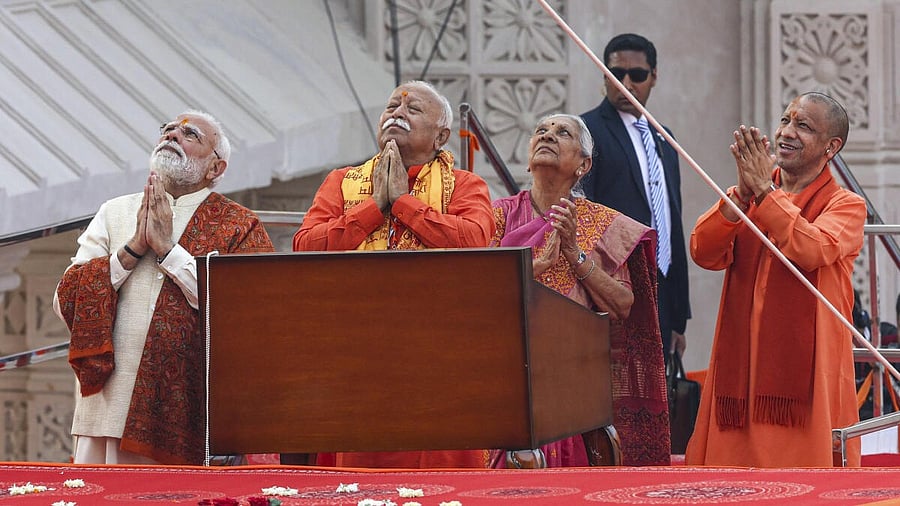
File photo: Prime Minister Narendra Modi, RSS Chief Mohan Bhagwat, UP Governor Anandiben Patel and UP CM Yogi Adityanath during the Dhwajarohan ceremony at the Ram Temple in Ayodhya, Uttar Pradesh.
PMO
To comprehend the innate strength of our democratic norms, practices, and institutions, we need to examine the origins of democracy in the forging of the Indian nation – its identity, its unity, its agenda – in the crucible of the struggle for Independence against British imperial rule. In the 19th and early 20th centuries, the nationalists had argued that British rule was responsible for the poverty of India, the drain of wealth from India to Britain, the deindustrialisation of India to favour British industry, and overall economic backwardness. They debated, represented, and agitated for participation in governance through democratic representative institutions, initially within the framework of British rule. From the 1920s onwards, the movement acquired mass support and a radical agenda of complete independence. As national unity was seen as essential for the success of the struggle, from the start, the movement sought to include all social groups – castes, classes, religions, tribes, etc. With the achievement of Independence, the nationalist leaders, their ideology, practices, and agenda rose to hegemony in society; they became the mainstream, the common sense of society. They had tremendous popular support and legitimacy. They realised their liberal social-democratic vision in the Constitution, its institutions and procedures, and the policies and actions of the governments they led. Their ideology formed the basis of public opinion and civil society.
Narendra Modi’s spectacular victory in the 2014 Lok Sabha elections was based on the adoption of that vision of inclusive development as the main platform and slogan of his campaign – vikas or development, sabka saath, sabka vikas, achche din or prosperity. In other words, he donned the mantle of the nationalist leaders of the anti-imperialist struggle. To get the BJP to adopt his new agenda, he had in the run-up to the elections to fight the old guard to put the three main pillars of the BJP agenda till then – building the Ram temple in Ayodhya, abrogation of Article 370, and Uniform Civil Code – on the back-burner. To this day, the BJP governments in the Centre and states have fought all elections and pushed their earlier Hindutva agenda under the overarching promise of good governance (sushasan) and development. It has been reported that the RSS cadre campaigned for the NDA in the recent Bihar Assembly elections under those very slogans.
In power, Modi has continued to advance the agenda of earlier governments, both domestically and internationally. On the economic front, Nehru’s interpretation of the nationalist agenda, as modified by the 1991 reforms, largely endures. Those reforms included a greater tilt towards the private sector, some pullback in the State’s role in economic development, less emphasis on self-reliance, greater reliance on foreign capital and trade, and abandonment of policies aimed at bringing down economic inequality by reducing the income and wealth of the rich. Initially considered the most business-friendly of Prime Ministers, Modi has over time shifted towards a more Nehruvian policy – increasing State intervention, strengthening the public sector, massive investment in infrastructure, greater emphasis on self-reliance, and more expenditure on social welfare. Even “disinvestment”, which had a separate ministry in the Vajpayee government with Arun Shourie as minister, is not heard. As earlier, agriculture continues to be low on the list of priorities. But the strength of farmers in the political arena has led to the abandonment of amendments to land acquisition laws and the agriculture reforms legislation. Socialism, defined as reducing economic inequality, has been off the agenda since the 1991 reforms.
On the social welfare front, the realities of electoral competition have forced Modi to do a U-turn on what he disparaged as revdi and others as “freebies”, and the NDA-BJP governments at the Centre and the states have joined the race to outbid their political opponents for votes. Indeed, governments led by the BJP as well as its opponents have in recent decades benefited from pro-incumbency resulting from increasing outlays for a plethora of welfare schemes, made possible by economic growth and rising incomes due to growth. Electoral considerations are also behind the BJP-RSS support of caste-based reservations. Modi has also recently made a U-turn on the issues of caste census and the enumeration of caste in the national Census. On some issues, he has been seen as advancing the BJP-RSS agenda of undermining caste-based criteria. For example, economic criteria for reservations have been seen to favour the poor of the upper castes and could, in the long run, undermine the caste criteria. Furthermore, Modi has welcomed internal reservations, or quota within quota, for the SCs, possibly because it could undermine the unity of the communities, and reservations themselves. The emergence of women as a distinct and influential constituency in determining electoral outcomes led Modi to initiate the Constitutional Amendment for women’s reservation in legislatures, which was passed after a long delay, although its implementation has been inexplicably postponed for several years.
A familiar script, with tweaks
In foreign policy, the refusal to join alliances or blocs has its origin in Jawaharlal Nehru, and has been an unwavering lodestar ever since. Post-1991, in line with economic reforms, the focus shifted to aligning with the advanced Western nations, even while preserving “strategic autonomy”. However, the solidarity with the poorer, underdeveloped nations of the Global South and the search for a more just international order, as expressed in organisations and agendas as the Non-Aligned Movement, G77, and the New International Economic Order, was abandoned. This was in line with the abandonment of the objectives of reducing economic inequality and of socialism domestically. But, first, after the freezing of Russian assets by Western powers following its invasion of Ukraine and, more emphatically, after the implementation of Trump’s tariffs, the Nehruvian agenda of solidarity with the Global South, together with self-reliance, is very much back on the table. With the attack on Venezuela coming on top of the endless delay in the Indo-US trade deal, the emphasis has taken on even greater urgency. There is one major discontinuity, though: the revanchist rhetoric against Pakistan, which is in line with that against Muslims domestically. But nothing has been heard of the RSS agenda of Akhand Bharat or undivided India. Except, probably, in the recent statement by Defence Minister Rajnath Singh that Sindh could one day be part of India.
On the domestic political and constitutional front, the most contentious issue is the abrogation of Article 370, which gave a special status to the State of Jammu and Kashmir. However, as scholars such as AG Noorani have shown, the content of the Article has been progressively eviscerated since Jawaharlal Nehru. The Modi government only removed the empty shell. In Centre-state relations, the push towards centralisation, which is there in the Constitution itself and pursued by successive governments at the Centre, has been intensified.
Governors in non-NDA states have frequently clashed with the state governments when they have tried to exercise authority over these governments. States under NDA governments have been favoured with more Central investments and projects, and Indian and foreign-linked private sector projects. Besides, states’ powers have been clipped and overridden by Central legislation, court orders, Governors’ partisan actions, and probes by Central investigative agencies. In the case of the AAP government in the national capital, it took a complex, many-sided, highly coordinated, multi-year plan involving many agencies and institutions, including the BJP in Opposition, to oust a party of greenhorns that had inflicted the most humiliating and crushing defeats from the early days of Modi’s prime ministership, from power. All this made dismissing state governments under Article 356 seem almost redundant. In all this, the Modi government was following in the footsteps of its predecessors.
Modi has gone far beyond earlier BJP-RSS leaders in treating the Constitution, nationalist freedom fighters, most importantly Mahatma Gandhi, major past OBC, SC and ST leaders, and the national anthem, song and flag, as sacrosanct. Recently, on the birth anniversary of his bête noire, Jawaharlal Nehru, Modi even recognised Nehru’s contribution as a freedom fighter and the first Prime Minister. Furthermore, let alone bringing the Hindu Rashtra Constitution issue to the forefront, there is no mention even of reviving an idea such as the Vajpayee government’s National Commission to Review the Working of the Constitution (NCRWC), which had an open-ended mandate to suggest possible amendments to the Constitution. Stray comments and actions by some Sangh Parivar leaders and BJP ministers and legislators, many of which were quickly retracted following public criticism, may intentionally or not reveal what lies underneath and cannot be said openly
at present. Recent examples include a BJP minister in Madhya Pradesh saying that social reformer Raja Ram Mohan Roy was a “British agent” and accusing him of aiding missionaries in religious conversions, and the Rajasthan government’s decision to observe the anniversary of the Babri Masjid demolition on December 6 as “Shaurya Diwas” (Day of Valour) in schools.
What accounts for this continuity over many decades and across many governments led by rival parties and coalitions with different ideologies and programmes? Who maintains and changes the agenda of the nation in line with rapidly evolving situations, both domestically and internationally? Who places constraints on those who want to challenge and disrupt the national consensus or break away from the mainstream?
The backstage players
It is my argument that it is the bureaucracy, together with the judiciary, that plays that role. From Independence, the national leadership, including Jawaharlal Nehru and Sardar Patel, relied on the bureaucrats and judges they inherited from the British Raj, whom they refashioned to serve the nation’s agenda and interests. From drafting the Constitution (Benegal Narsing Rau) to building a unified nation from a large number of princely states (V P Menon), the bureaucracy’s skills and abilities proved indispensable. For a range of reasons, Nehru, as Prime Minister, was more inclined to depend on select individuals from the bureaucracy than on his party leaders in ministries at the Centre and in the states for governance. Subsequently, especially under Indira Gandhi, the Prime Minister’s Office (PMO) gained prominence as the centre of power for decision-making and policy implementation. She relied on key bureaucrats to formulate and execute her political strategy, most importantly, P N Haksar. Additionally, several retired bureaucrats, along with retired senior judges and armed forces personnel, were appointed as Governors of states.
Under Modi, the power of the bureaucracy has reached new heights, starting with the PMO’s greater size and importance. Over the years, an unprecedented number of retired bureaucrats have been appointed to key Cabinet positions in his government. Modi’s own signal contribution is to forcefully drive the implementation of his government’s good governance, development and welfare programmes, which may have been what the bureaucracy wanted in the first place. The key role of the bureaucracy extends to the state governments, except possibly to some extent those run by the Left parties, as well. Another prominent example of this more general trend is that of V K Pandian under Chief Minister Naveen Patnaik in Odisha.
The enormous success of the bureaucracy in governance arises from its key role in advising and guiding politicians in power, always promoting their interests, remaining in the background, and not posing a threat to them politically. Their career-long experience in political administration, cohesion as a cadre, expertise and knowledge of public affairs, flexibility in bending but not breaking, enable them to control and restrict politicians and political parties, to provide continuity and overall stability in domestic and foreign policy, and to formulate and implement the agenda of the nation. Something like what can be seen in the British satirical comedy series, Yes Minister and Yes, Prime Minister, but the failures of politicians in governance have given the bureaucracy vastly greater power.
Disclaimer: The views expressed above are the author's own. They do not necessarily reflect the views of DH.