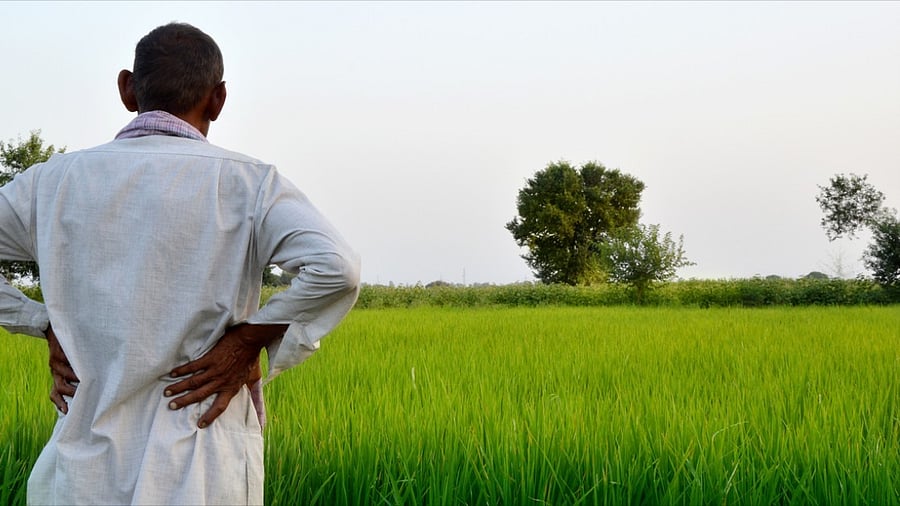
Representative image of a farmer looking at the farm land.
Credit: iStock
Among India’s most climate-exposed regions, Odisha stands out for both its agricultural heritage and acute vulnerability. More than half its land area is exposed to cyclones, droughts, floods and extreme heat, with climate hazards recorded in 41 of the past 50 years. Nearly two-thirds of the state’s cropped area is rainfed, making agriculture highly sensitive to monsoon variability. While coastal districts face cyclones and flooding, interior regions contend with recurring droughts and intensifying heatwaves. These pressures have depressed yields, heightened food insecurity and pushed farmers into distress, compounded by a long-standing dependence on water-intensive paddy cultivation.
Yet Odisha’s response marks a clear shift from vulnerability to leadership. In recent years, the state has placed climate action at the centre of its agricultural reforms, prioritising climate-smart and regenerative practices. By restoring soil health, diversifying crops, improving water management, and enhancing farmer incomes, Odisha is protecting livelihoods while offering a compelling model of climate-smart development.
The future of food is increasingly understood as regenerative—an approach that restores soils, revives biodiversity, reduces emissions, and builds resilience while sustaining productivity and livelihoods. Odisha was ahead of the curve, embracing this shift well before it gained global traction.
The Shree Anna Abhiyan, formerly the Odisha Millet Mission (2017), revived climate-resilient grains in rainfed areas. Millets improved soil organic matter, reduced reliance on water-intensive crops, enhanced nutrition, and raised incomes in tribal regions. Building on this success, the Revival and Sustainable Intensification of Forgotten Foods and Neglected Crops (2025) is reintroducing indigenous pulses, legumes, tubers, and traditional cereals.
Soil restoration has been equally central to the state’s strategy. Regenerative soil management programmes such as SAFAR—which uses basic slag (a by-product of basic steel-making) and fly ash to reclaim acid soils—and ICAR–NRRI’s enhanced biofertiliser and bioinoculant production programme (2023) are reducing dependence on chemical inputs while improving soil carbon and nutrient cycling.
Water systems, too, are being rebuilt to withstand climate extremes. Low-energy, gravity-fed irrigation systems in tribal regions; decentralised water harvesting under Jaladhara (2024) and Farm Pond Plus (2017); and expanded micro-irrigation under the ‘Per Drop More Crop’ component of the Pradhan Mantri Krishi Sinchayee Yojana are strengthening climate-resilient water access while lowering energy demand.
Odisha is also regenerating landscapes by bringing fallow land back into production. The Comprehensive Rice Fallow Management scheme (2023) enables farmers to grow post-monsoon pulses and oilseeds, improving soil moisture use and boosting incomes. Complementing this, the Special Programme for Promotion of Integrated Farming in Tribal Areas links crops, horticulture, fisheries, livestock, and on-farm composting to circular, diversified livelihoods.
On the rural circular bioeconomy front, the state is converting water hyacinth and agricultural residues into valuable inputs such as compost and biochar and embedding decentralised composting within the broader waste-to-wealth initiative. Together, these efforts lower emissions, enhance soil carbon, and generate green livelihoods.
The most forward-looking step is the Carbon Standards for Incentivising Farmers for Regenerative Agricultural Practices. By building transparent monitoring, reporting, and verification systems for soil carbon and other ecosystem services, Odisha is preparing its farmers for the emerging carbon finance landscape.
What stands out is that regenerative agriculture in Odisha is not an isolated programme. It is deeply embedded within the state’s broader climate-smart and climate-resilient agriculture framework.
Odisha’s experience shows that climate action and agricultural development can reinforce each other. Sustaining and scaling this progress, however, will require steady investment in farmer-centric extension, innovation, and training, alongside robust climate risk management, with crop insurance and early warning systems as critical safeguards.
Comprehensive monitoring will also be essential. Tracking agricultural greenhouse gas emissions, changes in soil carbon, gains in agro-biodiversity, and improvements in water-use efficiency will help sustain the momentum. Empowering the Climate Resilience Cell and institutionalising regeneration metrics within the Viksit Odisha 2036 and 2047 vision will enable targeted resource allocation for maximum impact.
As food systems gain prominence in climate strategies, Odisha offers a credible blueprint for aligning sustainability with livelihood security in the tropics. With global climate finance evolving and nature-based solutions gaining ground, Odisha is uniquely positioned to translate international ambition into locally grounded action. By deepening innovation, strengthening institutions, and empowering farmers as stewards of land and climate, Odisha can continue to lead and inspire others. Its proactive stance gives it a clear edge over states that are still seeking viable resilience strategies.
(Indu heads the Climate, Environment and Sustainability sector at the Centre for Study of Science, Technology and Policy (CSTEP); Arabinda is Principal Secretary, Department of Agriculture & Farmers’ Empowerment (DA&FE), Government of Odisha)
(Disclaimer: The views expressed above are the author's own. They do not necessarily reflect the views of DH.)