
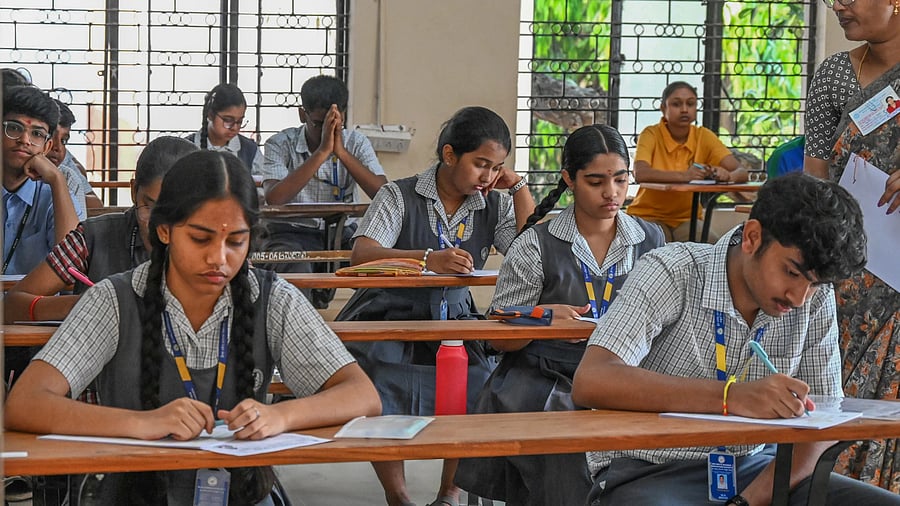
The Karnataka government has issued orders to start 700 government schools across the state as ‘KPS Magnet Schools’ by upgrading selected government schools and merging schools
Credit: DH Photo/ S K Dinesh
Despite opposition, the Karnataka government has issued orders to start 700 government schools across the state as ‘KPS Magnet Schools’ by upgrading selected government schools and merging schools located within a 5-6-kilometre radius into them.
The stated aim is to address the problem of small schools with dwindling enrolment and to provide well-equipped schools offering education from the primary level up to PUC at a single location.
Activists, however, fear that this will lead to the closure of 7,000 government schools and, in the long run, to the closure of 37,000 schools, as indicated in the government notification.
While few would dispute the need for better-equipped schools, there is strong opposition from the public and educationists to the proposed mergers. The government has promised to provide transportation, but parents remain unconvinced, as several villages lack proper roads. They fear that children will be forced to walk long distances, with girls being particularly affected.
The government’s solution of merging schools appears to address the symptoms rather than the root causes of the problem. If parents are increasingly choosing to send their children to private schools, the government must introspect on the reason behind this shift. One of the reasons given is that parents are choosing English-medium education. But is that the only reason?
Since 2013, nearly 3,000 government schools have been closed, while about 3,500 private schools have been granted permission in recent years. As one activist points out, where once 500 students attended the lone government-run village school, today only 37 remain, as eight private schools have come up in the same village. How did so many private schools mushroom? According to experts, the reason is that political leaders, who run private schools, are ruling the roost in the government.
Compounding this is the problem of vacancies of regular government teachers, which is 79,000, with just 51,000 guest teachers filling the gap. This is despite the ruling party’s manifesto before the 2023 elections promising to fill all government vacancies within the first year.
As many as 29% of schools function with a single teacher, and 21.2% of children are enrolled in such schools. Often, one teacher is required to handle more than 30 children across classes 1 to 5, inevitably leading to poor learning outcomes. This is in clear violation of the Right to Education Act, which mandates at least two teachers for a lower primary school with enrolment of up to 60 students.
The poor infrastructure of schools is the next impediment. Only 23% of schools in Karnataka are fulfilling the 13 facilities required under the RTE Act. The department’s website says that 2,039 schools have no boys’ toilet, 701 lack a girls’ toilet, 16,519 lack playgrounds, and 4,755 lack compound walls. Is it any wonder if parents are turning away from such schools?
In the long-pending suo motu PIL (WP 15768/2013) in the High Court of Karnataka, the government has been asked to provide the budgets and timeframes required to fulfil all RTE norms in all schools. In its response, the government has stated, “Proposals are made every year based on the available funds allocated. Hence, the total requirement of infrastructure is not considered during the budget proposals, and “if sufficient funds are allocated, the entire infrastructure … can be fulfilled by the next 5 to 10 years.” This, when all RTE norms were supposed to be fulfilled by 2015, and it is now 10 years after that deadline.
This is the result because the state’s budget for education has been consistently less than the national average and is at 10.8% this year when the national average is 15%. This, from a well-developed state with the highest per capita income in the country.
While the State Education Policy is dormant, a report submitted in 2017 on how to rejuvenate government schools, placed in the Assembly by the CM with the promise to implement it, has been forgotten.
At a recent discussion organised by the All-India School Education Committee (AISEC), protestors against the merging of schools said that their village school is a cultural icon of the village, and all villagers participate in its cultural activities, which builds solidarity among them. A distinguished thinker said, “Had I not got free education at a government school, I would have ended up just grazing cows or sheep in the village.” The feeling was that those who study only in English lose their cultural roots, while education in the local language in a local school enhances their rootedness in local culture and promotes critical thinking on societal issues. That the government school is a vehicle for building an inclusive society and needs to be preserved was the dominant opinion.
The indifference towards education as a government duty by those in power is the cause of the government school system losing its importance and credibility, was the overarching feeling. Allowing full-scale privatisation of a public good such as the right to education cannot be the hallmark of a welfare state. So, should the government be focusing on removing the current deficiencies in the government school system before deciding that merging the schools is the only answer?
(The writer is the Executive Trustee of CIVIC-Bangalore)