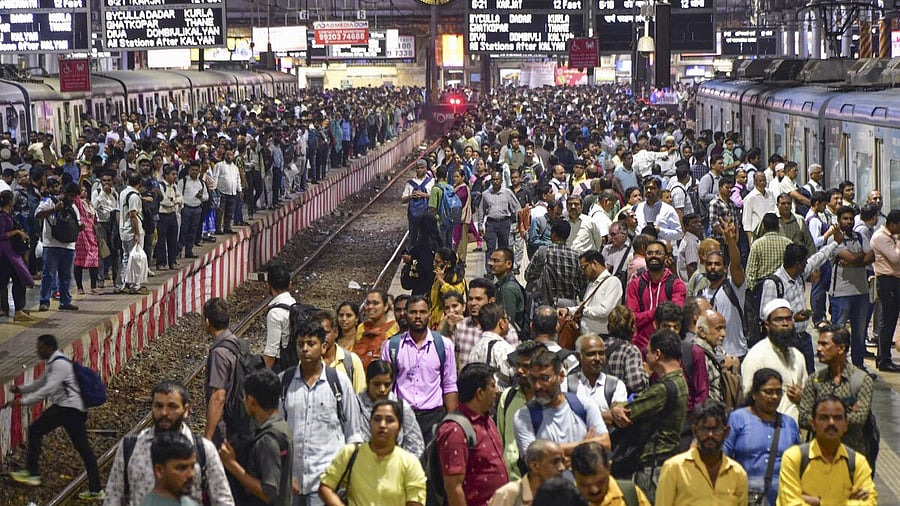
Representational image.
Credit: PTI Photo
The Union Budget 20206-2027 is set to be presented on February 1. It is time to contemplate the state of the economy, tracing the impact of the income tax cuts announced in the previous Budget aimed at boosting private consumption, particularly among the middle class. After all, this class is uniquely positioned to influence the seat of power in New Delhi. It is, therefore, logical to assess the fortunes of the ‘Great Indian Middle Class’.
According to a latest report by the State Bank of India, India is set to join the upper middle-income club by 2030, joining the ranks of China and Indonesia, with an estimated per capita at $4,000. This transition will likely manifest in rising aspirational consumerism, driven by a burgeoning middle class with higher disposable incomes, which will open new avenues of economic opportunity. For comparison, China achieved this milestone in 2010. But before we lament the discernible income disparities between the middle-class societies of the two Asian giants, it is prudent to gauge their sustainability from a political economy standpoint.
Although India and China gained independence around the same time, the political economy that shaped the two nations diverged sharply. China pursued economic reforms while maintaining a tight grip on political freedoms, whereas India followed a socialist economic path, rooted in political freedoms enshrined as fundamental rights enshrined in the constitution. This distinction is crucial: any comparison between the two nations that ignores political economy risks producing flawed conclusions.
New York University professor Peter Rosendorff highlights this point, noting that power structures sympathetic to authoritarianism tend to flatten incomes, deplete capital stock, and shrink the relative size of the workforce. It is, therefore, unsurprising that India fares better on the Gini coefficient (25.5) compared to China (35.7). The Gini coefficient is a statistical measure of inequality ranging from zero (perfect equality) to 100 (perfect inequality).
As China transitioned from a middle-income to an aspirational society, mimicking Western standards of living, its growth model has largely concentrated on export-led manufacturing, even as sectoral imbalances remain and real estate troubles deepen. Economist Jeffrey D Sachs argues that the quality of economic development is closely tied to the strength of financial intermediation. In China, this intermediation has traditionally relied on lending institutions, but the lack of borrowing opportunities for individuals has led to the rise of shadow banks, often circumventing regulatory oversight. The resulting bad loans, driven by high levels of non-performing assets (NPA), weaken balance sheets and create systemic risks for the broader economy.
In India’s case, sectoral imbalances pose a lesser challenge, with financial inclusion acting as a bulwark that fuels mass consumerism and generates spillover effects across sectors. With no dearth of retail lending from financial institutions of all sizes, India has largely avoided the shadow bank concerns. The regulator’s role in enforcing prudential standards has further helped prevent institutional failures — such as the collapse of Silicon Valley Bank (SVB) in the US and Credit Suisse in Switzerland — that have afflicted even developed countries.
Meanwhile, geo-economic pressures in the form of tariffs and trade barriers continue to weigh on growth forecasts, compounded by global uncertainty. The IMF projects China’s growth rate to decline from 5% in 2025 to 4.5% in 2026, advocating a structural shift from export- and investment-led growth toward consumption.
The socio-economic benefits afforded by India’s democracy stand in sharp contrast to those under communist China. One of the most significant non-pecuniary rewards of democracy is the liberty for private enterprises to challenge the State through an independent judiciary. A landmark example is the Indian judiciary’s rejection of the State’s retrospective tax demand on Vodafone, which underscored the importance of keeping executive overreach in check. Such checks and balances are vital to strengthening private enterprise. India’s burgeoning middle class, in turn, is a direct beneficiary of sustained capital formation by the private sector.
The middle-class is defined as a family earning between Rs 5 lakh and Rs 30 lakh annually, which by 2030 is expected to reach 715 million, representing an increase from 14% of the population in 2004-2005 to 46% in 2030. Some economists lament comparing income levels in non-dollar terms, but from a purchasing power parity view, measurement in local currency ensures greater precision in capturing economic well-being.
So, while India may still be far away in matching per-capita income levels, the country’s progress as a vibrant democracy remains sustainable, best tailored to deliver results in the long haul.
Ullas Rao is Assistant Professor of Finance at the Manipal Business School (MBS), Manipal Academy of Higher Education (MAHE) Dubai.
(Disclaimer: The views expressed above are the author's own. They do not necessarily reflect the views of DH)