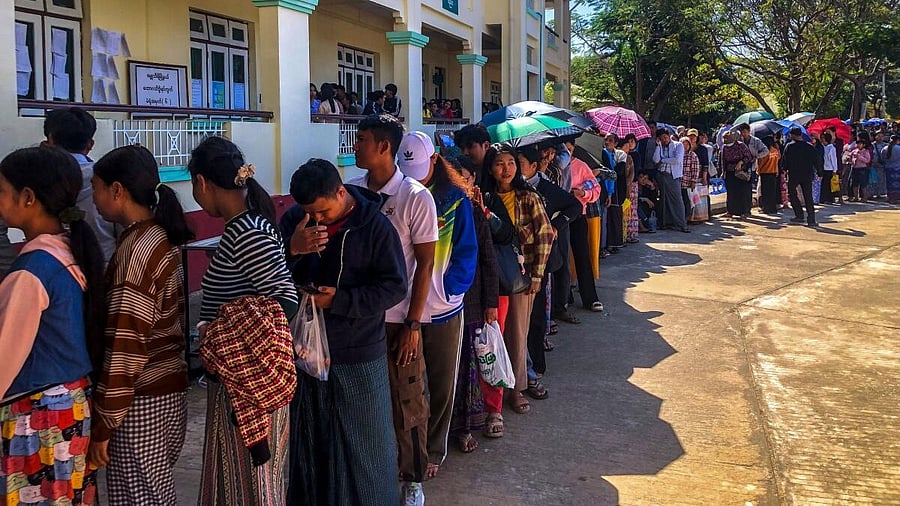
People queue to cast their votes at a polling station during Myanmar's general election in Naypyitaw, Myanmar.
Credit: Reuters Photo
The first phase of a three-phase general election in Myanmar began last Sunday, which will be followed by subsequent phases on January 11 and January 25, marking a distinctly new political phase for the multi-ethnic nation of 53 million population scarred by decades-old internal turmoil. The abrogation of the national emergency on July 1 marked the beginning of this transition.
China played a pivotal role in the general election in Myanmar. For Beijing, Myanmar is a crucial link to the Indian Ocean. China has invested heavily in Myanmar - a rough estimate through the 15 years since 2011 touches $50 billion.
It is gratifying that India has distanced itself from the West’s attempts to view the election through the geopolitical prism. Although, in principle, the Donald Trump administration disallows the neocon-globalist ideology of previous administrations, it is, in practice, pursuing the strategy of the ‘deep state’ in most cases. The Western underwriting for the insurgent groups in Myanmar may appear to have diminished, but the agenda continues to put in power a pro-American regime or splinter the country altogether. Naypyidaw has hired an American lobbying firm to normalise economic and humanitarian ties with Washington.
In fact, the lobbying firm signed the formal agreement with Naypyidaw under the US Foreign Agents Registration Act just the day before a civilian-led interim government was formed ahead of a planned election — signalling a sort of green lighting from the Beltway. The US attitude was previously to block ASEAN's search for a modus vivendi with Naypyidaw.
India has backed free, fair, and inclusive polls in Myanmar, and underscored the participation of all political stakeholders. The MEA spokesman said recently that India supports a transition to democracy in the country and will continue to back efforts that promote a return to normalcy. India’s stance harmonises with China’s. Beijing has also attributed high importance to domestic peace in Myanmar.
In a remarkable statement, China’s foreign minister Wang Yi called on Myanmar to work for an end to the fighting and ‘national governance based on the will of the people.’ And Beijing offered to provide technological assistance and help to compile voter lists. This new thinking signals that Beijing sees the imperative need for representative rule that would enhance the government’s legitimacy internally, regionally, and internationally.
No doubt, China’s motivations are security-centric. Geography becomes a key determinant in any country’s foreign policy calculus in comparable circumstances. China has a multi-vector approach vis-a-vis the ruling elite and rebel armies in Myanmar, and even uses its leverage over some armed groups to pressure them to hand back territory to the military.
The New York Times reported that Ko Ko Gyi, chairman of the People’s Party in Myanmar (who used to be a prominent pro-democracy activist) said Chinese officials told him in Beijing that Myanmar’s peace and stability ‘directly affects China’s interests’. He added that even though China is clearly pursuing its interests, it is ‘close, influential and willing to engage, while the US remains on the fence. Washington talks about values, but Beijing brings leverage. That is why Myanmar keeps leaning toward China, because America offers rhetoric, not commitment.’
True, ballots will only be cast in government-controlled areas, which is only about half the country. It is entirely conceivable that the USDP, previously led by Aung San Suu Kyi, will win the election. This is important, given the USDP’s unique reach across political and ethnic divides, and its potential to restore a complex, multi-layered political architecture, which could be a critical factor for stability.
It is a significant leap forward that a civilian government will emerge through the election. Something fundamentally changes as the elections lead to a return to what may still be a nominally civilian government. At the very least, a shake-up among the military elites may ensue, as the system they operate in will have changed even if the military would still control the levers of power. That means a certain shift towards a more democratic path. In a deeper sense, therefore, China is helping Myanmar move one step closer to democracy to meet the aspirations of the nation.
Such historic transitions have been successfully accomplished in South Korea and Turkey. What differentiates the Myanmar situation are three things — unlike South Korea or Turkey, Myanmar is an ethnic mosaic and demands an eclectic political culture to hold together; non-State actors (drug cartels, cybercrime syndicates, etc.) are powerful ‘influencers’ undermining the economies and security of Myanmar (and China) and offering fierce resistance to attempts to eliminate them; and, thirdly, external intervention.
In immediate terms, the collective West will try to delegitimise the Myanmar election. The Indo-Pacific is a critically important region to the US. Myanmar also happens to have a strategic location. Deposed Prime Minister of Bangladesh Sheikh Hasina didn’t mince words when she pointed a finger at the Joe Biden administration for the regime change in her country, and the main reason she flagged was her refusal to allow the US to have a military base in the Bay of Bengal.
Hasina said, “I resigned so that I did not have to witness the bloodshed. They (US) wanted to seize power over the dead bodies of students, but I did not allow it. I stepped down from the premiership. I could have stayed in power if I had surrendered the sovereignty of Saint Martin Island and allowed America to dominate the Bay of Bengal.” Belatedly, New Delhi has come to its senses that the US’ regional strategy works against Indian interests — be it in Bangladesh, Nepal or even Sri Lanka. The same mistake should not be repeated in Myanmar, which is a critically important neighbouring country bordering Assam and the northeast region.
Plainly put, Myanmar is challenging the US’ regional authority and international dictates, and the political marginalisation of Naypyidaw is advantageous to Washington. Against such a backdrop, the neighbouring countries need to play a responsible role. Alas, ASEAN is a divided house when it comes to Myanmar.
But the rogue elephant here is the regime in Dhaka, which seized power in the US-backed colour revolution, and has become a playpen for Western intelligence to fuel the insurgency in Myanmar, with an eye on India’s restive northeastern region as well. The bottom line is that there is a strategic congruence between India, China, and Thailand over security and stability in Myanmar, which needs to be acted upon at the political and diplomatic level.
(M K Bhadrakumar is a former diplomat.)
Disclaimer: The views expressed above are the author's own. They do not necessarily reflect the views of DH.