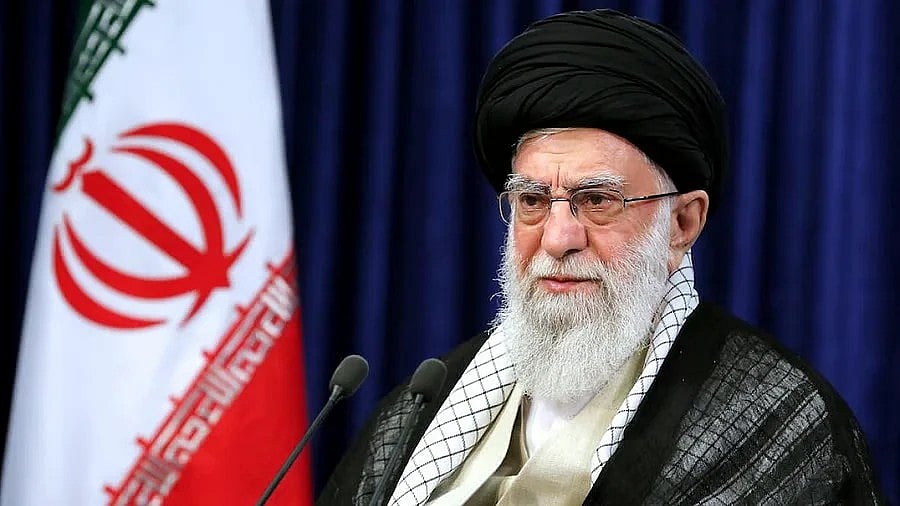
Iran's Supreme Leader Ayatollah Ali Khamenei.
Credit: Reuters File Photo
By Hal Brands
President Donald Trump faces a presidency-defining decision as he contemplates and threatens new military action against Iran.
His options range, reportedly, from non-lethal support for the opposition forces challenging the clerical regime to sustained military strikes meant to fracture that government’s hold on power.
The potential rewards are massive, given Iran’s destructive regional and global influence — but so are the complications.
If the moral logic of intervention is strong, given the courage Iranian protesters have shown in resisting a murderous regime, the strategic case is also tempting.
For decades, Iran has been perhaps the most malign, destabilizing influence in a perpetually turbulent region. It has cultivated proxies that violently strike the US and its allies; it stokes sectarian fires from the Levant to the Persian Gulf. Tehran has launched huge, indiscriminate ballistic missile strikes against Israel, while developing a nuclear program that only sharp military punishment could halt.
The regime has also fueled the Ukraine war by arming Russia. It has bound itself to an axis of autocracies that challenges US influence on a global scale.
Yet that regime has been drastically weakened by recurring rounds of popular revolt and by the military humiliation inflicted by Israel and the US last June. And beneath a radically anti-US regime is a far less hostile population. President Trump is surely attuned to the transformative impact regime change might have in the Middle East and beyond.
Few things would better promote Trump’s vision of a “new Middle East”— one in which commerce replaces conflict — than the end of a regime that deliberately fosters bloody regional upheaval. The collapse of the Iranian government would punctuate the post-October 7 era, in which Tehran and its proxies waged a multi-front war, only for Israel and the US to respond by redrawing the Middle East’s strategic map.
Helping Iranian protesters prevail would show that the pursuit of nuclear weapons endangers rather than strengthens rogue regimes. It could kill off the weakest member of the axis of authoritarians, offering further confirmation — following the US raid on Venezuela — that China and Russia can’t protect their friends from the superpower’s wrath.
The opportunities are alluring, yet military intervention is undeniably fraught.
A meaningful strike against Iran probably won’t be neat and tidy. Non-kinetic options, like cyberattacks against government targets or communications support to protesters, will harass but not fatally weaken a ferocious regime. Limited attacks against government targets probably won’t break the leadership’s tenacious hold on power.
Tilting the balance in the confrontation between the street and the state will likely take a more sustained campaign of airstrikes against the Islamic Revolutionary Guard Corps and other organs of repression. Even then, given the size and apparent commitment of the regime’s repressive forces, there’s no guarantee of success — and a real risk of failure, which would make Trump look weak.
For that reason, the politics of intervention could get messy. Trump could ignore the neo-isolationist wing of his coalition when conducting prior strikes against Venezuela and Iran, because those operations were brief and brilliantly successful. A more ambiguous, open-ended intervention risks exposing him to greater criticism, not just from Democratic rivals but also from restraint-minded MAGA friends.
There’s also the risk that the intervention leads to something ugly, if not necessarily something worse. Breaking the Iranian regime probably isn’t the same thing as birthing a pro-Western democracy. It could simply cause protracted internal violence that cascades into regional instability. Even a decapitation strike against the supreme leader, Ayatollah Ali Khamenei, might just precipitate a takeover by the IRGC.
Finally, consider the challenge of timing. There is surely a limit to how long Iranian protesters can stay in the streets, under a hail of bullets. But given the degree to which Trump has repositioned key assets, like aircraft carriers, to other regions, the Pentagon would presumably like more time to get ready for — and gird against the Iranian blowback from — a strike.
Trump could try to punish the Iranians for defying his warnings while skirting some of these dilemmas. He might institute a longer-term program of covert and informational support for the Iranian opposition, modeled on projects in Soviet-occupied Eastern Europe in the 1980s. He could launch a brief, punitive strike meant to degrade Iran’s military capabilities rather than topple the regime.
Or he could use this moment of leverage to seek a deal forcing Iran to sign away the remnants of its nuclear program.
These options might weaken or contain the Iranian threat — but they might also allow the regime to kill its way out of its current predicament. A president who likes clean, decisive solutions may struggle to find one here.
A decade ago, Trump took the White House while deploring America’s Middle East military interventions. Now, the fate of his presidency — and so much more — may hinge on how he handles the opportunities and dangers that another such intervention presents.