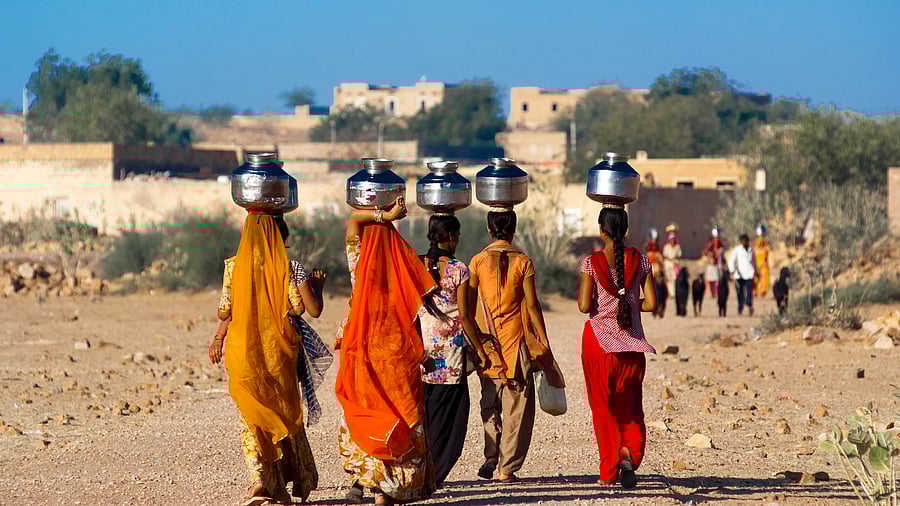
Women carrying water in the desert state of Rajasthan.
Credit: iStock Photo
As the climate crisis deepens, its impact is more acutely felt in rural India, where livelihoods are intricately tied to natural resources. Droughts, floods, and erratic rainfall patterns have disrupted agriculture, strained water supplies, and increased vulnerability in countless villages. But we continue to witness adaptation programmes often ignoring the traditional wisdom and solutions possessed by those most affected by climate change.
With the call for a ‘global mutirão’, a collective effort against climate change, COP30 is expected to prioritise the lessons from local communities on the frontlines of climate resilience. The summit will address the disparity in climate finance (currently, less than 10% reaches grassroots stakeholders), with a strong emphasis on direct funding and decision-making power for local communities. Summit themes include adaptation and resilience, decentralised funding mechanisms and recognition of Indigenous peoples and local communities.
Similarly, India’s first National Adaptation Plan (NAP) aims to enhance climate resilience across the country. A key objective of NAP is to prioritise decentralised solutions such as village microplans, farmer collectives, and participatory water management. By integrating Locally Led Adaptation (LLA) into existing policies, it ensures that frontline communities lead decision-making.
Despite this, adaptation programmes too often view rural communities as passive recipients, rather than as architects of their own resilience. This is a costly oversight. Those most vulnerable to climate change also possess the deep knowledge and motivation required to address it.
Why local leadership matters
India's villages are not homogeneous; each has its own unique geography, cultural practices, and socio-economic conditions. Climate adaptation and resilience strategies that work for one region may not be suitable for another. This is where the LLA becomes indispensable. By empowering key influencers within villages — teachers, self-help group (SHG) leaders, religious leaders, frontline workers, sarpanches, and traditional knowledge holders — Civil Society Organisations (CSOs) work with communities to design and implement solutions that are context-specific and sustainable.
Local influencers have deep, lived experience, and an intrinsic understanding of the community's needs, aspirations, and challenges. They command trust and can mobilise collective action in ways that external agencies often cannot. They can act faster than bureaucratic systems during crises, and their solutions are inherently sustainable because their survival depends on them.
By integrating local insights with scientific knowledge and technical expertise, we can co-create climate solutions that are more likely to succeed. We can learn from and build on certain models that have succeeded in India by empowering local leaders.
Models for success
For instance, Seba Jagat, in Kalahandi, Odisha, closely works with the adivasi communities, focusing on strengthening local governance and livelihoods. When some of the villages where Seba Jagat is actively working faced acute water shortage, the organisation engaged with the community and multiple government departments for seven years to build a dam.
In Keonjhar district’s Telkoi, WORD, a CSO, mobilised 300 smallholder farmers from 25 gram panchayats, forming an FPO that helps farmers grow eight types of millets and helps them get a good market price through the Odisha Millet Mission programme.
Along Odisha’s coast, in Ganjam district, the CSO VIEWS works to identify alternative livelihood options for the local Jaalari community (fishers), which is the most vulnerable to cyclones every year.
These initiatives underscore the importance of entrusting decision-making power to those who are directly impacted by climate change.
The path forward
To scale LLA across India, several steps are essential:
Geographic segmentation: Identifying various bioregions in India, gathering relevant data, and conceptualising context-specific solutions.
Solution matchmaking: Identifying proven innovations, technologies, and best practices to cater to the vulnerabilities in the CSOs bioregion.
Governance and planning: Regional climate resource hubs could be established, enabling local-level governance and planning using data and local knowledge, identifying the levers of change and integrating with the gram panchayat development plan.
Data-based decision making: Like in the case of public health, nutrition, and education, systems and processes to gather and analyse village-level data need to be established.
Strengthening grassroot CSOs: Local-level organisations are often closer to the last-mile beneficiaries and require organisational and technical capacity-building support.
Decentralised funding: Allocate funds, both public and private, directly to village-level/regional hubs, thus enabling them to implement tailored climate solutions.
As we mark Earth Day 2025, let's take the fight against climate change to India’s villages, where the first impacts are felt, and where resilience must take root. By empowering key influencers at the village level to make decisions for their communities, we not only strengthen our climate response but also uphold the principles of equity and justice. It is time to invest in the leaders who stand on the frontlines of the climate crisis and trust them to guide their communities toward a more resilient future.
(Climate Asia has partnered with Seba Jagat, WORD, and VIEWS.)
(Pallavi Khare is chief of staff, and Koushik Yanamandram is consultant, at Climate Asia.)
Disclaimer: The views expressed above are the author's own. They do not necessarily reflect the views of DH.