
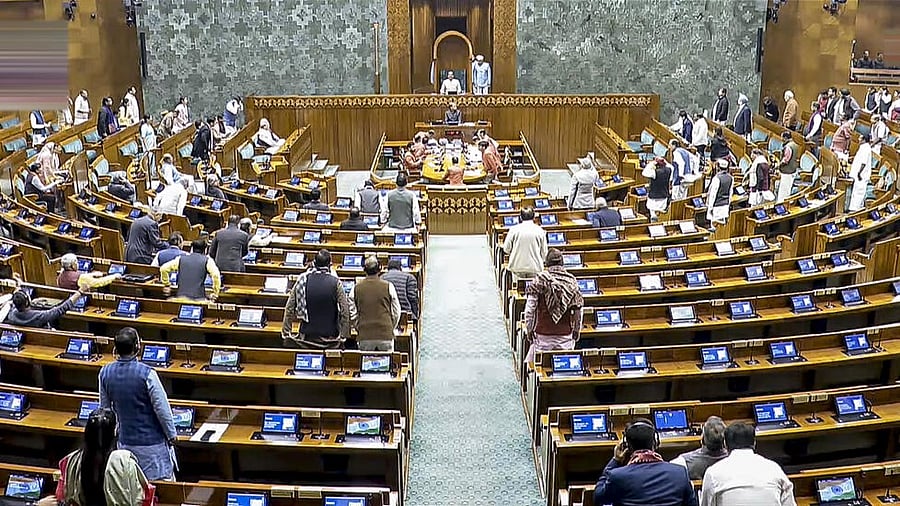
Lok Sabha Speaker Om Birla conducts proceedings in the House during the Winter session of Parliament. (Representative image)
Credit: PTI
After its introduction in the Lok Sabha, the Viksit Bharat Shiksha Adhishthan Bill has been referred to a joint parliamentary committee. Aimed to overhaul the regulation of higher education in the country and to “re-energise the sector and enable it to thrive”, the Bill risks dismantling established systems through tighter government control and overregulation. Its stated objective to simplify and streamline regulation may create a system where the diversities are extinguished under centralised power. The Bill seeks to repeal the UGC Act, the AICTE Act, and the NCTE Act. It proposes to set up an apex umbrella body that will control higher education, along with three councils for regulation, accreditation, and stipulation of academic standards for universities and higher education institutions.
When one apex body replaces the three existing regulators, decision-making will get centralised. Education is in the Concurrent List, making states an important stakeholder in its administration across levels. This federal nature of the system will be lost in the setup envisaged in the Bill. State universities, where most students are enrolled, will be severely constrained in academics and administration. Their views and priorities on syllabi, teaching methodologies, courses, and practices are bound to be influenced by a set of uniform, centrally-decided norms and standards. The chairman and members of the apex umbrella body, the Viksit Bharat Shiksha Adhishthan, will be appointed by the President. The body and councils under its ambit will be bound by directions of the Union government on matters of policy. In case of a disagreement, the final decision will lie with the government. The Bill also gives the government powers to supersede these bodies and assume their roles.
If the regulatory system as envisaged in the Bill comes into force, the central government will be able to influence all institutions of higher education, administratively and financially. This will translate into control of ideas, content in textbooks and teaching materials, research orientation, and the selection of faculty. The idea of promoting Indian knowledge systems and languages has merit, but its implementation is likely to be influenced by political and ideological interests. Titling the Bill in Hindi is a giveaway. The autonomy that regulatory bodies, universities, and other institutions had will be substantially reduced, and states will no longer be able to exercise their powers derived from the Concurrent List. The shift is already in play, seen in the Centre’s attempts to control higher education through Governors in states ruled by Opposition parties. The Bill formalises this push towards absolute, uncontested control.