
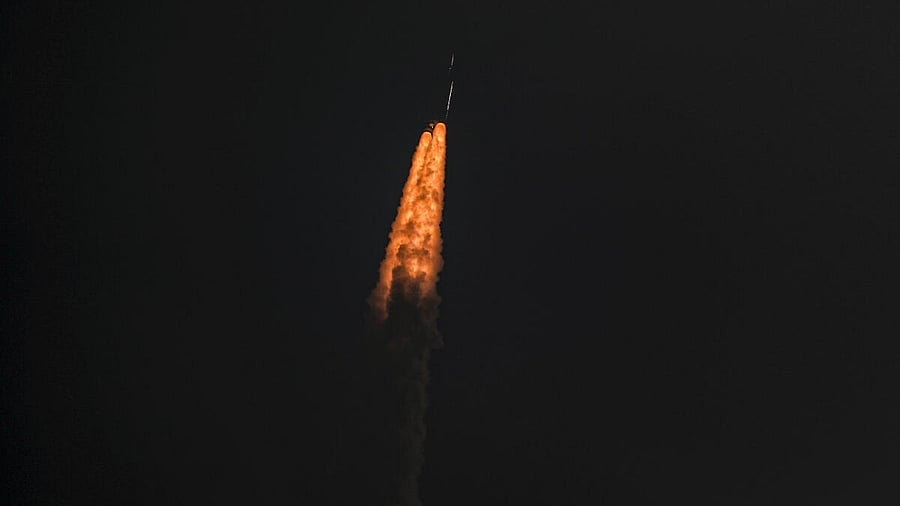
Indian Space Research Organisation (ISRO) launches the BlueBird Block-2 communication satellite of AST SpaceMobile, USA, onboard its launch vehicle LVM3-M6 from the Satish Dhawan Space Centre, in Sriharikota, Andhra Pradesh.
Credit: PTI Photo
Indian Space Research Organisation (ISRO) set yet another record last week by launching its heaviest ever satellite aboard Launch Vehicle Mark-3 (LVM3) into a low earth orbit. The satellite is functioning normally. It is a US satellite weighing nearly 6,100 kg, and with its successful launch, ISRO has shown that it can undertake the most complex and sophisticated scientific and engineering feats at the lowest cost.
It is ISRO’s third commercial mission involving the new launch vehicle. It has confirmed that India has established itself as an important space power, with its mastery of heavy-lift launch capabilities, essential for deep-space exploration and human spaceflight.
ISRO has till now launched as many as 434 foreign satellites belonging to 34 countries. It has steadily improved its capabilities through these launches to establish its position as a credible space power.
It has been a year of steady progress and achievements for ISRO. In January, it successfully accomplished its SPADEX mission which involved docking and undocking of two satellites in space. The capability is essential for its future missions, including the lunar landing programme and the building of a space station of its own.
The next important enterprise was the NISAR mission, a joint India-US space mission, undertaken in July. It produced the most detailed images of earth ever captured from space. The LVM3-M5 mission in November placed in orbit the 4,400-kg CMS-03 satellite, till then the heaviest payload to be launched. With three launches of very heavy satellites into the low-earth orbit and the geosynchronous orbit, ISRO looks forward to further refining its technological capabilities.
Describing the LVM3 mission as successful, ISRO chairman V Narayanan has revealed the organisation’s agenda for the next few months. Next year will see the launch of the uncrewed Gaganyaan programme, which will mark a new frontier in space exploration. ISRO is planning at least six more launches before March next year.
A major technology demonstration mission is on the anvil to showcase about 30 important homegrown technologies. The LVM3 launchers are designed for heavier payloads in future. With an environment that encourages private sector participation in space programmes, start-ups are active in the area.
Skyroot aerospace, which was behind the country’s first private rocket launch, has planned the maiden launch of its Vikram-1 rocket in the coming months. The ISRO chief also said that the LVM3 mission marked an important step in India’s progress to realise its human spaceflight ambitions. It also shows that the country is on course to achieve its aim of securing 10 per cent of the global space business by 2033.